


AI Agents: Crypto's Next Frontier

The AI agents narrative has been one of the crypto market’s defining storylines this past year. AI agents are moving from chatbots to autonomous actors that transact, and crypto is racing to become their settlement layer. Every major smart-contract chain has already taken significant steps to cater for a machine-to-machine economy. This Token Takeaway unpacks the agentic narrative, zooms in on the progress so far, and looks at what lies ahead.
Introduction
For most people, an AI agent still means a chatbot: something you prompt that answers, and then waits for the next instruction. But an agent, in the sense that matters here, is autonomous software that can pursue a goal across multiple steps without human supervision. It can independently discover services, negotiate terms, call tools and APIs, and pay for what it uses.
How an AI Agent Works
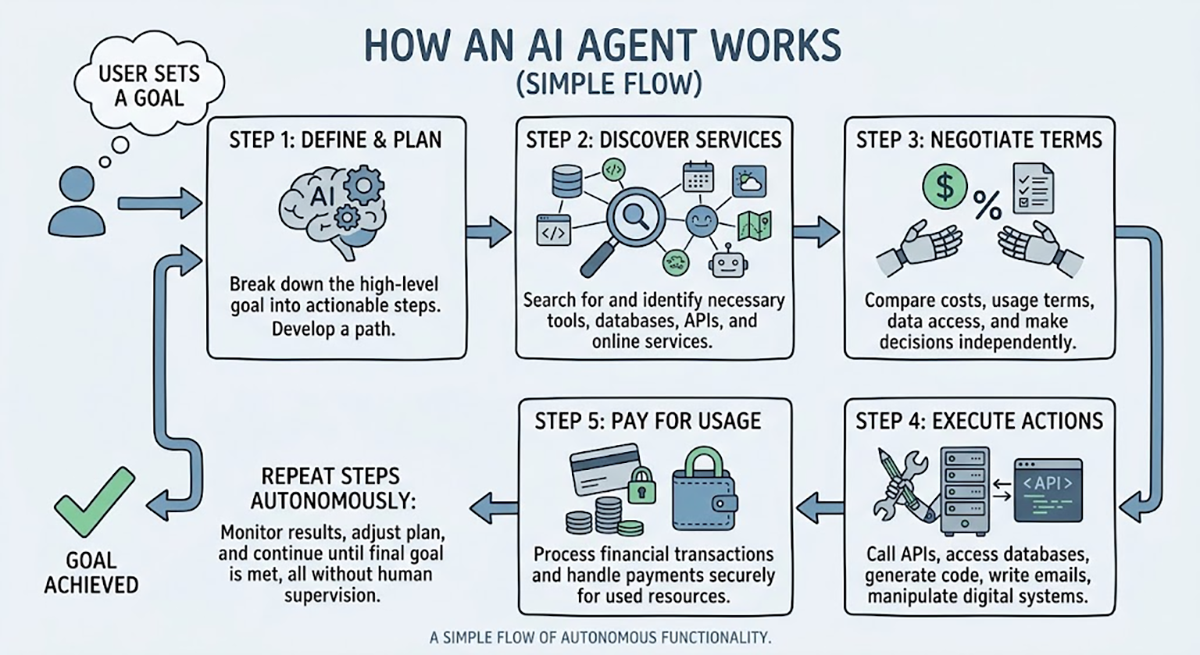
It’s the monetary aspect that makes this a crypto story. An agentic transaction is a payment initiated and completed by software, which is a process that differs significantly from those of conventional consumer payments. If an agent accesses a data feed, buys an hour of compute or hires another agent to complete a subtask, it needs to settle the bill programmatically. The transactions may be tiny, repeated hundreds of times within a single workflow, and executed across borders without a human in the loop.
While traditional payment systems offer fast authorisation and can process many transactions within seconds, agentic transactions may require sub-second processing and near-instant finality. The stronger crypto thesis is that agents need money that is natively programmable, globally accessible, and capable of machine-to-machine micropayments. Card networks are built around human cardholders, merchant relationships, and payment economics that make very small, high-frequency transactions impractical. An agent cannot easily open a card, enter payment details and approve each purchase, nor is a fixed payment fee well suited to a transaction worth a few cents.
Crypto is built around a different model. Stablecoins on fast blockchain networks can move value directly between software-controlled wallets, with low fees, and without human authorisation. The result is money that can be programmed into an agent's workflow rather than bolted onto it afterwards. That alignment is why the agent-payments conversation, from Google and Coinbase to the Ethereum Foundation, increasingly leads back to crypto rails.
History
Interest in AI agents built slowly, then arrived all at once. The large language model boom that followed ChatGPT laid the groundwork, showing that software could reason over language well enough to be genuinely useful. But a model that only answers questions is not an agent. The shift came when developers began wrapping models in systems that could plan, call tools, retain context across sessions and act without being re-prompted at every step.
That shift became visible to a mainstream audience with a single open-source project. Launched in November 2025 by Austrian developer Peter Steinberger, OpenClaw (originally Clawdbot) became one of the first AI agents to capture mainstream attention. What made OpenClaw resonate, particularly with crypto natives, was its design. It runs locally, often on hardware users already own, keeping private data and API keys within their own infrastructure. It was not a trading bot in the traditional sense, but a persistent, self-hosted assistant that could be given real tasks and, crucially, interact with real money. Its rise was messy, marked by security scares and a wave of copycat token scams that Steinberger repeatedly disowned. But, more importantly, it made the idea of an autonomous agent that lives alongside you, rather than one you simply visit in a browser tab, tangible to a much wider audience.
OpenClaw was the breakout, but it was part of a much broader wave of agent frameworks and experiments. More importantly, it arrived after the communication standards needed to make this ecosystem work were already in place, including Google's Agent2Agent protocol and Anthropic's Model Context Protocol (MCP), which was launched in November 2024. These standards provide the tooling that allows agents to communicate with one another and interact with external tools and services.
The Crypto Story
Progress over the past year has been less about a single killer app than about how fast the underlying pieces have snapped into place. Agent-to-agent marketplaces have gone live, payment standards have moved from whitepaper to production, and identity and reputation layers have shipped to mainnet. Individual agent platforms now count hundreds of thousands of users, and the agent-friendly payment protocols have already settled hundreds of millions of transactions. Every major smart-contract chain is positioning for the agent economy, albeit with different strategies.
Ethereum
Ethereum is building the trust layer. Its centrepiece is ERC-8004, or "Trustless Agents," a standard that gives agents a persistent on-chain identity, a portable reputation, and independent validation of their work, held across three registries. Co-developed by MetaMask, the Ethereum Foundation, Google, and Coinbase, its core registries went live on mainnet on 29 January 2026, and tens of thousands of agents registered in the first month. The bet is familiar: Ethereum as the neutral, high-value settlement and trust layer where agents from different vendors can transact without prior relationships.


