


AI Agents: Crypto’s Next Wave?

Issue 208;
Cryptocurrency has never moved in a straight line. Instead, it advances through distinct waves, each driven by a particular innovation that captures capital, builds infrastructure, and attracts new participants to the space. The wave model helps us understand not just where we've been, but where we're heading next.
The first major wave began with decentralised finance, or DeFi, around 2019. Protocols like Uniswap and Aave showed that you could recreate traditional finance on blockchains without intermediaries. Next came non-fungible tokens, or NFTs, which captured mainstream attention in 2021 with digital art and collectables. Gaming and play-to-earn models followed, introducing the concept that blockchain games could reward players with real economic value. Tokenization then emerged to bring real-world assets on-chain by tokenizing stocks, bonds and currency, bringing trillions of dollars of value into the digital asset landscape. Of course, we must also mention stablecoins, DePIN, perpetuals, and prediction markets, many of which remain red hot to this day.
Now there is a new wave forming, and it centres on AI agents.
What Are AI Agents, and What Can They Do?
An AI agent is a self-directed software program that can perceive its environment, make decisions, and take actions autonomously to achieve specific goals. Unlike traditional AI that responds to human prompts, agents can operate continuously, tirelessly following decision-making sequences and adapting their behaviour based on the outcomes.
In the context of crypto and blockchains, AI agents represent something even more powerful: autonomous economic actors. An agent can browse the internet for information, execute smart contracts, transfer funds, negotiate with other agents, and manage entire workflows without human intervention. This is different from previous crypto waves because it introduces a new class of participants to the blockchain economy that aren’t humans or institutions, but rather smart machines.
The emerging application capturing real momentum is agentic payments. These are micropayments that AI agents make to access services, conduct transactions, or pay for computational resources. An agent might need to call an API, pay for data, or execute dozens of micro-transactions within a single workflow. Traditional payment systems like Stripe and PayPal cannot handle this volume and cost structure. Blockchains can.
The Infrastructure Already Exists
This isn't theoretical. The infrastructure is live, and activity is already happening.
The x402 standard, also known as the Machine Payments Protocol, has been active on Solana and Base for a year now. It allows agents to discover, access, and pay for services programmatically in seconds using stablecoins.
As shown below, Base currently dominates x402 activity with 129 million transactions and $42M in volume since May 2025. Given that both Base and x402 are Coinbase products, the early network effects are unsurprising. Solana (highlighted in pink) follows behind.
X402 Transactions on Base vs Solana
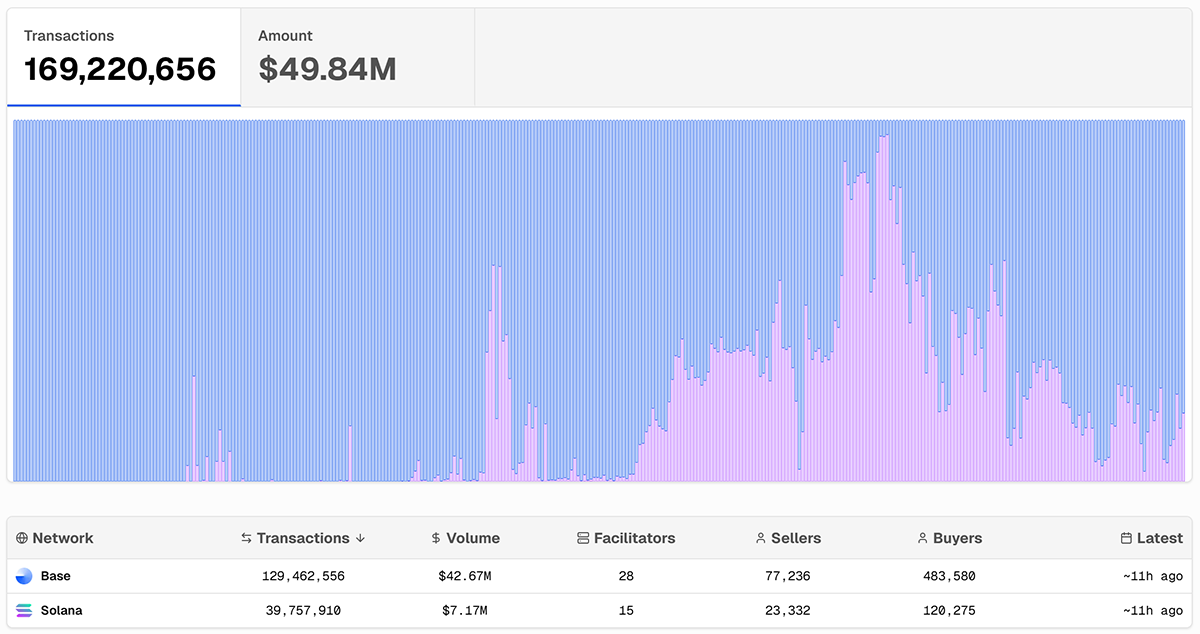
But who facilitates these payments? The list below highlights the top facilitators of x402 transactions on Base and Solana. Aside from Coinbase, PayAI and Dexter are two notable players.
X402 Facilitators
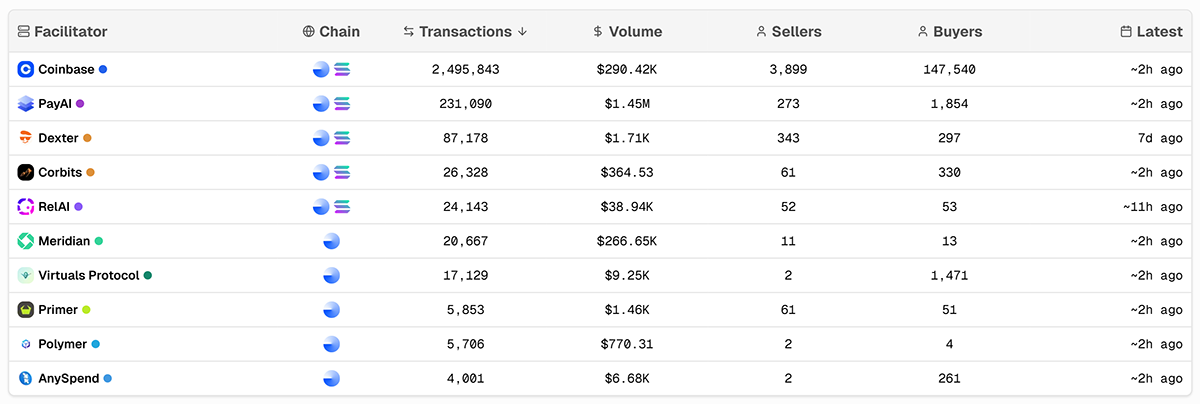
PayAI enables usage-based payments for AI agents, SaaS platforms, and traditional applications, supporting fast and secure settlements across multiple digital currencies. Dexter takes a more infrastructure-focused approach, handling verification, signing, and settlement across Solana and other chains.
Just this month, the Solana Foundation and Google Cloud launched Pay.sh, a gateway that allows AI agents to pay for over 75 Google Cloud APIs using USDC on Solana. The fees are a fraction of a cent per call, with no subscriptions or billing accounts required.
Base and Solana are not alone. Ethereum has been developing its own standards to support the agentic economy. ERC-8183 provides a commerce layer for AI agents, enabling them to agree on work, escrow payments, and settle transactions based on verifiable proof. This complements ERC-8004, which handles agent identity and reputation, giving Ethereum a structured foundation for agent-to-agent commerce.
The buzz around all of this is hard to ignore. From innovation to institutional interest, the conversation around AI agents and crypto is growing louder, and the infrastructure being built today suggests this wave has real legs.
Why High-Performance Chains Have the Edge
For all of this to work at scale, you need a blockchain that can handle high throughput at negligible cost. This is where Solana and Base hold a structural advantage.
Solana was built for performance from the ground up, with transaction costs at fractions of a cent and block finality under one second. An AI agent transaction can involve multiple sub-transactions within a single workflow, which can lead to fees accumulating quickly. Infrastructure that makes the micropayments economics work isn't a nice-to-have; it's a requirement.
Base, built on top of Ethereum, offers similar fee efficiency while inheriting Ethereum's security and developer ecosystem. Both chains have positioned themselves early in the agentic era, and that bet is beginning to show some traction.


