


BNB Chain Is Growing, But Where's the Money?

Token Takeaway: BNB;
Following a strong H2 2025, which carried BNB to a new all-time high, the token has been a notable underperformer. The flash crash in October 2025 set off a market-wide sell-off, and the panic that followed drained liquidity and on-chain activity. The swift recovery many expected hasn't materialised, but there are early signs that both capital and usage are now returning. This Token Takeaway reviews the BNB Chain ecosystem, its architecture and technical progress, and the value proposition of BNB.
Overview
Binance launched in July 2017 and grew into the world's largest cryptocurrency exchange by volume within a matter of years. At the heart of the Binance ecosystem sits BNB Chain; the decentralised counterpart to the centralised exchange, and home to the BNB token, its applications, and its users. However, although Binance introduced the original idea and still supports the ecosystem, BNB Chain is independently operated through a community-driven governance model.
The BNB Chain ecosystem has had several re-designs over the years, but the current iteration is the “One BNB” model. This came about in response to the wider crypto industry prioritising decentralisation and censorship resistance by moving from partially on-chain to fully on-chain Web3 applications.
Launched in 2024, One BNB consolidated the then-fragmented BNB Chain ecosystem into a simplified model. The result was three core, interconnected chains – BNB Smart Chain (BSC), opBNB, and BNB Greenfield – each serving a specific purpose.
BNB Chain: Architecture
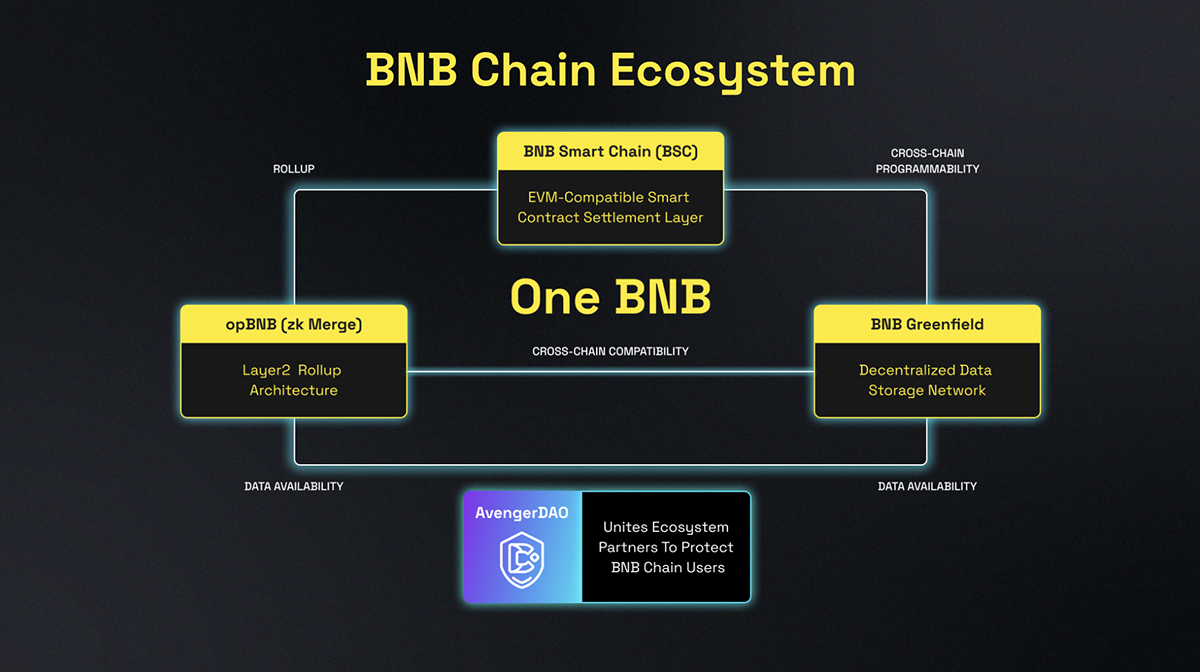
BNB Smart Chain (BSC) is a Layer-1 blockchain and the core execution layer – i.e. the DeFi hub - within the BNB Chain Ecosystem. It is the primary home for smart contracts, dApps, Web3 applications, DeFi protocols, and more. As it is EVM-compatible, developers can instantly access Ethereum’s ecosystem and connect Ethereum-based applications to BSC without changing a thing.
opBNB is a high-performance Layer-2 scaling solution built using Optimism. Its core purpose is to process transactions off BSC and then settle them back onto the chain. Removing the transaction process from the primary execution layer avoids bottlenecks, allowing for much higher throughput and lower fees.
BNB Greenfield is the data storage pillar of the BNB Chain ecosystem. Built using Cosmos SDK and Tendermint, it is Web3’s decentralised answer to Web2’s centralised data servers, such as AWS and Google Cloud. BNB Greenfield is mostly aimed at developers and data-heavy dApps and is suitable for high-value or utility data rather than raw data.
Under the One BNB model, BNB Chain has been optimised for speed, throughput, and institutional-grade stability: blocks confirm in under a second, fees cost fractions of a cent, and capacity currently tops 5,200 TPS. These are the essential building blocks for BNB Chain’s long-term vision:
“To establish BNB Chain as the premier global network for high-frequency trading and AI integration - defined by speed, institutional-grade reliability, and infrastructure that holds up under real use.”
Market Reach and Activity
Binance is the default entry point for millions of first-time crypto buyers, and the transition from exchange to chain is frictionless: the same account, the same assets, near-instant withdrawals. This is a one-way adoption funnel from a centralised giant into a decentralised ecosystem - an advantage few Layer-1s can match - and it has made BNB Chain the third-largest blockchain by market cap, behind only Bitcoin and Ethereum.
Some 880 million unique wallets have been created since inception, with more than 600,000 in the last 24 hours alone.
BNB Chain: Total Unique Wallets
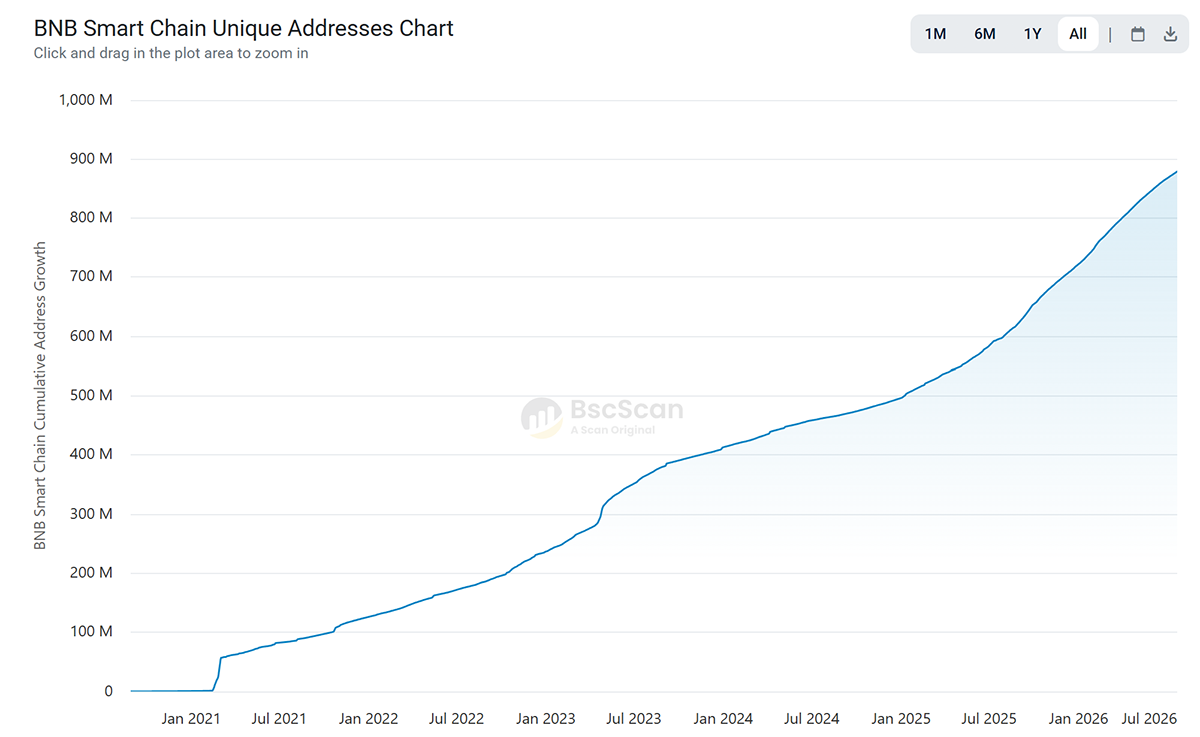
However, while cumulative wallet creation is a useful indicator of reach, it is a poor measure of usage, as wallets are cheap to create and easy to abandon. Active addresses tell us more, with around 2.2 million currently transacting daily.
BNB Chain: Active Addresses
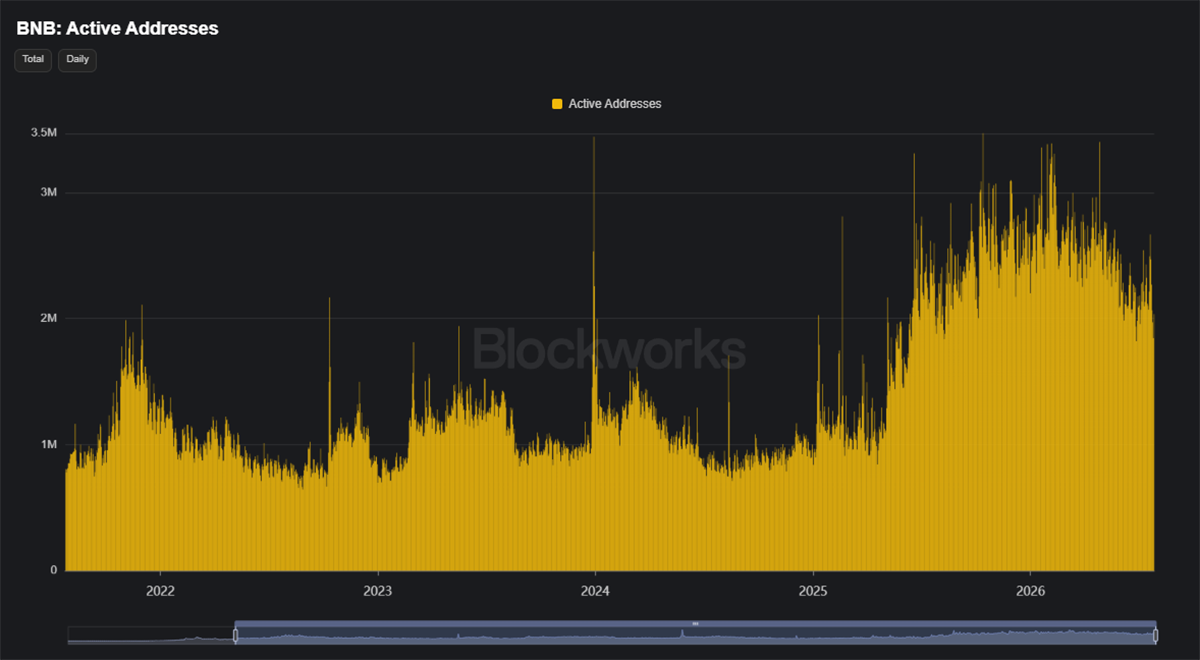
Looking at activity over the past six years, it remained consistent but flat until May 2025, when we see the beginning of the new growth curve, which peaked in February 2026. While activity has declined since the start of the year, current numbers have settled to where they were about a year ago, which is encouraging. Notably, the entire past year has sustained a level of activity well above anything in the chain's earlier history. Where previous years saw activity spike and fade, the last twelve months have held a consistently higher baseline.
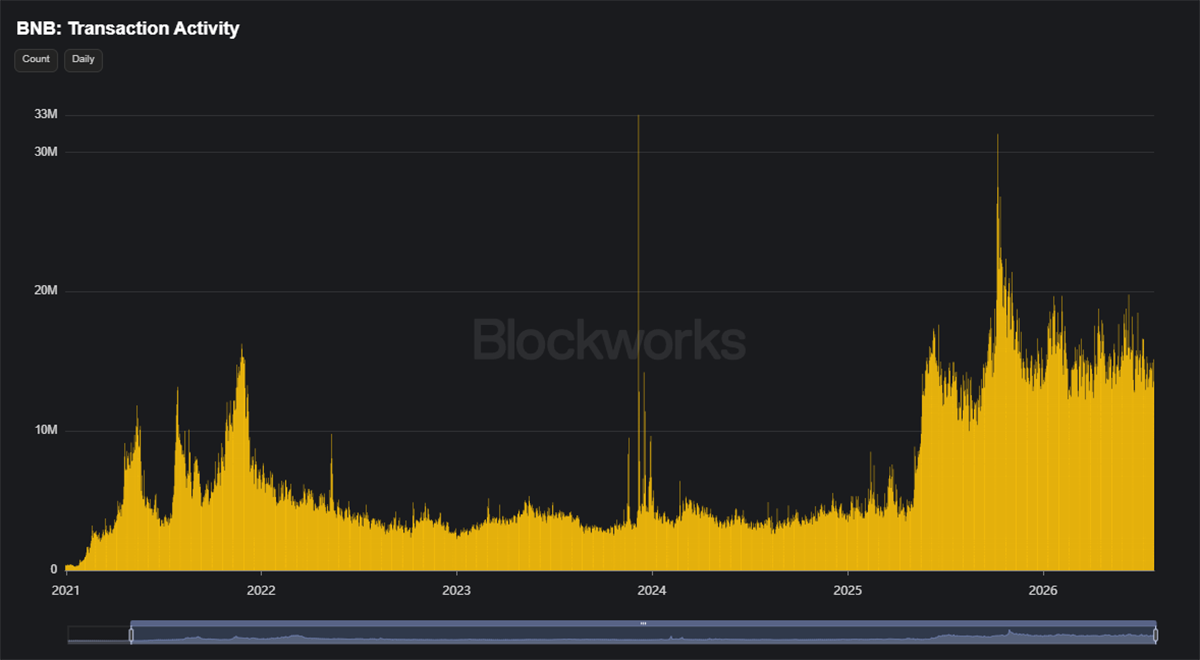
Daily transactions on BSC have grown in line with active addresses. On 1 January 2025, BSC processed 3.4 million transactions, but today that number has grown to 15.1 million. The sudden jump in transactions around May 2025 coincided with Binance airdrops, specifically the Polyhedra token, which we covered in ByteFolio Issue 162.
Daily Transactions on BSC - 1 Year
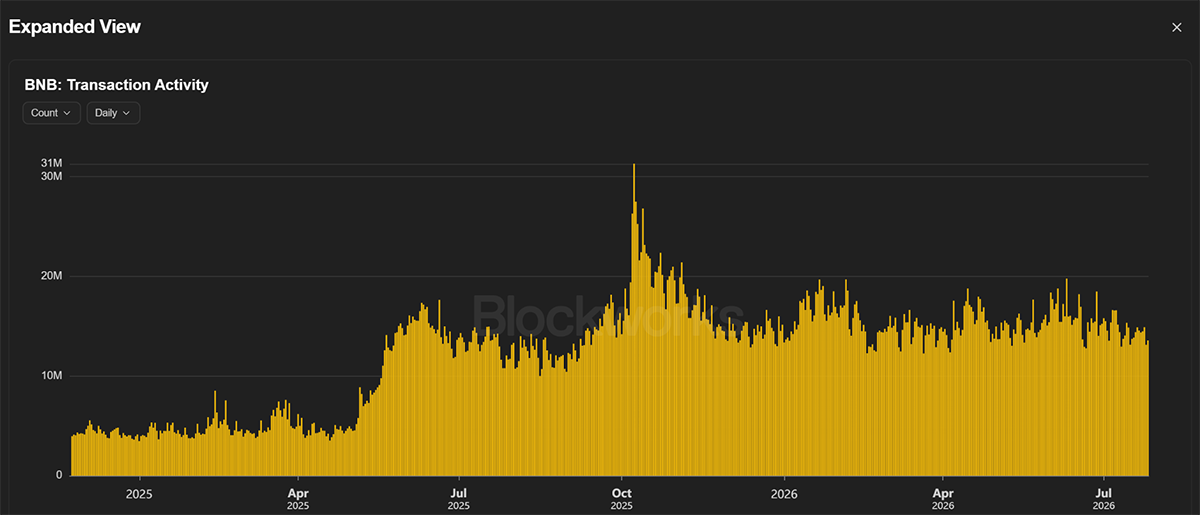
Moreover, a shift in the regulatory backdrop likely helped sustain the elevated activity. From early 2025, the new SEC leadership in the US, the dropping of enforcement cases against major exchanges including Binance, and clearer stablecoin rules under the GENIUS Act removed much of the overhang that had discouraged on-chain activity.
If we zoom out to a longer timeframe, the level of sustained activity has never been higher than it is today.
Daily Transactions on BSC - 5 Years
DeFi TVL
On-chain activity tells us how much a chain is being used, but not how much capital users have deposited. The current total value locked (TVL) on BSC is $4.8bn, with PancakeSwap accounting for the largest single share at $2bn. At its 2021 peak, BSC carried roughly $33bn, making today's figure an 83% decline from the high.
BSC TVL
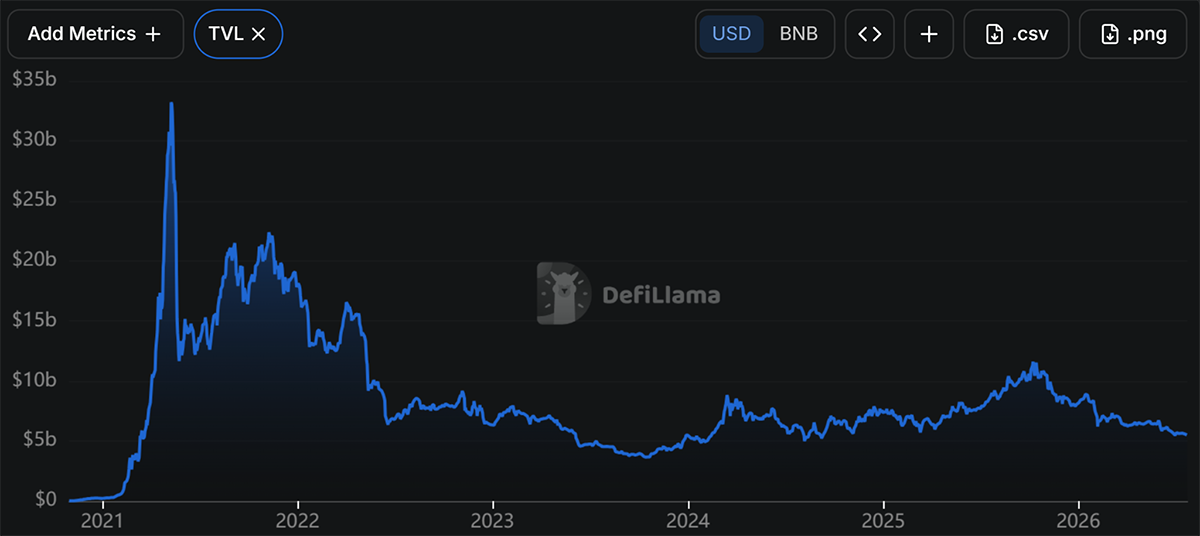
The initial drawdown is easy to explain: the 2021 top gave way to a bear market, and capital was drained from all chains. What followed is more telling. Over the next cycle, liquidity returned to Ethereum and flooded into Solana, while BSC's TVL stayed range-bound.
Ethereum TVL
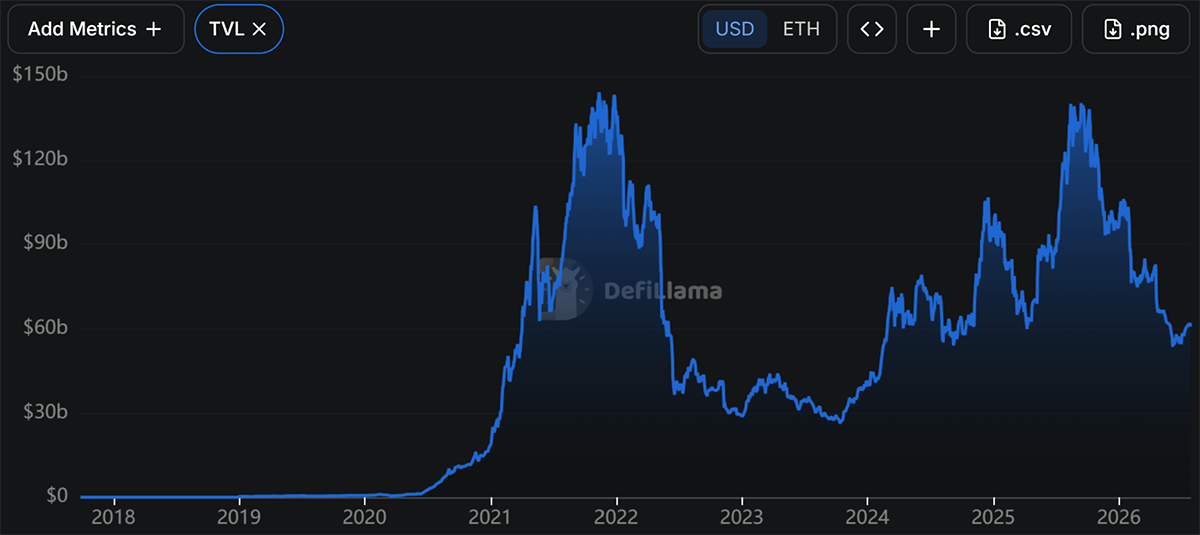
While Ethereum reasserted itself as the settlement layer for serious DeFi liquidity, Solana in particular became the destination for the speculative, high-velocity capital that once might have flowed to BSC.
Solana TVL
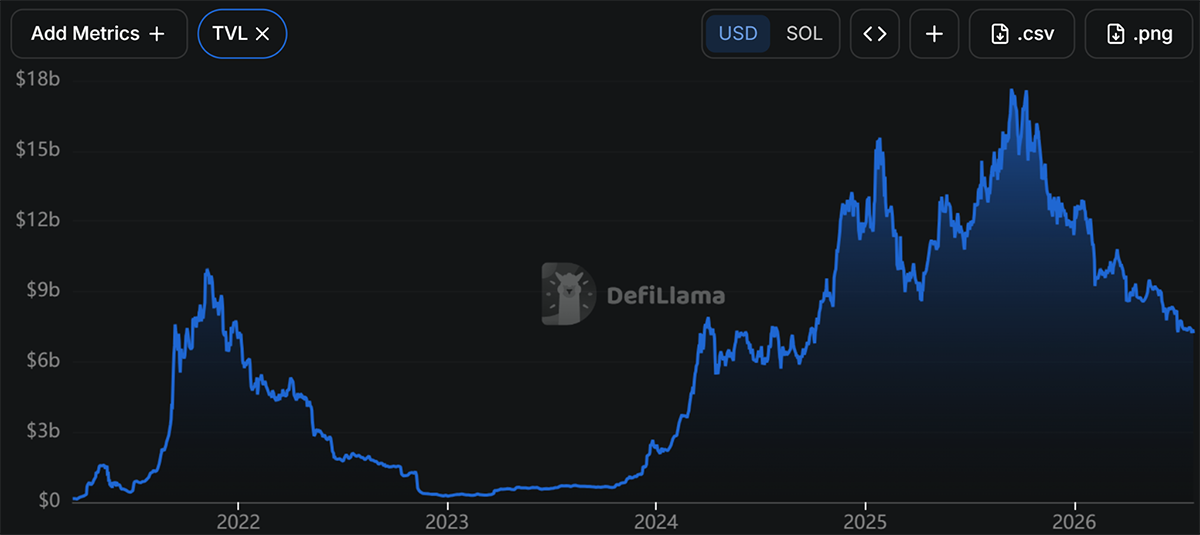
BSC kept its users but not their capital. The amount of value locked on-chain is ultimately a measure of trust, and by that measure BSC's recovery has lagged its peers.
However, while DeFi is a key sector on BNB Chain, there’s one sector that is much bigger, namely stablecoins.
Stablecoins
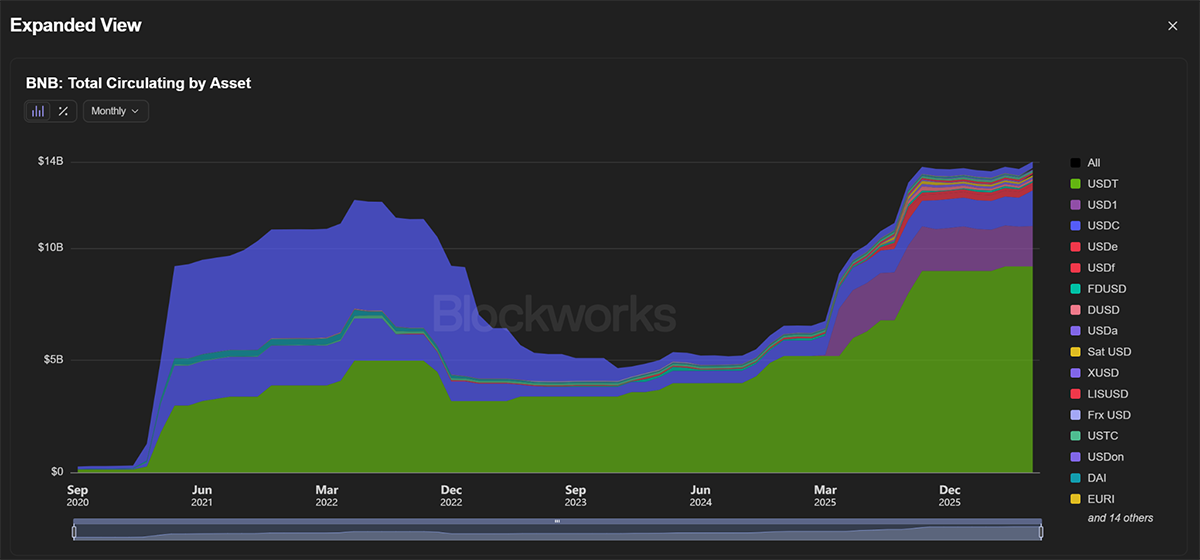
Monthly stablecoin supply on BNB Chain sits at an all-time high of $13.8bn, more than double the $6.5bn in January 2025 and roughly 3x bigger than the chain’s DeFi sector. So, while capital may not be flooding back into BSC's contracts, it is arriving in the form of on-chain dollars.
USDT dominates at $9.1bn, followed by USD1 at $1.8bn and USDC at $1.6bn. The sharp drop in stablecoin supply visible in Q4 2022 was the unwinding of Binance USD (BUSD) in favour of third-party issuers.
BNB Chain: Total Stablecoin Supply
Volume surged through May 2025 as overall ecosystem activity picked up. However, unlike daily transactions, it has retraced meaningfully from the June 2025 peak, though it remains comfortably above the April 2025 low.
BNB Chain: Stablecoin Volume
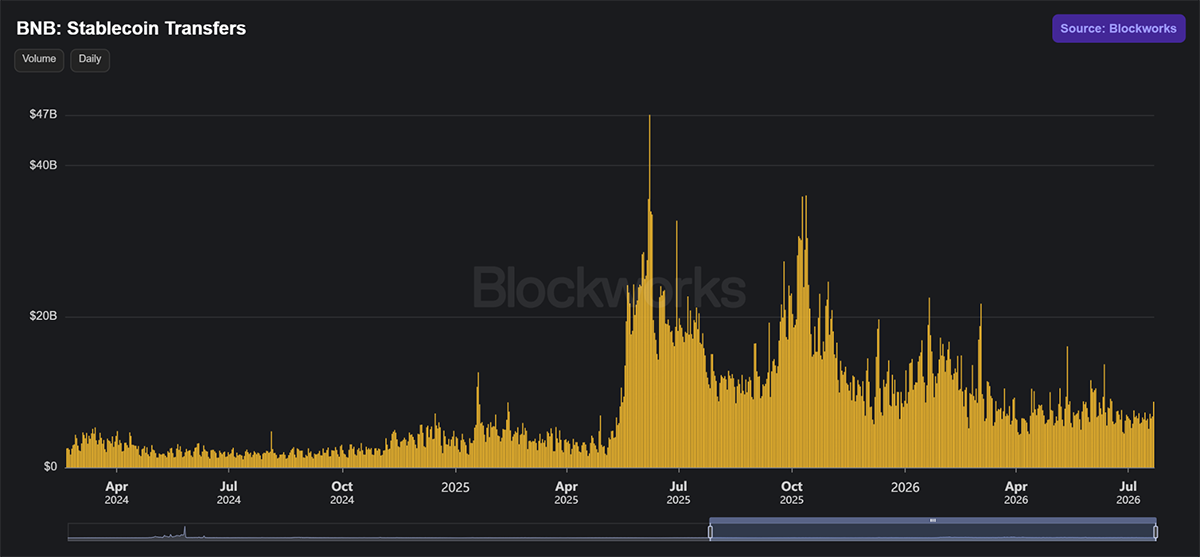
More encouragingly, the decline appears to have halted. Volumes have traded broadly sideways since April 2026, which points to a floor forming rather than continued erosion.
Tokenized RWAs
Tokenization, i.e. bringing real-world assets on-chain, has been one of the few crypto sectors to show consistent growth in 2026, and BNB Chain is capturing a meaningful share of it. Total RWAs tokenized on the chain have reached an all-time high of $6.4bn, up from $2.5bn on 1 January 2026, a 153% increase.
BNB Chain: Total RWA Supply
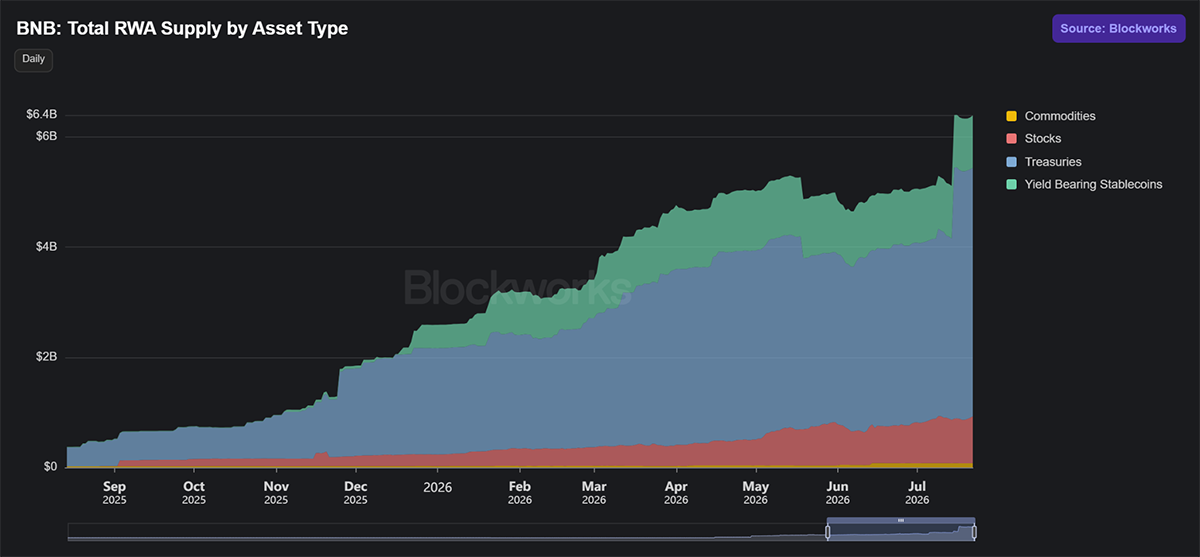
Tokenized treasuries make up the largest asset type by a wide margin. Circle's tokenized money market fund, USYC, leads with $2.9bn in total supply, followed by Franklin Templeton's IBENJI at $1.5bn, making BNB Chain its largest market. BlackRock's BUIDL comes third at $111m.
BNB Chain: Tokenized Treasuries
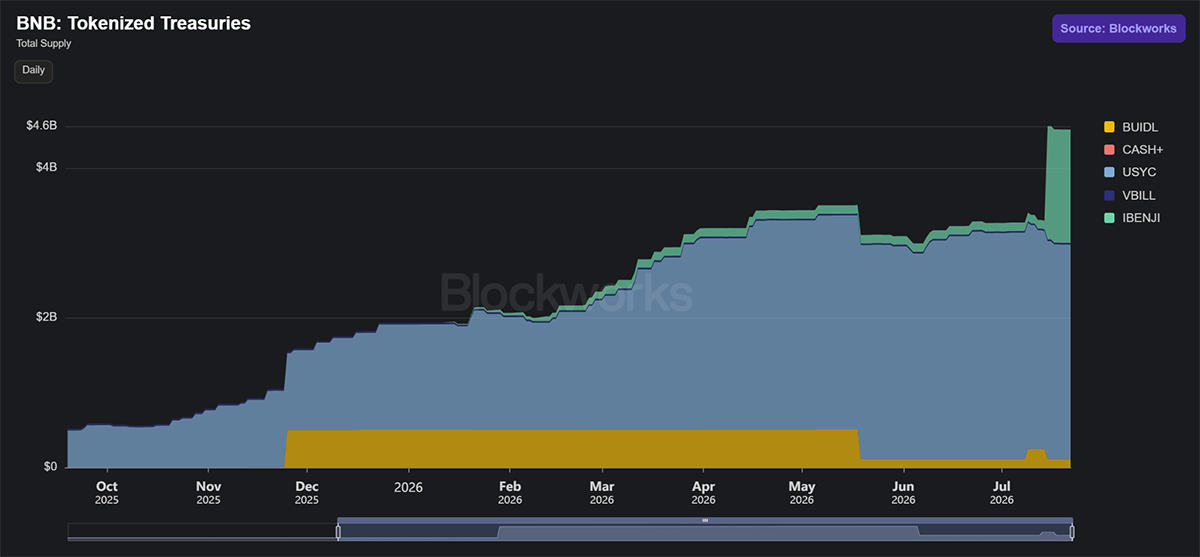
The presence of Circle, Franklin Templeton, and BlackRock on the chain says something that the TVL chart does not: these institutional issuers have chosen BNB Chain for distribution. It is a slower and stickier form of capital than DeFi liquidity, with high growth potential.
BNB Performance
So, while BNB Chain has lagged its peers on the DeFi front, it is currently seeing record transactions, record stablecoins, record RWAs, and a genuine institutional footprint. By all accounts, BNB Chain is doing well, and yet, the token tells a different story. BNB currently scores a 0-star bearish trend in USD on ByteTrend.io.
BNB in USD
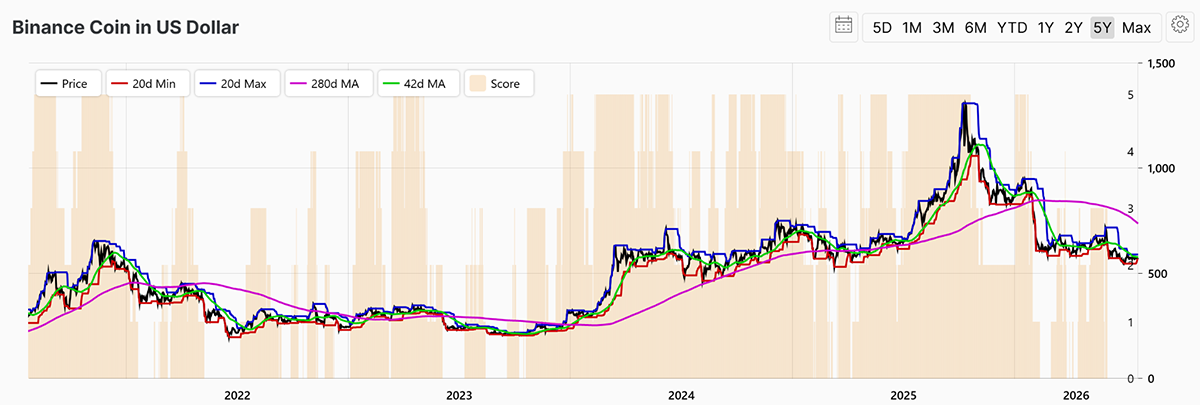
BNB reached an all-time high in October 2025 and has been a notable underperformer since, drifting lower even as the usage metrics have pushed to records. A chain with an expanding ecosystem ought to have that reflected in its native token. This raises the question: if the network is being used more than ever, why isn't that economic value reaching BNB?


