


Zcash, Monero, and the Growing Demand for Financial Privacy

Token Takeaway: ZEC, XMR;
Privacy coins have been among the most discussed crypto sectors in 2026. Overall, this sector tends to perform when the broader market is weak, and given the current crypto winter, it has done exactly what was expected: outperformed.
Several factors, including major technical upgrades, governance proposals, influencer publicity and investors seeking refuge from a growing regulatory crackdown, have played a role in this renewed interest. It is also one of the most controversial sectors in crypto, facing significant regulatory pressure worldwide. This Token Takeaway will analyse the fundamentals of privacy coins, using Zcash and Monero as case studies, uncover the driving factors behind the sector’s recent surge, and explore the regulatory landscape.
Introduction
Privacy coins are a category of cryptocurrencies built to hide what regular public blockchains broadcast by design: who sent what, to whom, and how much. They have existed since the early days of crypto but tend to drift in and out of focus, usually returning to the conversation when surveillance concerns rise or when investors start hunting for assets that aren't tracking the broader market. That's the setup we have right now in 2026.
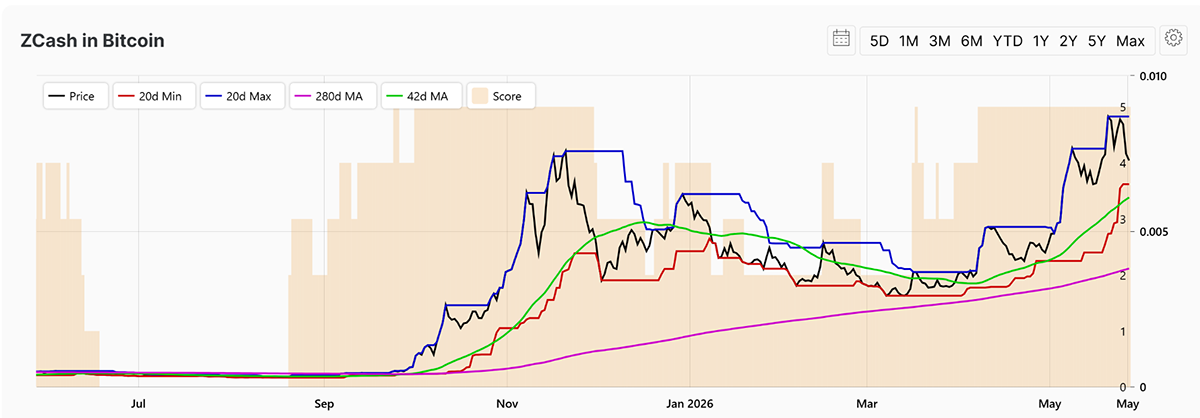
This is evident in the sector leader, Zcash, which has been among the best-performing assets in crypto, delivering an extraordinary return of around 180% since its low this year. It currently scores a 5-star ByteTrend score against BTC, USD and ETH, indicating relative strength across the board. The price action is also clearly bullish.
ZEC in USD
Monero, trailing Zcash in market cap, had a very strong January 2026, hitting an all-time high near $800 before cooling off. Despite the pullback, it retains a 5-star ByteTrend rating against BTC, indicating that it is still outperforming the benchmark even on a deeper retrace.
XMR in BTC
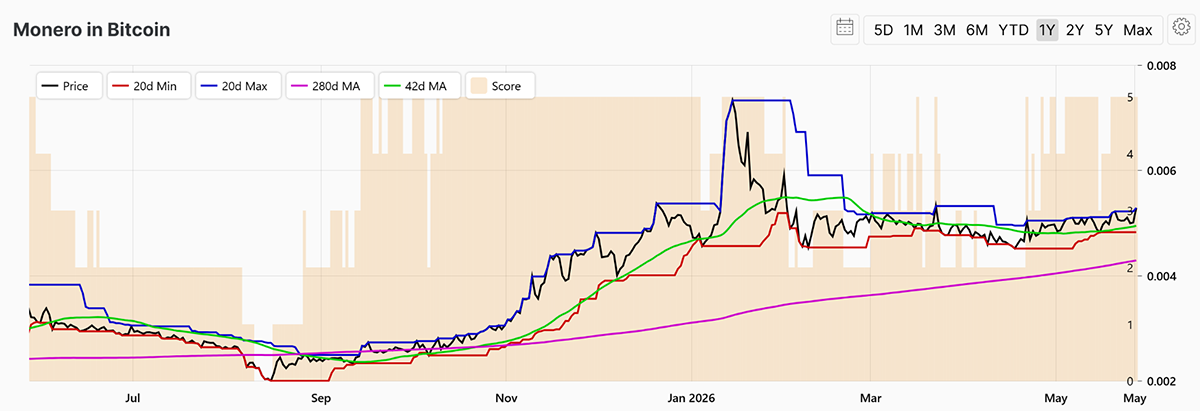
Both charts highlight that privacy coins are quietly outperforming a market that is otherwise struggling for direction. Before unpacking what's behind this rotation, we will step back to the basics, looking at what makes a privacy coin and why they exist.
What Are Privacy Coins?
To understand privacy coins, we first need to examine the surrounding context. Bitcoin and Ethereum are public blockchains, where every transaction is recorded in a permanent, publicly viewable ledger. You could pull up a block explorer right now, paste in a wallet address, and see every transaction it has ever made, the amounts involved, the addresses it has interacted with, and the current balance. The wallet itself doesn't have a name attached to it (it's just a long string of random characters), which gives users a layer of pseudonymity, but the activity is fully transparent.
Privacy coins flip that model. Networks like Zcash (ZEC) and Monero (XMR) use cryptography to hide the sender, receiver, and each transaction amount, while still allowing the network to verify that the transaction is valid. How each blockchain does this varies, but the end result is the same: the transaction graph cannot be reconstructed by an outside observer, even one with full access to the blockchain.
Beyond the technical mechanics, what matters at a conceptual level is that these networks give users a credible way to transact on-chain without broadcasting every detail of that transaction to the world. That capability simply does not exist on public blockchains, which brings us neatly to why these networks were built in the first place.
Why do Privacy Coins Exist?
Imagine if your bank account details were posted on a public website. Not your name, just an account number that anyone could search. Your salary, your rent, your grocery spending, the date you bought a house, the bar tab from last weekend, the donation to that political party, all of it sitting there for any employer, ex-partner, business competitor or curious stranger to scroll through. You might shrug it off at first, since the account number isn't tied to your name. But then your employer pays you, your landlord receives your rent, and your friend Venmoses you for dinner. Anyone who knows even one of those transactions can now connect your account number to a real-world identity, and from there, they reconstruct your entire financial history.
That is, in essence, what a public blockchain is. Wallets are anonymous strings of characters, but the moment a wallet is linked to a person or entity, the entire history of that wallet becomes attributable. All it takes is a centralised exchange withdrawal, a public donation address, an on-chain purchase, or even a poorly chosen post on X. Chain analysis firms like Chainalysis, TRM Labs, and Elliptic have built their core businesses around this kind of forensic work, primarily for governments, law enforcement, and exchanges trying to meet AML obligations. Their tooling has become so sophisticated that even experienced users routinely get deanonymised when they don't actively protect their on-chain footprint.
This is the gap that privacy coins are designed to fill. The pitch isn't that financial privacy is about hiding wrongdoing; it's that financial privacy is the default state for cash and for the traditional banking system. Consequently, some see the transparency of public blockchains as a regression rather than a feature. Tushar Jain, Managing Partner at Multicoin Capital, made this exact argument when disclosing the firm's ZEC position, framing transparent crypto balances as increasingly problematic for sophisticated holders. It's a thesis that has historically sat on the fringe of the crypto industry, but is now being underwritten by some of the largest names in the institutional pipeline.
What's Behind the Renewed Interest in Privacy Coins?
By the end of 2023, the privacy coin sector looked structurally finished. Fifty-one exchanges worldwide had delisted at least one privacy coin under regulatory pressure. By late 2025, that number had climbed to 73, a 43% increase, with major venues like Binance, Kraken, OKX and Upbit pulling XMR, ZEC and DASH pairs across various jurisdictions. Aggregate trading volume that disappeared from regulated venues was estimated at around $600m. Combined with MiCA's push to effectively ban privacy coins and accounts in the EU by 2027, most analysts had written the sector off. The conclusion was simple: regulators would slowly strangle privacy coins, exchanges would keep delisting, and liquidity would dry up.
Despite all that, privacy coins are now among the hottest sectors in the crypto market. The shift didn't happen because the regulatory environment improved; it hasn't. It happened because the case for privacy on-chain became dramatically more concrete over the past 18 months, where a series of developments stacked up to make that case for ordinary users rather than just cypherpunk diehards. There are five core developments, which I will go through in turn.
The first piece of the puzzle is what is happening to stablecoins. Under the GENIUS Act, stablecoin issuers in the US are now required to freeze and seize tokens on lawful order, which they have been doing at scale. In April 2026, Tether froze over $344m in USDT in coordination with OFAC and US law enforcement. That came on top of a $182m freeze in January 2026 across just five Tron wallets. Most of these freezes are connected to genuine illicit activity, but the underlying point is unambiguous: dollar-denominated value on a public chain can be turned off remotely by the issuer. For users who assumed crypto was a hedge against exactly that kind of intervention, this has been a wake-up call.
The second piece is the accelerating Central Bank Digital Currency (CBDC) pipeline. The European Central Bank has formally moved to accelerate the digital euro rollout, with a 2029 target for launch. CBDCs are well known for their surveillance potential. They give the issuing central bank a direct, real-time view of every transaction, with the ability to set programmable controls on what users can and cannot spend their money on. China's digital yuan is already operational at scale, and other major economies are working on their own versions. For an EU citizen, the medium-term trajectory is clear: cash is shrinking, banking surveillance is tightening, and the digital alternative being prepared for them is a fully visible programmable currency.
The third piece is tax reporting. The IRS has rolled out Form 1099-DA, which requires custodial brokers (centralised exchanges, payment processors, hosted wallet providers) to report digital asset sales directly to the IRS starting with 2025 transactions filed in 2026, with cost basis reporting following from 1 January 2026. The IRS has also scrapped the universal cost basis method, forcing taxpayers to track basis on a per-wallet, per-account basis. The end result is one that every transaction involving a regulated exchange is automatically reported, and the IRS can match those reports against the on-chain history of the wallets involved. Anyone who has ever bought or sold crypto through a US exchange now has their on-chain footprint linked to their tax file.
The fourth piece, and arguably the most important, is the advancement of the on-chain surveillance industry. Firms like Chainalysis, Elliptic, TRM Labs, and Arkham Intelligence have built a multi-billion-dollar surveillance layer sitting atop every major public blockchain. Chainalysis alone has clustered over 1 billion wallet addresses across over 134k uniquely identified real-world entities. Academic research has validated their clustering at up to 94.85% accuracy and a false-positive rate below 0.15%.
The implication is straightforward. The moment a user interacts with a KYC-compliant exchange, their real-world identity gets permanently linked to their address cluster. From that point onwards, every historical transaction associated with that cluster becomes visible to anyone with access to the tooling; i.e., governments, tax agencies, law enforcement and, increasingly, private actors with the budget for it. Most users have no idea this has happened, as there is no notification, no opt-out, and no way to undo it.
Finally, the fifth piece takes the conversation entirely out of the digital world. Jameson Lopp, a security expert and long-time crypto user, has maintained a public database of physical, real-world attacks against crypto holders over the past decade. The 2025 numbers are stark: there were roughly 70 documented physical attacks on crypto holders, up from around 41 in 2024 and 36 in 2021. Cumulatively, Lopp's database now lists more than 240 verified physical attacks since tracking began.
As you’ve probably guessed, the number of attacks has not slowed in early 2026, with multiple kidnappings and home invasions in France, the Philippines, the US, and elsewhere already logged in January and February alone. About a quarter of these are home invasions, frequently aided by leaked KYC data (Lopp's preferred shorthand for KYC is "Kill Your Customer"), combined with public on-chain records that let attackers see exactly how much a target is holding. The pattern is consistent: the user’s identity is linked to a wallet through an exchange or a data breach, their wallet is analysed for balance and activity, and the user becomes the target of an attack if the balance is high enough. The combination of mandatory KYC and fully transparent blockchains has effectively created a directory of crypto holders sorted by how much they have, and the data is now showing up in violent crime statistics.
None of this means public blockchains are broken, as Bitcoin and Ethereum work exactly as designed. The transparency is a built-in feature, and for many use cases (auditing reserves, verifying solvency, settling commercial transactions), it is the right trade-off. The point is that the same transparency feature creates an attack surface, which has been growing as the analytics toolset, the regulation, and the surveillance economy have matured in parallel. Privacy coins exist to give users an alternative when they don't want to be part of that attack surface.


