


Prediction Markets May Have Cracked Crypto Mass Adoption

Prediction markets started making headlines during the 2024 US presidential election and have grown rapidly since. Despite intense regulatory pushback, they now compete directly with traditional sportsbooks and betting operators. Web2 platforms dominate the sector, but blockchain-based Polymarket remains one of the sector’s best-known names and crypto’s clearest consumer success story. This Token Takeaway examines the state of prediction markets, the role blockchain plays, and what they reveal about the road to crypto mass adoption.
What Is a Prediction Market?
A prediction market lets users trade contracts on the outcome of a future event. Each contract pays $1 if the event happens and $0 if it does not, so its price reflects the probability. For example, if a contract on "Will the Fed cut rates at its next meeting?" trades at 70 cents, the market is pricing a 70% chance of a cut. Notably for crypto fans, a “Bitcoin: Up or Down” event runs at 5-minute intervals on Polymarket.
Trending on Polymarket
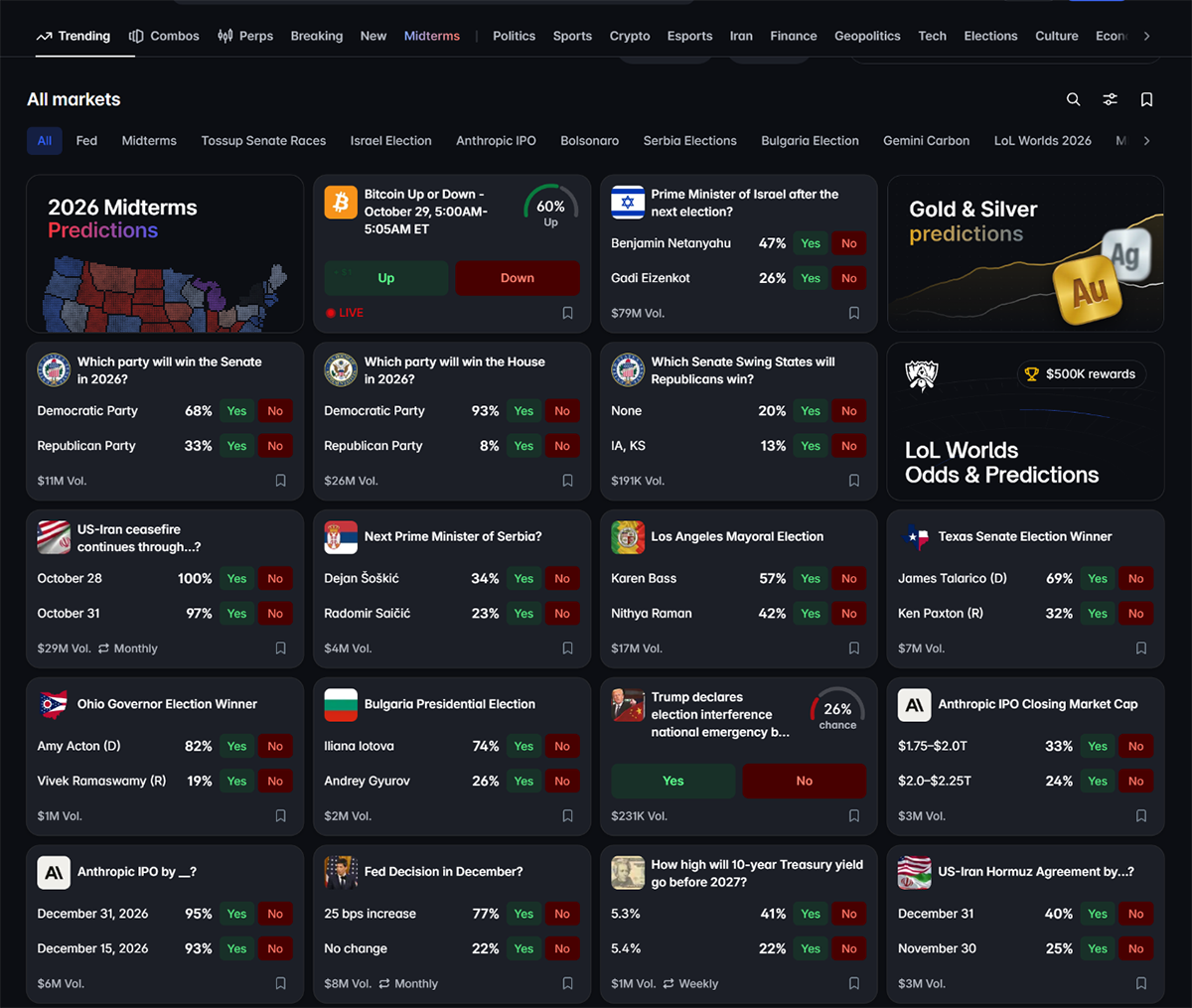
Because prediction markets are peer-to-peer exchanges, no “house” sets the odds. Instead, traders on both sides set the price, and a position can be sold at any time before the result. Someone who bought at 70 cents and sees the price climb to 85 cents can take the 15-cent gain straight away. That puts prediction markets closer to stock trading than betting, which is how these platforms have argued their way into financial regulation rather than gambling law.
From Niche to Mainstream
The sector was growing for years, then broke into the mainstream in 2026. Combined monthly volume on Kalshi, Polymarket, and Polymarket.US, the top three prediction market platforms, went from $12bn in December 2025 to over $72bn by September 2026, a 500% increase. Additionally, while October volume is incomplete at the time of writing, it’s already at a new all-time high, breaching $100bn for the first time.
Prediction Markets: Monthly Volume
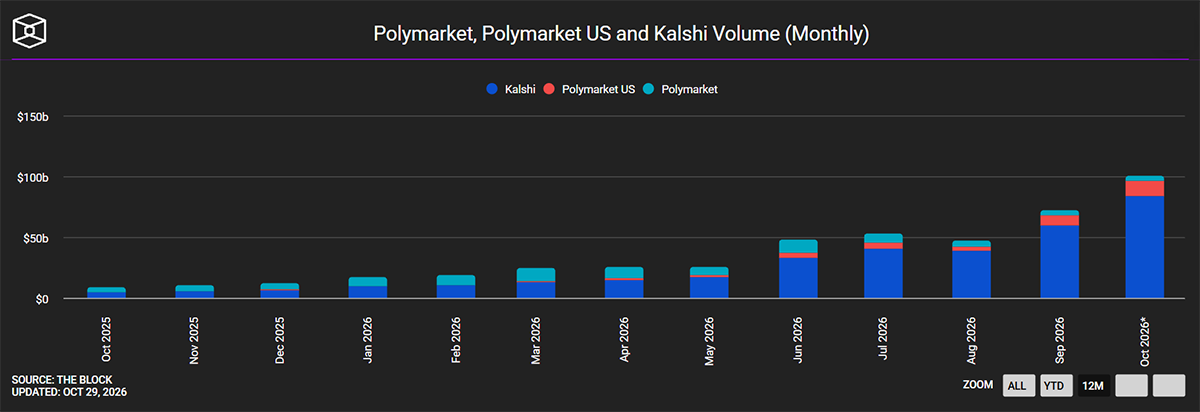
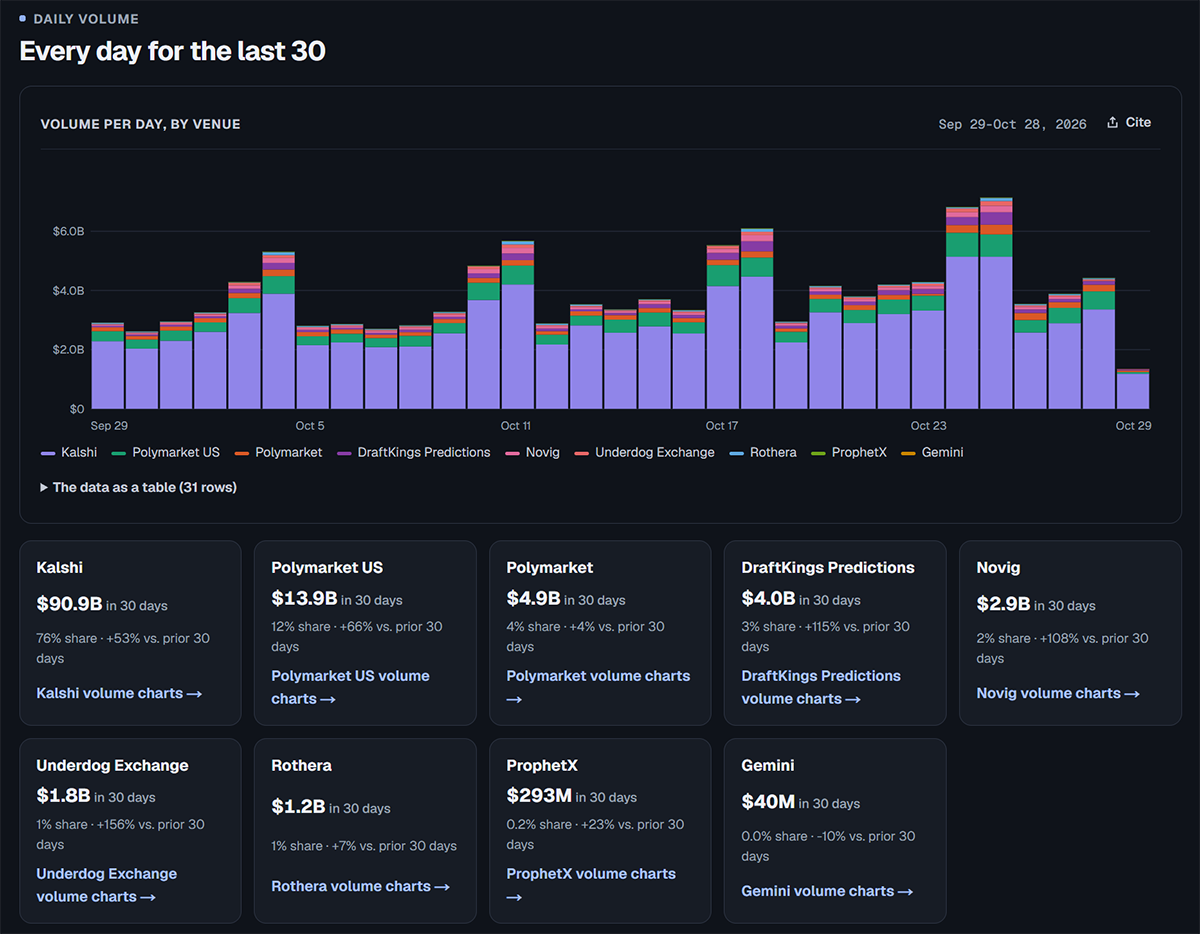
More broadly, $120.2bn has been traded across nine platforms over the past 30 days. Kalshi contributed the biggest market share with $90.9bn (76%), while Polymarket and Polymarket.US collectively processed $18.8bn (16%).
Prediction Markets Daily Volume – Last 30 Days
Prediction markets cover a broad range of categories that users can trade, including politics, sports, finance, crypto, weather, and tech. While politics helped prediction markets break through into the mainstream, sports are the engine, with football being the main driver for bets. As shown below, the sports category has been growing exponentially in 2026.
Kalshi, Polymarket, and Polymarket.US - Volume by Category
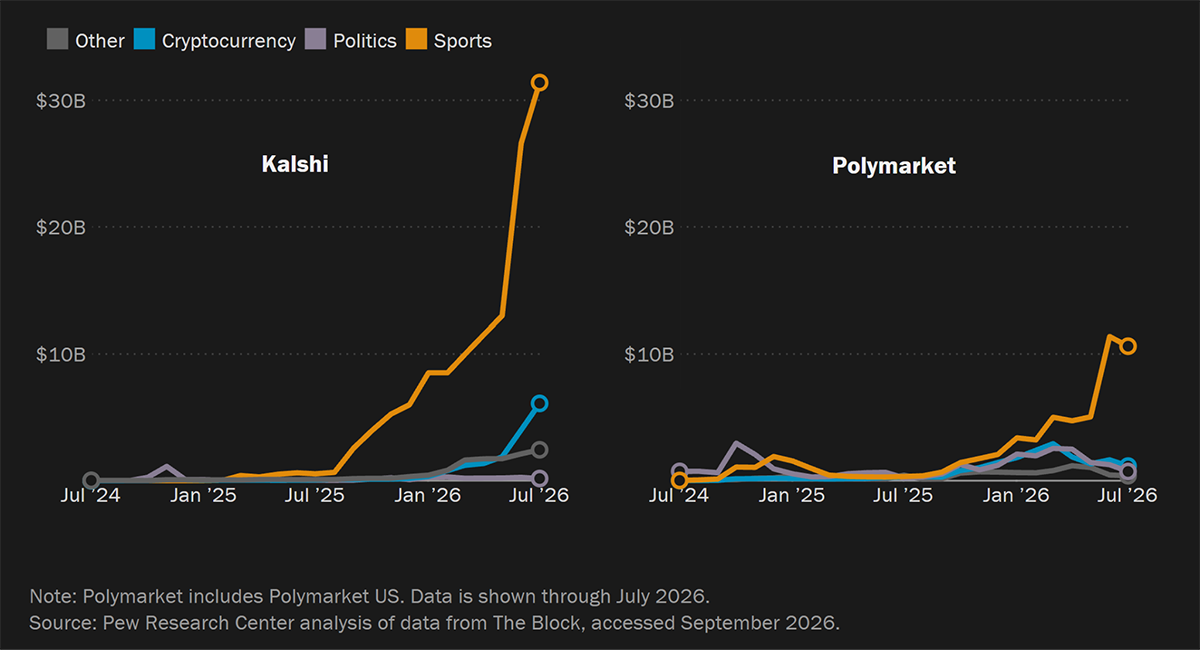
That is hardly surprising, as sports is also the most popular category within the traditional betting industry, with Americans betting $40.5bn at traditional licensed sportsbooks in Q1 2026. Considering prediction markets weren’t on most people’s radar prior to 2026, they are becoming a serious contender for the traditional betting industry. Let’s look at the top players, Polymarket and Kalshi.
Polymarket vs Kalshi
Founded by Shayne Coplan in 2020, Polymarket is a global prediction market platform built on the Polygon blockchain. The platform uses a hybrid order book, where trades are matched off-chain on Polymarket but then settled on-chain on Polygon. This is possible with smart wallets, where trades automatically execute settlements as smart contracts on the blockchain. Polymarket is also non-custodial, meaning funds remain under the user's full control.
Polymarket rose to popularity during the 2024 US election, with over $3.2 billion in bets on the Trump vs Harris race. Notably, US users were barred from participating as Polymarket had exited the US in 2022 following a settlement with the CFTC. This remained the case until 2025, when the global platform launched Polymarket.US, a non-blockchain platform, after acquiring QCEX, a CFTC-licensed derivatives exchange and clearing house.
Notably, Polymarket's absence in the US created an opportunity for a competitor: Kalshi. Originally founded in 2018, Kalshi sought regulatory approval from the outset. In 2020, the CFTC designated it as a Designated Contract Market (DCM), making it the first fully regulated US exchange for events. The regulatory-first approach paid off, as Kalshi is now the leading prediction market in the US (helped by holding a near-monopoly of the US market in 2022-2025).
While neither Kalshi nor Polymarket.US is blockchain-based, the global Polymarket platform remains a crypto-native player. Google Finance has even added its odds, alongside Kalshi’s, putting prediction market probabilities in front of everyday investors. That makes Polymarket the closest the crypto industry has come to a mass-market consumer product, and many users never realise a blockchain is involved.
Although Polymarket popularised the sector, it was not the first on-chain prediction market. Gnosis built prediction market tools from 2017, and Augur launched on Ethereum in 2018, but neither built a large user base.
Others have followed since, most recently Hyperliquid. The largest decentralised exchange for crypto perpetual futures launched its own prediction markets in May, though it remains small compared to Polymarket.
Mainstream platforms are piling in too. Robinhood launched prediction markets in March 2025 and is now building its own exchange, while Coinbase opened them to users in all 50 US states in January 2026. Both are powered by Kalshi rather than a blockchain; a sign of how quickly prediction markets are becoming a standard feature of everyday trading apps.
Although blockchain-based prediction markets have existed for almost a decade, and several have launched since, Polymarket is the only platform to reach a mainstream audience. So why did it break through when most on-chain attempts stalled?


