


Blame France

Atlas Pulse Gold Report - Issue 118;
The extraordinary thing over the past five years, compared to the last 30, is how gold has had such modest setbacks when real yields have risen. Between 2021 and 2023, the real yield surged from -0.8% to 2.7%, a massive 3.5% move. Yet gold held flat during that period. This time is different from the pre-pandemic era, which is why I gave it a name: The Super Bull.
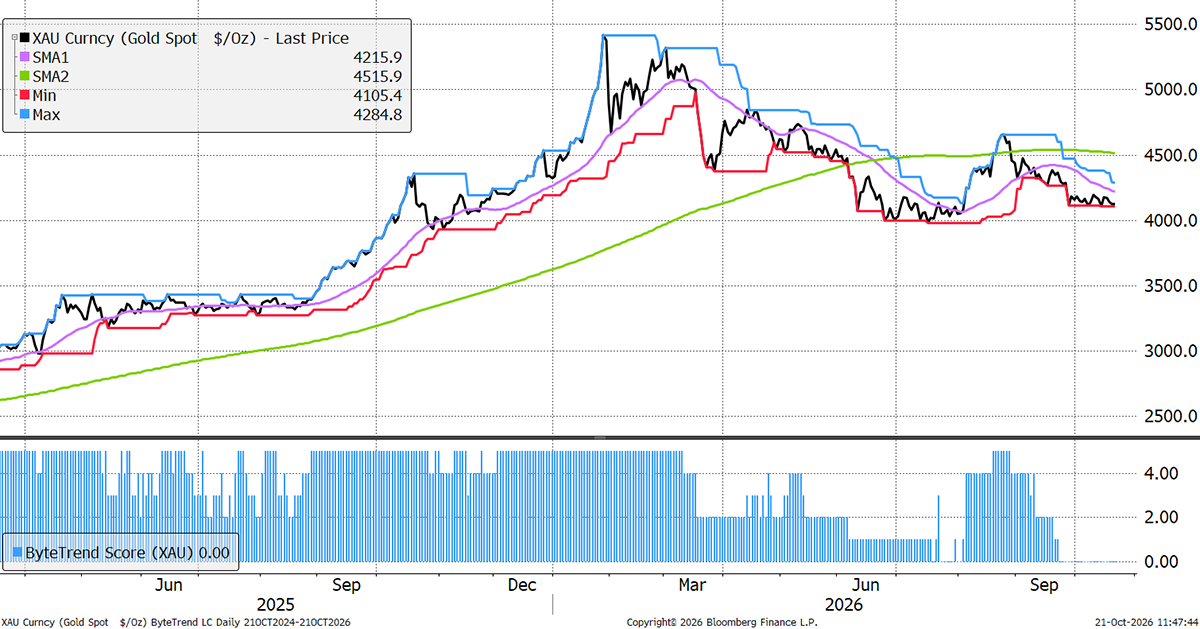
Gold’s short-term trend is under pressure, and a break below $4,000 seems increasingly likely. The trend score is now a bear, and the rallies have been lacklustre.
Gold Daily
The medium- and longer-term picture is more constructive, but I want to dive into the reasons why gold currently lacks spirit. The obvious opener is that gold has more than doubled over 5 years, tripled over 10 years and seven-bagged over 20 years. The simple conclusion is that gold has already anticipated the increased global instability, and while things may get worse, they are merely bad-bad rather than terrible-bad. Let’s look at the bond market, where yields have been rising worldwide.
We have a sovereign bond crisis underway, and it’s a serious one. French CDS spreads (cost of insurance against default) are uncomfortably high, with Italy not far behind. Bond yields in France and Italy are rising faster than in Germany because credit risk is rising. France last balanced its budget in 1974. In the end, time catches up with you.
Sovereign Default Swaps
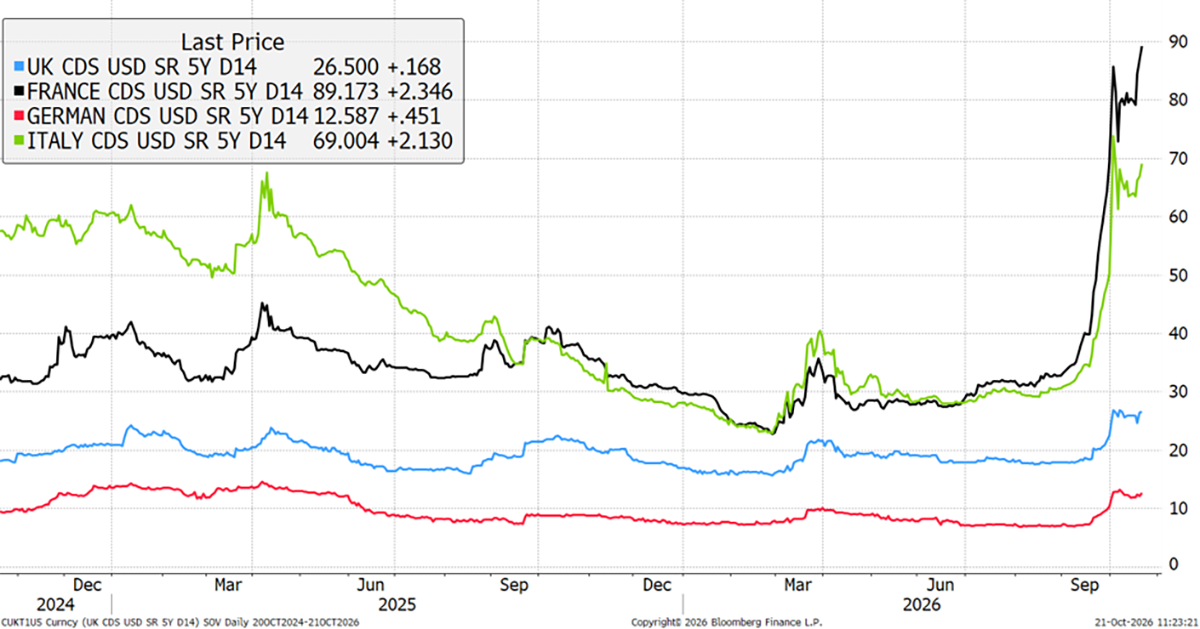
Surprisingly, the UK and other similarly indebted countries are not yet considered a credit risk. In the UK, that is because the CDS is measuring credit risk in pounds. Sovereign credit risk is generally low in countries that can print their own currency. If they borrow in another currency, which they can’t print, that’s another matter. But if they print too much, their currency will fall, but the creditor will be repaid as promised, just in devalued paper. France and Italy borrow in euros, which they can’t print. Only the ECB can do that.
The last time Euro spreads blew out was after the credit crisis, with peak spreads in late 2011. Portugal, Spain, Ireland, and Greece are off the naughty step. Greece had bailouts, but fiscal restraint was adopted by the others. That is proof that where political will exists, budgets can be balanced.
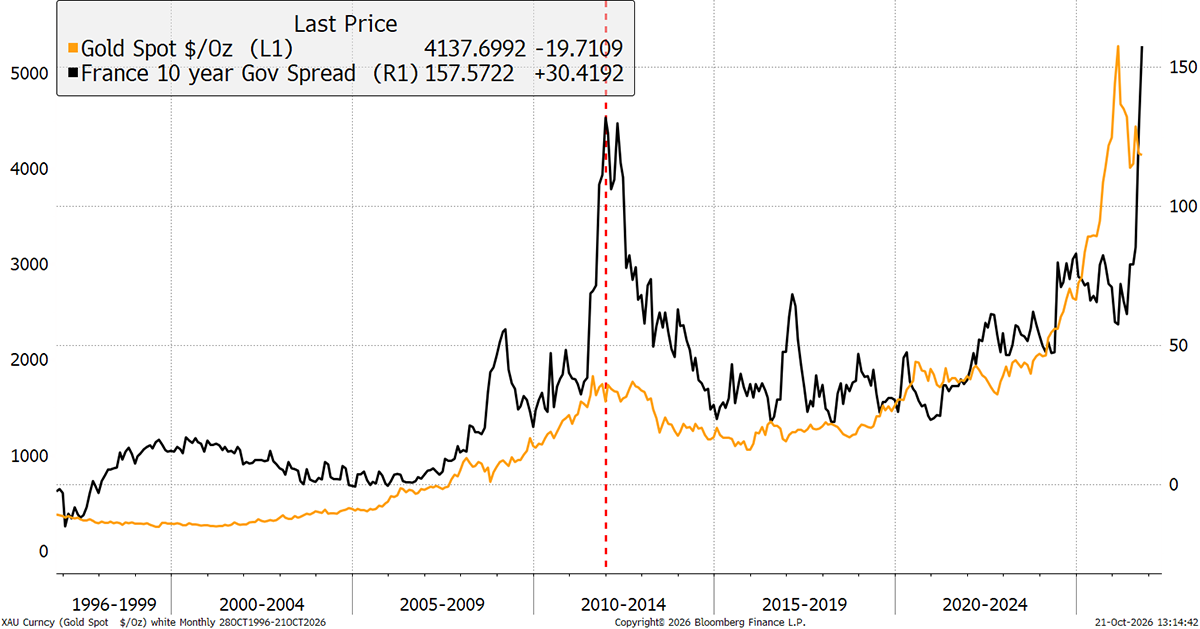
There’s a slight linkage between French spreads and the gold price. Curiously, gold peaked shortly before French spreads. Naturally, many other factors drive the gold price beyond French bonds, but could this be happening again?
French Bond Spreads over Germany and the Gold Price
In the 2010/12 Euro Crisis, oil was highly priced, as it is today. Yet, when CPI-adjusted, a barrel of oil is 35% cheaper today, and in terms of gold, it is 60% cheaper. No doubt high energy costs back then weighed heavily on the Euro Crisis, as expensive energy curtails economic growth. By 2014, the oil price collapsed, and bond markets calmed. It seems likely that rising energy prices will continue to cause stress for bonds, especially in France.
To put the rise in gold in perspective, an ounce of gold still buys 37 barrels of oil. We saw this in 2025, as gold surged. Before that, we saw this only during the pandemic, when oil was more or less free.
Gold vs Oil
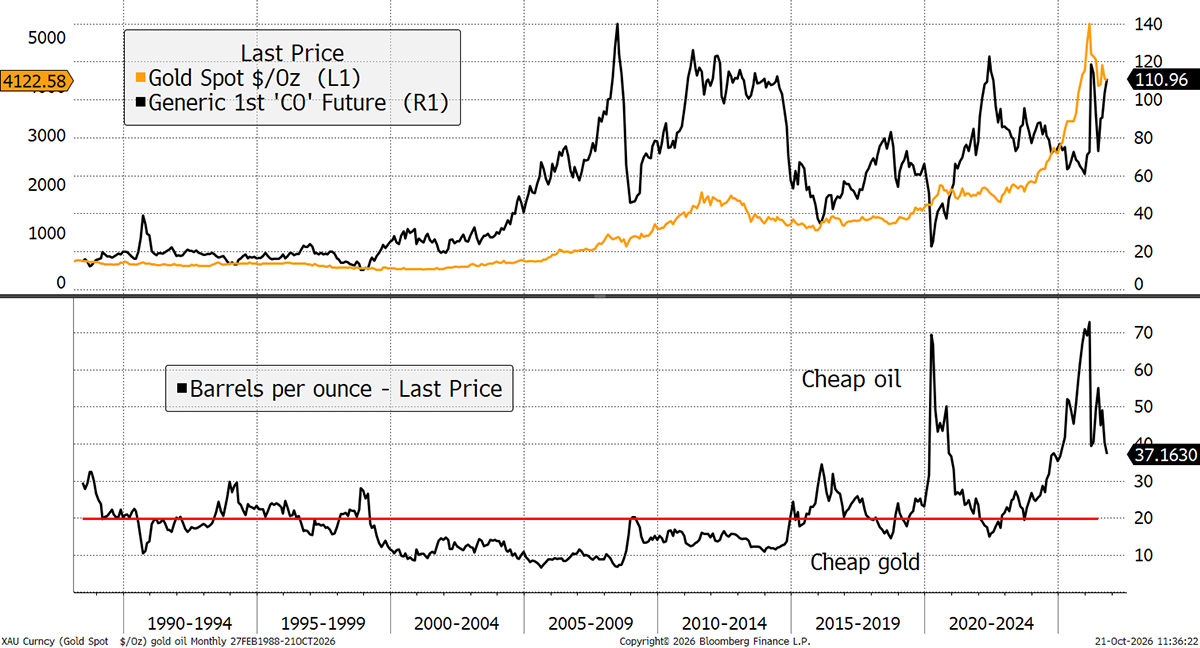
With never-ending wars in Ukraine and the Middle East and bottlenecks in refining and shipping, the energy bull market is well supported. This ought to boost inflation. In the short term, it is, but in the longer term, it isn’t, at least according to the bond market. This could change.
US 20-year inflation expectations (green box below) have been flat at 2.3% since 2022, while bond yields have risen. The higher yield reflects normalisation, demand for capital, and growth, not credit or default risk. If credit, or debasement, were a problem, inflation expectations would be rising, and they are not. Markets believe the US and the UK can service their debts because they could materially raise taxes if they chose to, an option France probably no longer has.
The real yield (blue) is derived from the bond yield (black) less the inflation expectations (red). The real yield started rising just as the gold price peaked in January 2026. I have marked the periods of rising real yields with red boxes. These have always weighed on the gold price.
20-Year Real Yields and Gold
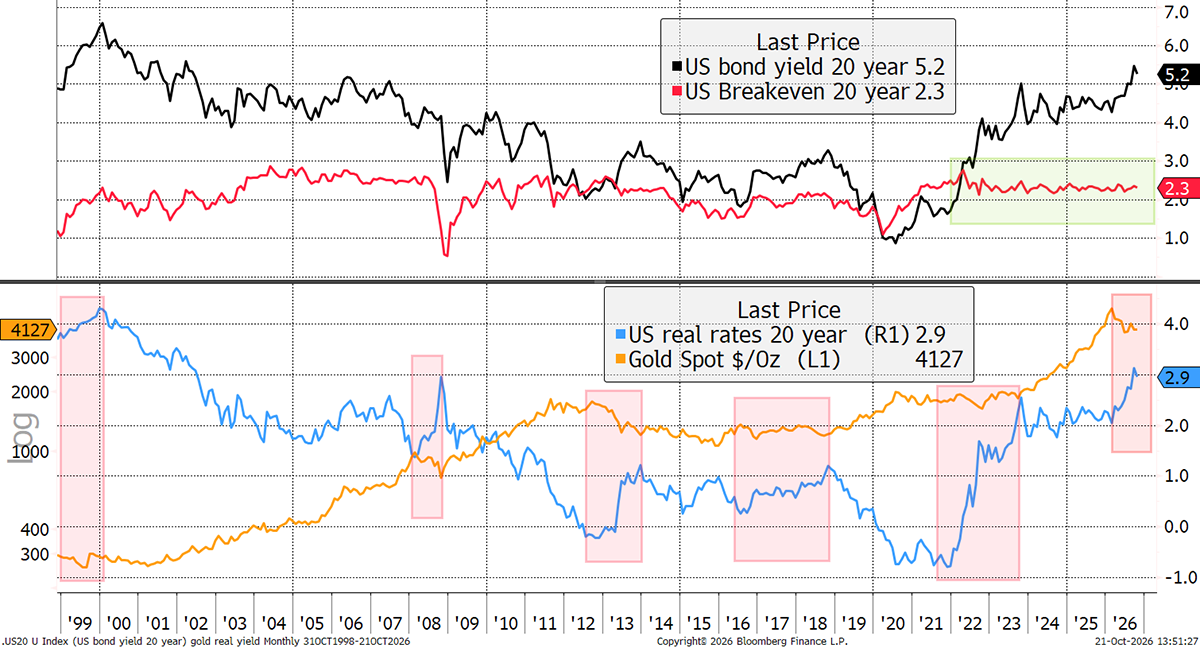
Fortunately, a 20-year real yield of 2.9% is high. Weaker growth would drive down yields, and sustained higher energy prices would drive up inflation expectations. If you are a world bear and think the energy crisis is far from over and that the AI bubble will burst, then gold will find its feet.
But even if you are a bull and see the energy shock easing and growth sustaining, the real yield is still 2.9%, which is historically very high. It would be surprising if it went much higher, and if it did, it wouldn’t last for long because a high real yield is the market’s way of driving up the cost of capital and rebalancing the system. We saw this in late 1999, when the tech trade broke. Real yields halved by 2004. It is hard to imagine the real yield moving much higher for a sustained period. The gold bear case is that it does.
The extraordinary thing over the past five years, compared to the last 30, is how gold has had such modest setbacks when real yields have risen. Between 2021 and 2023, the real yield surged from -0.8% to 2.7%, a massive 3.5% move. Yet gold held flat during that period. This time is different from the pre-pandemic era, which is why I gave it a name: The Super Bull.
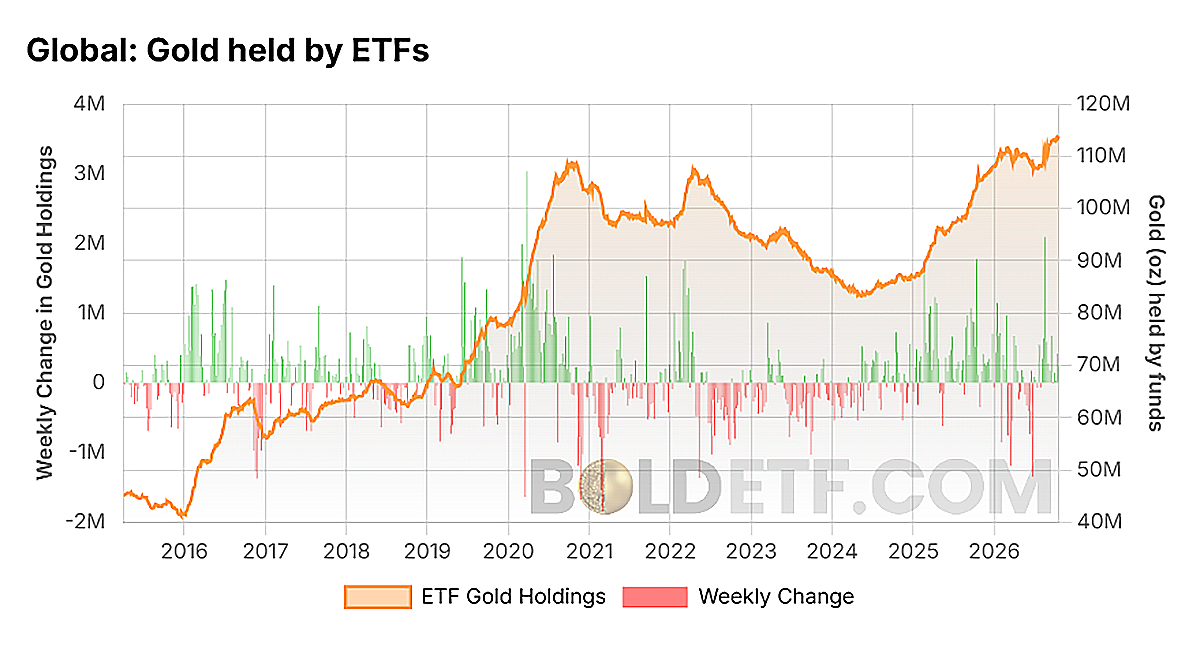
Sooner or later, real yields will cool, and when they do, the gold bull will resume. You certainly can’t blame recent weakness on the gold ETF buyers, as they remain resident. Gold held by ETFs has never been higher.
Gold ETFs
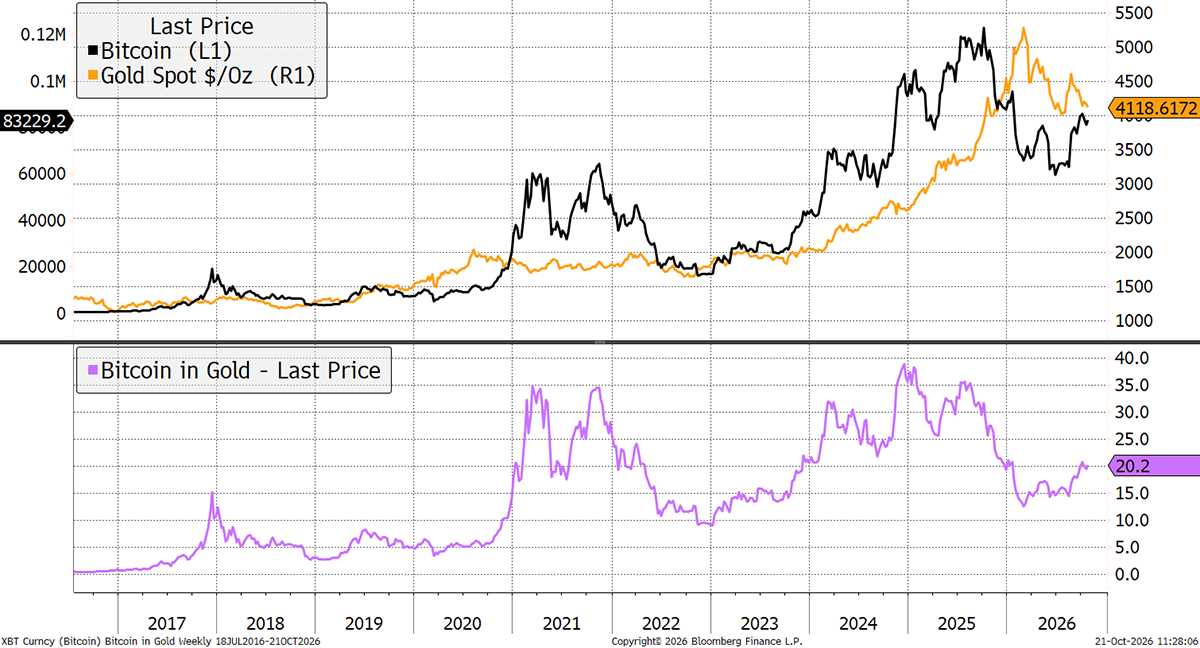
While oil is in the sweet spot, Bitcoin is also pulling ahead of gold. A Bitcoin now buys 20 ounces of gold, a material improvement from the 12.4 ounces it bought in February. Moreover, ByteTrend.io data suggest that crypto is back in a bull market. I expect the purple line to make a new high this cycle.
Bitcoin vs Gold
Despite a savage bear market in Bitcoin until August, the ByteTree BOLD index is back in front. How can owning Bitcoin and gold together beat the leading asset? The answer is simple. Over five years, BOLD made 60 monthly rebalancing transactions, each taking a little from the stronger asset and adding to the weaker. With an average annual turnover of 30%, the five-year turnover totals 150%, which soon adds up.
The ByteTree BOLD Index – Five Years
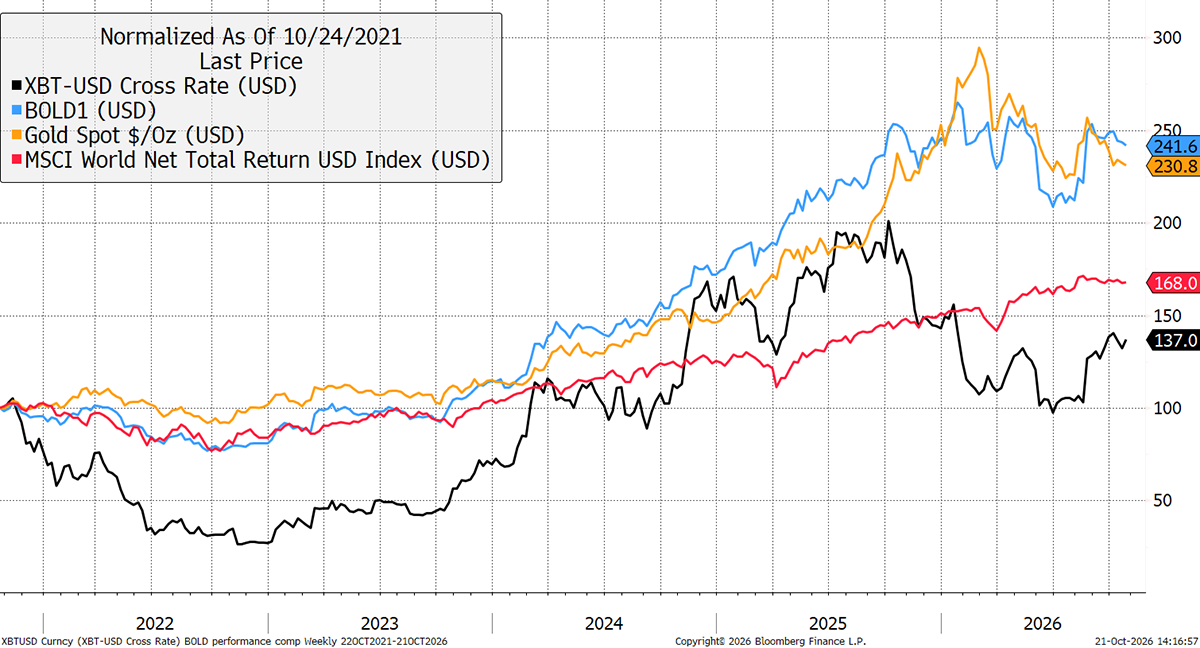
The average return of Bitcoin and gold over five years was 83.9%. BOLD returned 141.6%, which is 57.8% higher, or 11.5% per year. That is an extraordinarily high excess return from a simple strategy. The best part is you don’t even have to decide which asset you prefer; simply own both, risk-weight, and rebalance.
For more information, see our presentation, or, if you are keen, you can follow BOLD’s weights on BOLDETF.com.
The 21Shares Bitcoin Gold ETP (ticker: BOLD) tracks our BOLD index. It is listed in the UK, Switzerland, Germany, the Netherlands, France, Sweden, and Italy.
Summary
The short-term outlook for gold is precarious, but beyond that, the market is underpinned. The debt crisis is worsening, but real-world indicators, outside France and Italy, are still behaving somewhat normally. It may not feel like it, but it is not too late for indebted countries to tighten the reins and balance their budgets. The real bull case for gold is that they don’t. Despite the short-term risks, stay bullish.
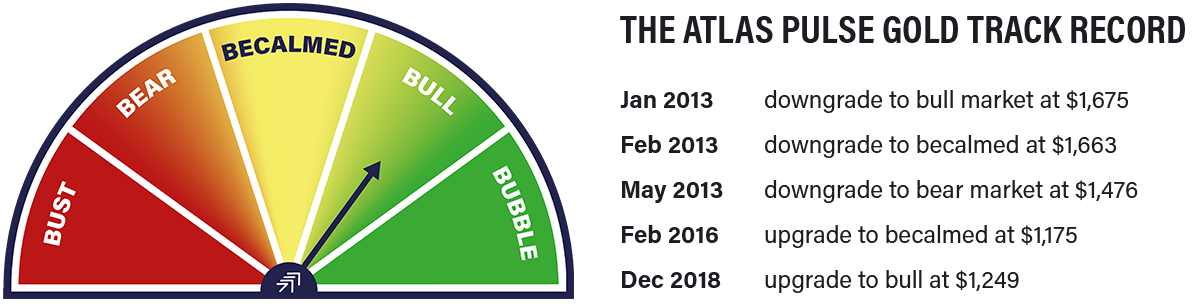
Thank you for reading Atlas Pulse. The Gold Dial remains in Bull Market.
Charlie Morris is the Founder and Editor of the Atlas Pulse Gold Report, established in 2012. His pioneering gold valuation model, developed in 2012, was published by the London Bullion Market Association (LBMA) and the World Gold Council (WGC). It is widely regarded as a major contribution to understanding the behaviour of the gold price.
Please email charlie.morris@bytetree.com with your thoughts.


