


A Breakout Year for Tokenized Real-World Assets

Token Takeaway
Ten months ago, we argued that tokenized real-world assets (RWAs) were closer to mainstream adoption than ever. Since then, most of the crypto market has moved sharply lower, yet tokenization has continued to grow. Stablecoins have contracted, but the value of tokenized RWAs has almost doubled. Tokenized stocks are worth nearly five times what they were in January, and regulators have found new ways to move the sector forward. This article revisits the figures from our January update and looks at where the market goes from here.
Overview
2026 has been a difficult year for crypto. The total value of the crypto market has fallen to $2.1tn, half its record $4.3tn set in October 2025, and almost every sector has followed it lower. Tokenization is one of the few exceptions, although not every part of it has fared equally well.
In our January update, stablecoins were the clearest driver of growth, with more than $300bn in circulation. That is no longer the case. Stablecoin supply now stands at $272.9bn, down 6.17% over the past 30 days and below the $300bn level it held previously.
Total Stablecoin Market Cap
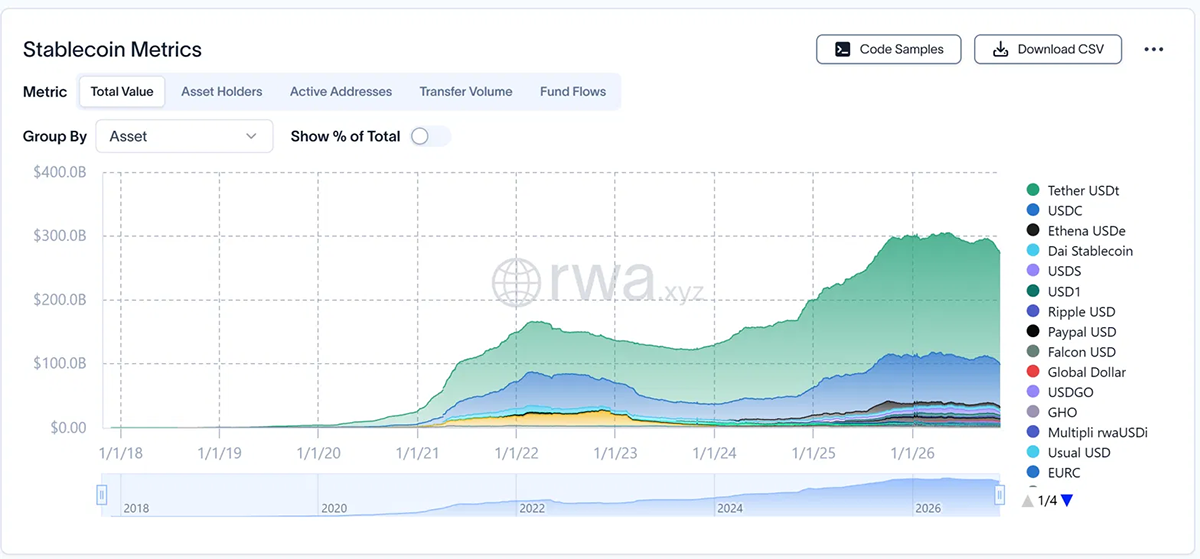
Usage, however, continues to rise. The number of stablecoin holders has grown to 308m, and 62.1m addresses transferred a stablecoin over the past month, up 6.31%. Less money is sitting in stablecoins, but more people are using them.
The contraction in stablecoins does not tell the whole story. Stripping them out reveals that the real tokenization race, bringing traditional assets such as government debt, commodities, credit and equities on-chain, has had a strong year.
Today, the total value of distributed tokenized RWAs stands at $40.8bn, almost double the $21bn we reported in January.
Total RWA Value
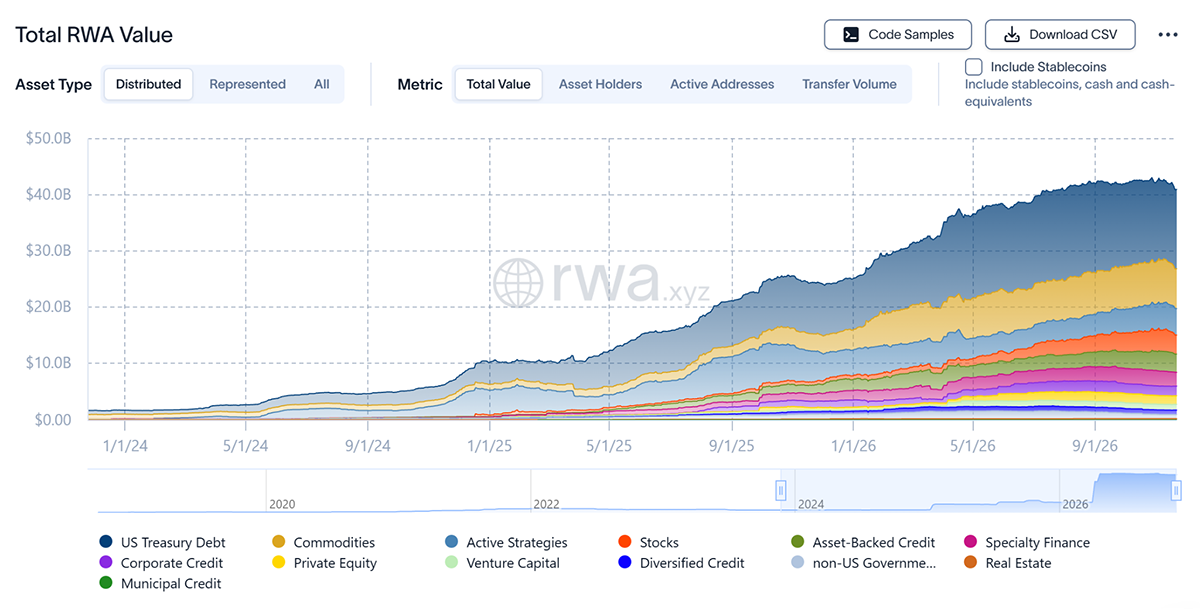
Tokenized US Treasuries remain the largest category at $14bn, up 58% from $8.9bn, and have attracted $4.6bn in net inflows this year, more than any other asset class. Commodities follow at $7.02bn, while tokenized stocks have grown to $3.38bn. The total has eased 3.77% over the past 30 days as the wider market sold off, but the trend for the year is clearly upwards.
Notably, user growth has been even more dramatic than growth in value. There are now 5.88m tokenized RWA holders, more than nine times the 630k we recorded in January, rising 7.16% over the past 30 days alone.
RWA Holders
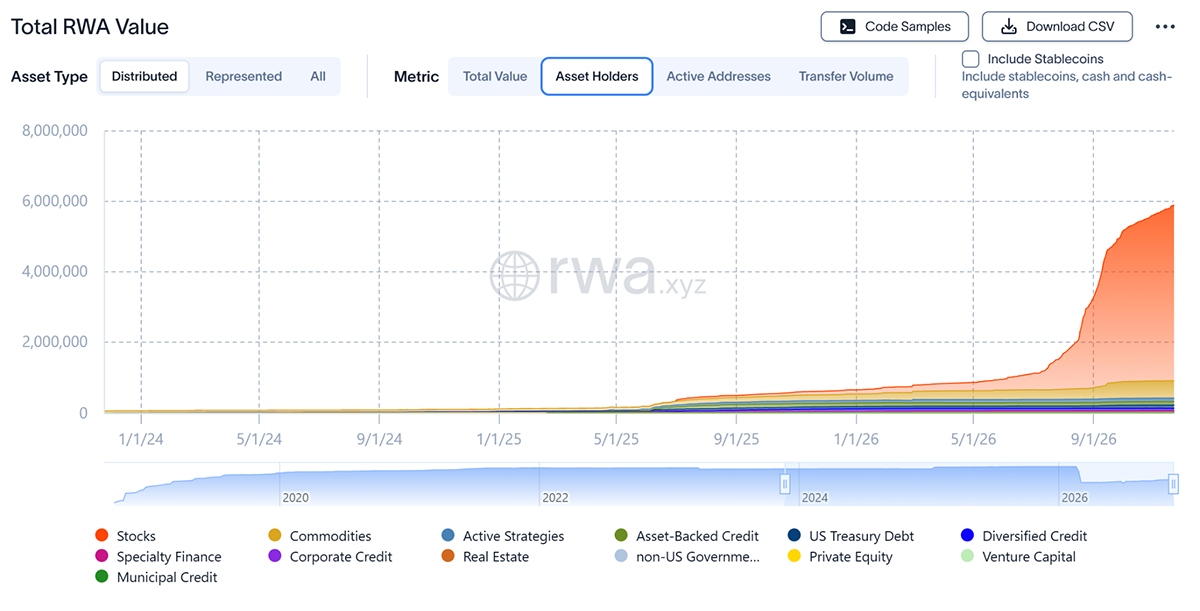
However, that growth is heavily concentrated. Around 84% of users hold tokenized stocks, and most of the increase has come since mid-year. Binance launched bStocks on BNB Chain in June, and Robinhood followed on 1 July by launching Robinhood Chain, available in over 120 countries, alongside its new Stock Tokens. These launches put tokenized equities in front of two large existing user bases within weeks of each other.
By mid-August, tokenized stockholders more than doubled over a month. Robinhood Chain was the main source of new holders until early August, when bStocks took over, with most new wallets opening small positions of a few hundred dollars. Even excluding stocks, there are around 920k holders, still well above the 630k total in January.
Before turning to tokenized stocks, the segment behind much of this growth, it is worth revisiting the asset that defined last year's safe-haven rally: gold.
Tokenized Gold
In January, tokenized gold had reached an all-time high of $4.6bn on the back of a historic run in the gold price, but the rest of the year has been far tougher for the metal. Gold set a record of $5,600 in January, but has since fallen 35% from that high, putting it on track for its worst annual performance since 2015.
Despite that, tokenized gold has held up well. The market is now worth around $5.1bn, roughly 11% above January's record. Tether's XAUT remains the dominant product, growing from $2.3bn to $2.87bn, while Paxos's PAXG has slipped from $1.7bn to $1.6bn. With the gold price falling, this growth comes from new tokens being issued rather than rising prices.
Tokenized Gold Market Cap
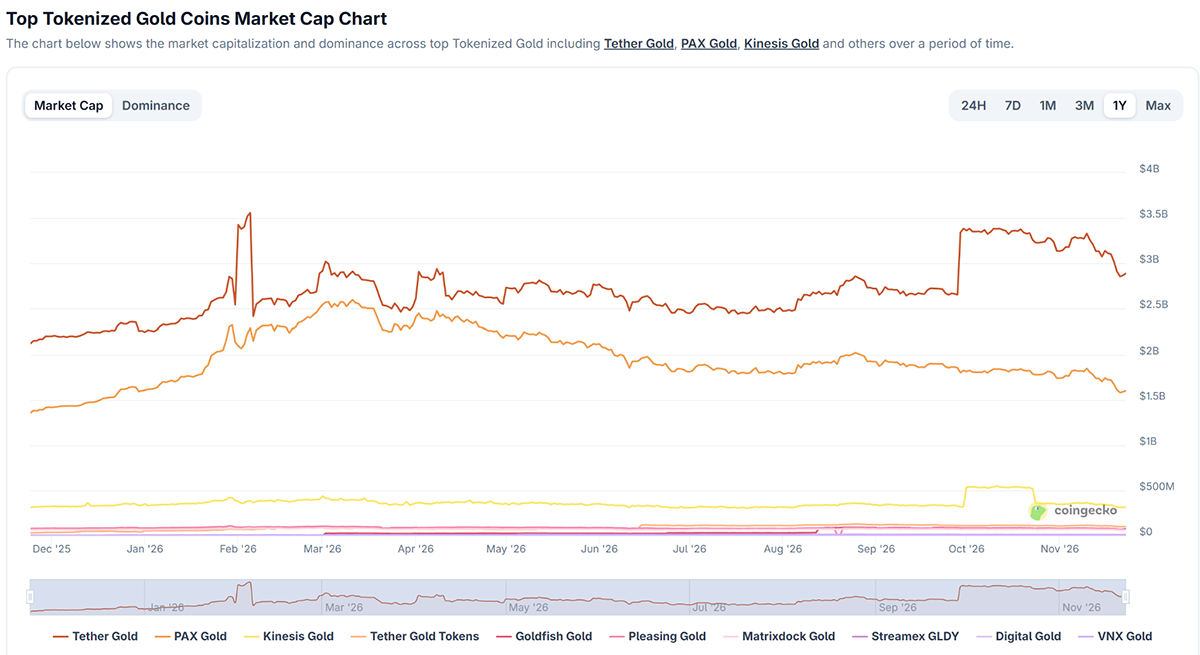
XAUT alone has attracted $1.3bn in net inflows this year, and commodities as a whole have drawn $4.5bn, second only to US Treasuries.
Tokenized RWA Net Inflows by Segment
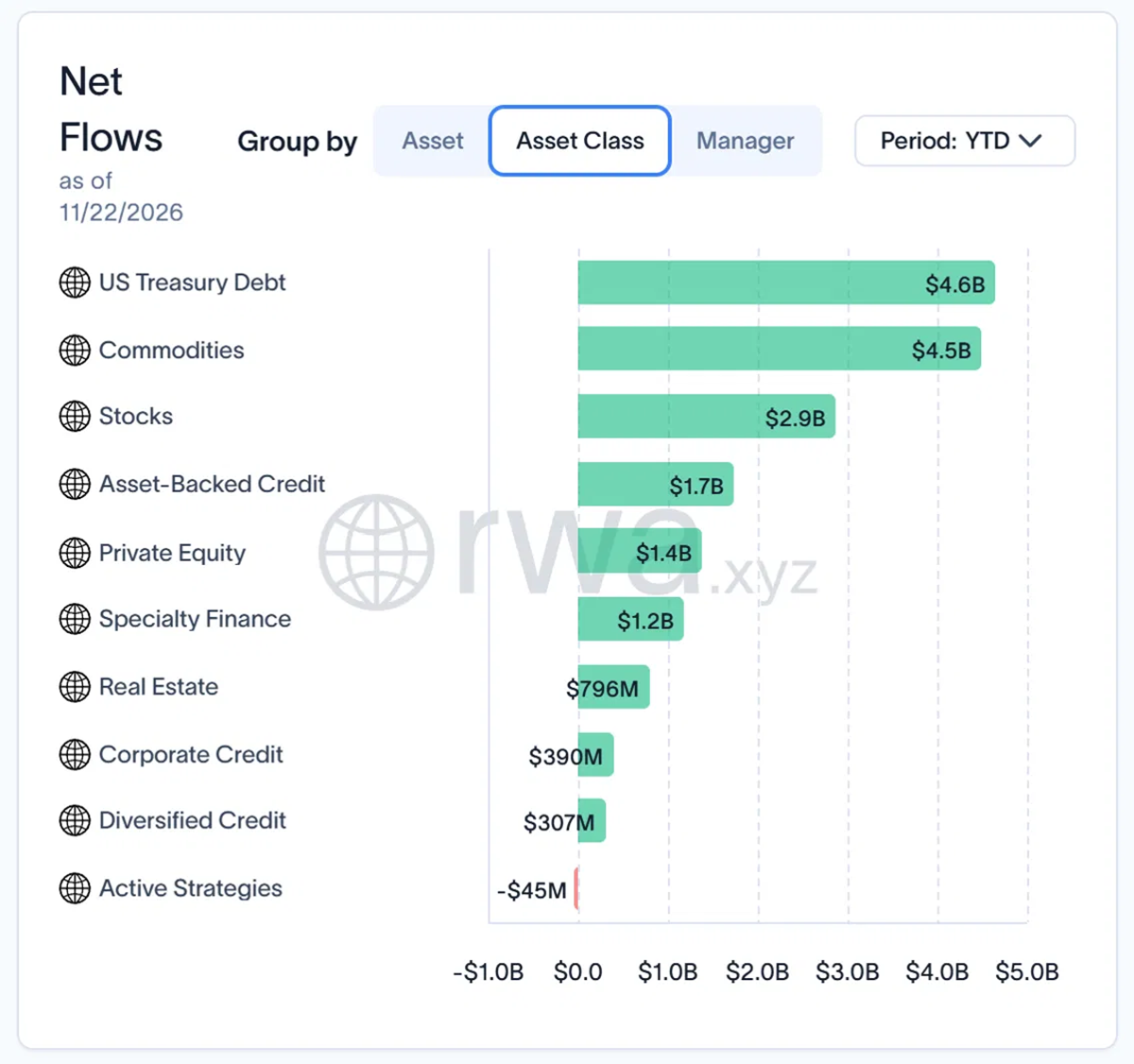
Investors have kept buying gold on-chain even as the metal sold off. This suggests tokenized gold is increasingly being used as a long-term holding rather than a momentum trade. While gold showed resilience, tokenized stocks showed something closer to a breakout.
We covered tokenized gold in more depth a year ago. Read the Token Takeaway here.
Tokenized Stocks
Tokenized stocks have been the standout segment this year. The appeal is simple: a tokenized stock can trade 24/7, settle almost instantly and be held in a wallet anywhere in the world. This removes many of the frictions non-US investors face when buying US equities, such as limited trading hours, currency conversion, and broker restrictions.
On 1 January 2026, tokenized stocks were worth $685m. Today, they stand at $3.38bn, an increase of 393%, or nearly five times where the sector started the year.
Tokenized Stocks Value
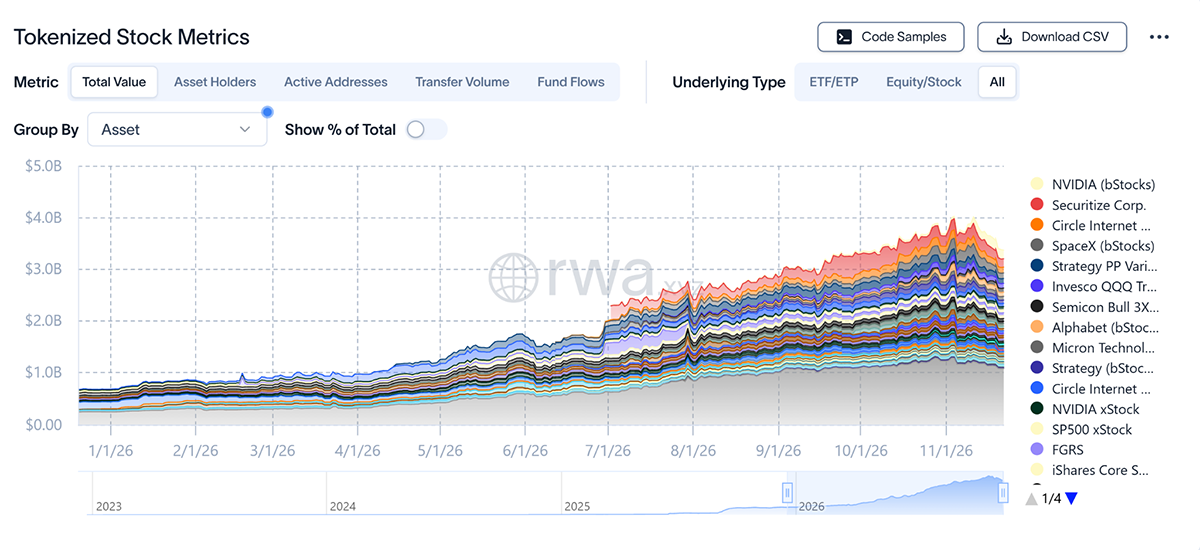
Holders have grown to 4.96m, up 8.35% over the past 30 days, and monthly transfer volume has reached $93.65bn. Value has eased 8% over the past month alongside the broader market sell-off, but the annual trajectory is clear.
Much of this growth has come from crypto exchanges and brokers launching their own tokenized stock products. Aside from Robinhood Chain and bstocks, Kraken's xStocks, which is also available on Bybit and Gate, has become one of the most widely held products. Kraken has since also acquired Backed Finance, the firm that issues them.
Binance's bStocks is now the largest platform, holding 36% of the market at $1.2bn, followed by Ondo at 25% and xStocks at 19%.
Tokenized Stocks Value by Platform
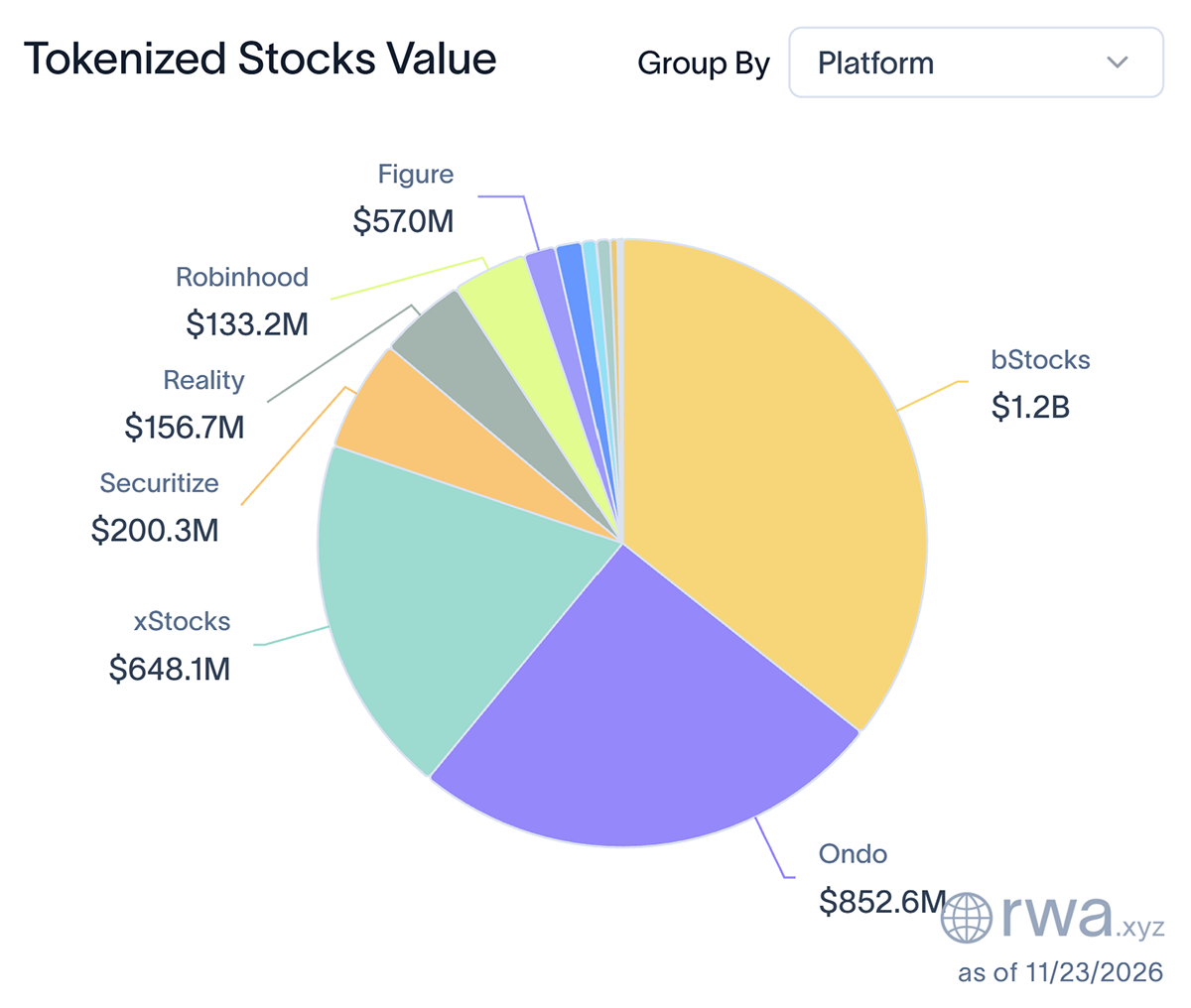
However, these products are not structured identically. For example, Robinhood's Stock Tokens are debt securities that track the performance of the underlying shares but do not give holders legal ownership, voting rights or other shareholder privileges.
While tokenized stocks have been accepted by users, not every company has welcomed the concept. Under the SEC's innovation exemption, which we cover in more depth in the next section, a company is notified when a venue plans to trade a third-party tokenized version of its shares. They then have 30 days to object, and if they do, it bars the venue from trading the stock.
OKXICE, a joint venture between Intercontinental Exchange and OKX that plans to offer round-the-clock trading of tokenized US stocks, had received objections from 50 companies by 30 October, including Nvidia, Costco, Nike, Walmart and Eli Lilly. While the reasoning behind these objections wasn’t clarified, Nasdaq, which also opted its own shares out, said it would not list on a venue lacking real-time best prices or consolidated trade reporting.
Their concerns are understandable. Tokenized stocks trade around the clock while their underlying markets do not, raising legitimate questions about price discovery, price mismatches outside market hours, best execution, and how corporate actions, such as dividends, reach token holders.
However, progress is being made on that last point. On 20 November, Securitize CEO Carlos Domingo announced that the firm had processed its first on-chain dividend for a tokenized Apple stock, sending USDC directly to holders' wallets.
This is still a young market, and this kind of friction is to be expected. While pricing, trading hours, and shareholder rights must be in place, they are solvable problems. The pace of growth this year suggests investors are willing to wait for them to be solved.


