


Seismic Shift and the Energy Crisis

Trades in Soda and Whisky;
The recording skips the Q&A, as I can have a tendency to be too frank. But one question stood out, and there was so much to say about it that I’ll tackle it again.
“Should we be taking more risk off the table? Against a backdrop of rising bond yields, higher energy prices and widening credit spreads, several potentially serious risks concern me. These include AI investment, France, Iran and energy, US politics, financial fragility and concentration, US property, and Food prices”
All of these concern investors, and all have been covered at some point. In my opinion, the greatest risk of all is an oil shock because it affects everything. The world still runs on oil and gas, and there is no getting away from it. Higher oil would boost inflation, send bond yields higher, boost food prices, further disrupt US politics, increase financial fragility, and weigh on US property via widening credit spreads and higher yields, which would also increase the financing costs of AI. The only thing it might not do is increase market concentration, which is another matter.
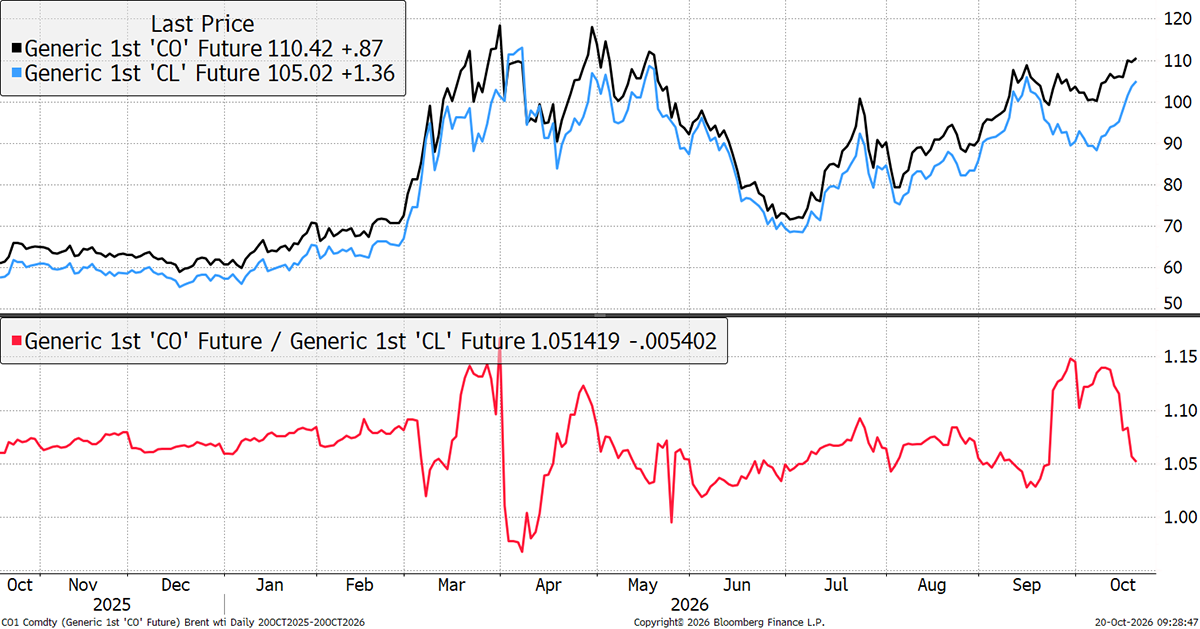
An oil shock seems more likely than not as crude approaches all-time highs again. More importantly, and especially for US politics, the US WTI oil price (blue) is catching up with Brent (black). The spread is narrowing again, meaning that the world’s problem is also a US problem. I sense that Trump’s tweets will no longer keep a lid on the price.
Crude Oil Price - US vs World
Market concentration is another story. The world’s largest companies have been the biggest beneficiaries of the growth of index funds. These amount to $24 trillion. To put that in perspective, the World Index is worth $90.5 trillion, of which the top 100 companies represent $41 trillion, or 43% of the total (red).
Largest Global 100 Companies vs World and Share of Market Cap
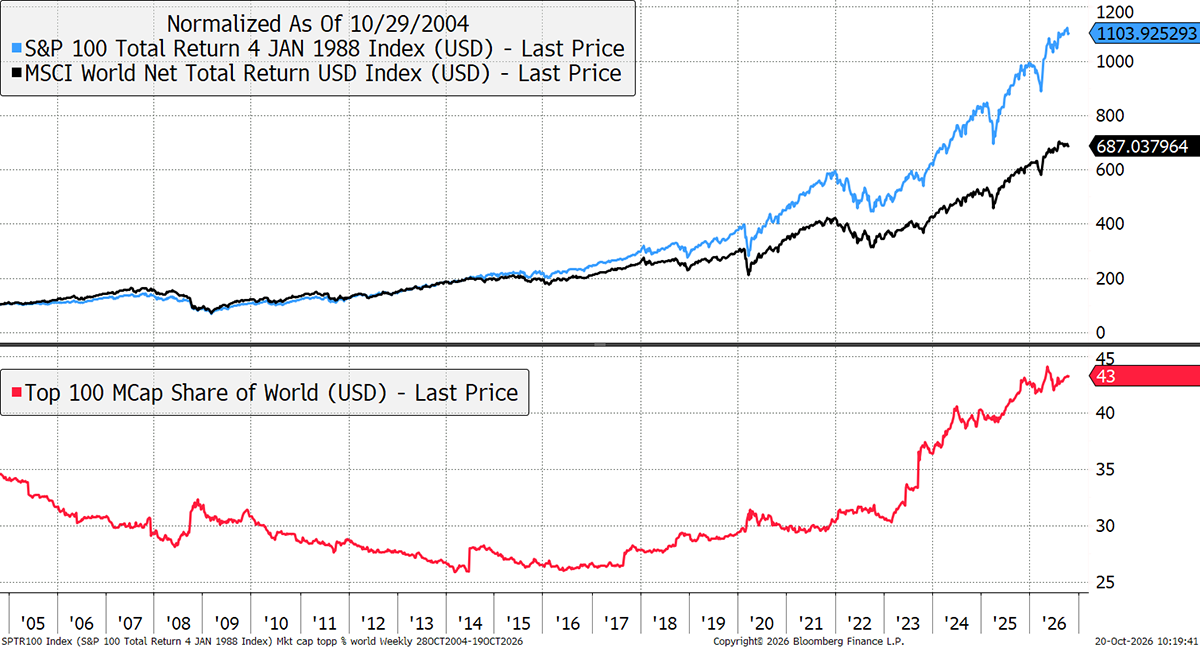
The largest stocks have beaten the world by 2.5% per year, with most of that since 2014. It isn’t vast, but the concentration, at 43%, most certainly is. This level of concentration is very rare and only seen at major market peaks.
As the index funds receive money, they put more into the largest stocks, and crucially, they never sell while they are growing. The active managers tend to focus on the other stocks and both buy and sell. That is the difference, and the tsunami of money flowing into index funds has become alarming.
Rotation is the other story. When the largest stocks are finally sold, which one day is inevitable as everything is cyclical, the real opportunity kicks in. We will have a great rotation, just as we did in 1975, 2003, and 2009. That is when this situation will finally reverse, not just for a few months, but for a few decades. I can’t wait because there will be so much to do. Unloved good companies, trading at low valuations, are the best possible opportunities for outsized returns.
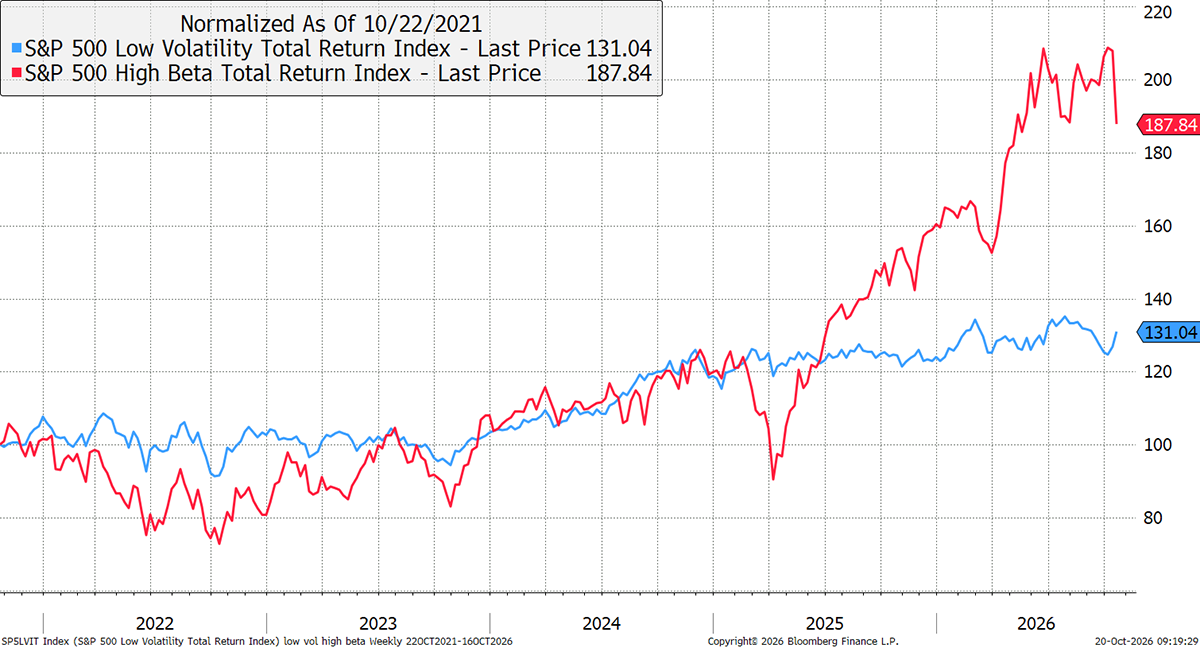
The great rotation may have begun. That is not to say the largest stocks are throwing in the towel, but the most speculative stocks have read my opening paragraph, i.e. that there is plenty to worry about. The volatile stocks sold off hard last week, and the beneficiaries were the quality stocks. The quality move may look modest, but as investors seek sanctuary, it can keep on going.
Risky vs Calm Stocks
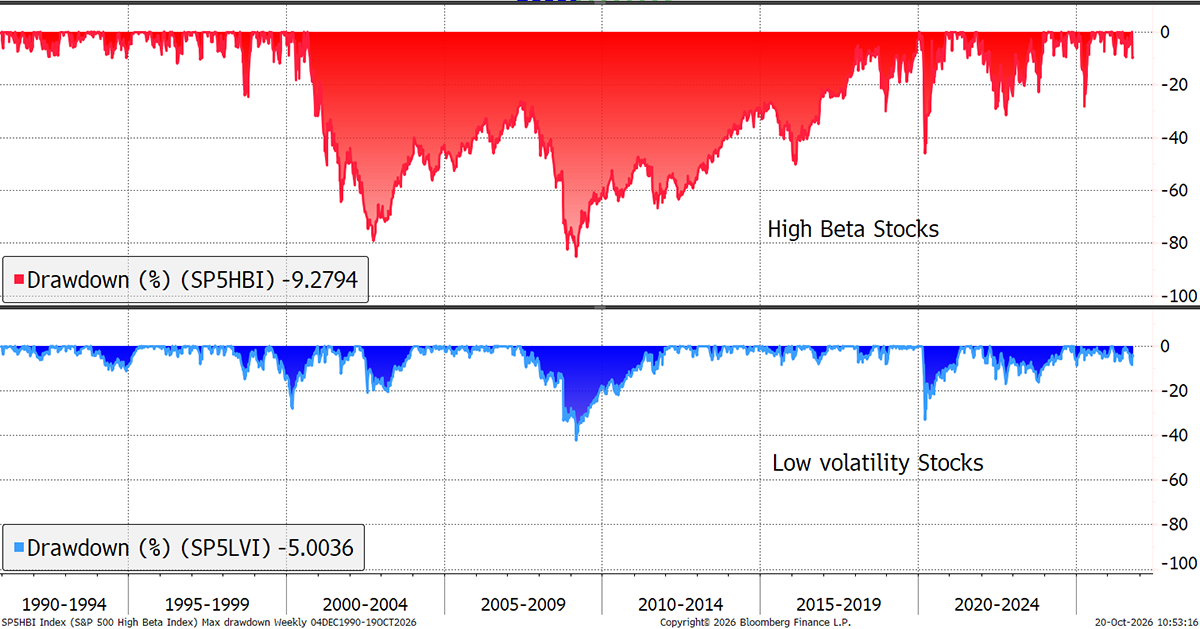
In 35 years of data, the calm stocks have had modest pullbacks, rarely over 20%, which was less than the market at the time. In contrast, the volatile stocks have fallen by 80% twice, with +20% drawdowns being quite common. It’s coming again, and this is why I won’t own these stocks. Of course, once they have blown, the risky stocks will be very interesting again.
Risky vs Calm Stocks – Maximum Drawdowns
Many stocks, sectors, and national stockmarkets, have lagged behind. This includes quality stocks, which are undervalued and should prove to be resilient in the next downturn. But the rotational process can take time. I think it has probably begun, but as long as the equity index funds keep growing, this distortion could continue.
General - Your capital is at risk when you invest, never risk more than you can afford to lose. Past performance and forecasts are not reliable indicators of future results. Bid/offer spreads, commissions, fees and other charges can reduce returns from investments. There is no guarantee dividends will be paid. Overseas shares - Some recommendations may be denominated in a currency other than sterling. The return from these may increase or decrease as a result of currency fluctuations. Any dividends will be taxed at source in the country of issue.
Funds - Fund performance relies on the performance of the underlying investments, and there is counterparty default risk which could result in a loss not represented by the underlying investment. Exchange Traded Funds (ETFs) with derivative exposure (leveraged or inverted ETFs) are highly speculative and are not suitable for risk-averse investors.
Bonds - Investing in bonds carries interest rate risk. A bondholder has committed to receiving a fixed rate of return for a fixed period. If the market interest rate rises from the date of the bond's purchase, the bond's price will fall. There is also the risk that the bond issuer could default on their obligations to pay interest as scheduled, or to repay capital at the maturity of the bond.
Taxation - Profits from investments, and any profits from converting cryptocurrency back into fiat currency is subject to capital gains tax. Tax treatment depends on individual circumstances and may be subject to change.
Investment Director: Charlie Morris. Editors or contributors may have an interest in recommendations. Information and opinions expressed do not necessarily reflect the views of other editors/contributors of ByteTree Group Ltd. ByteTree Asset Management (FRN 933150) is an Appointed Representative of Strata Global Ltd (FRN 563834), which is regulated by the Financial Conduct Authority.
© 2026 ByteTree Group Ltd


