


Where's Goldilocks?

Trade in Soda;
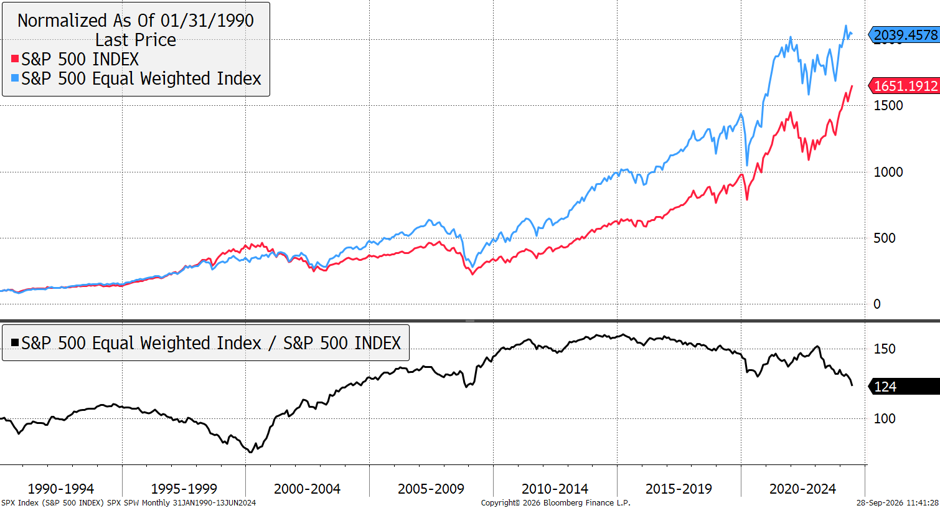
With bond yields rising and global energy under pressure, market breadth continues to deteriorate. That is a measure of market participation. It asks whether the market is driven by the many or the few. Peak breadth occurred in 2014, a time when the average stock in the S&P 500 did better than the largest stocks, but it has been falling ever since.
Market Breadth Falls as Average Stock Falls Behind
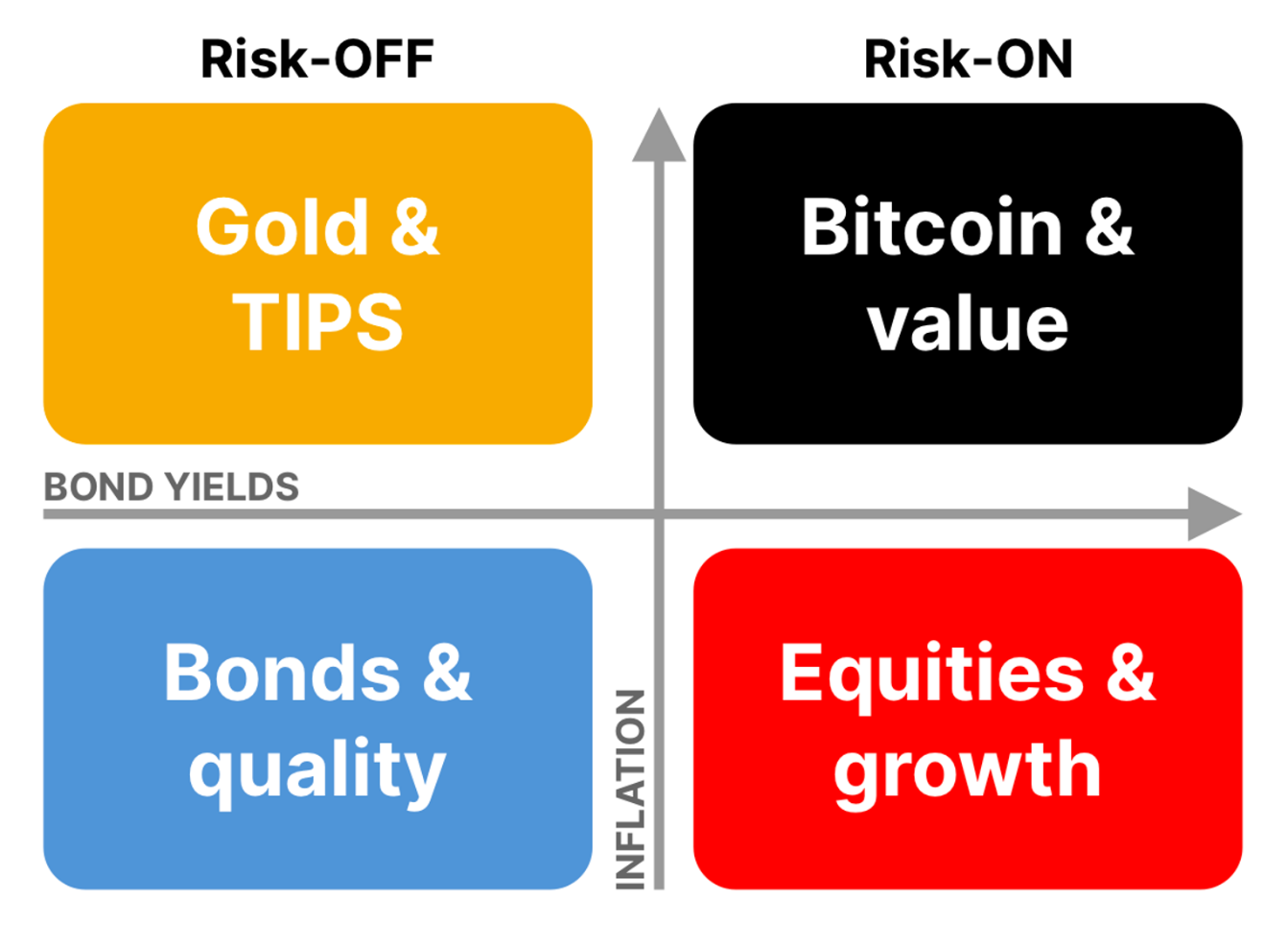
A quick refresher of the Money Map. With bond yields rising, we are on the right-hand side. Inflation is rising slightly but not by much, as the energy crisis is not as bad as might be expected. That means we are hovering between the red and black boxes. Recently we have seen strength in financials, commodities and bitcoin, which support the black box, but also the high growth stocks which support the red box. Gold may have bottomed, but is yet to blossom, while quality, real estate and bonds lag.
The Money Map
Most companies are rate sensitive. That is, all companies delivering goods and services that do not grow very quickly generally dislike a rising bond yield. If they are in debt as well, they like rising bond yields even less. This describes, very simply, why a rising yield coincides with weak market breadth. Only the true growth stocks can shake off the pressures of rising yields.
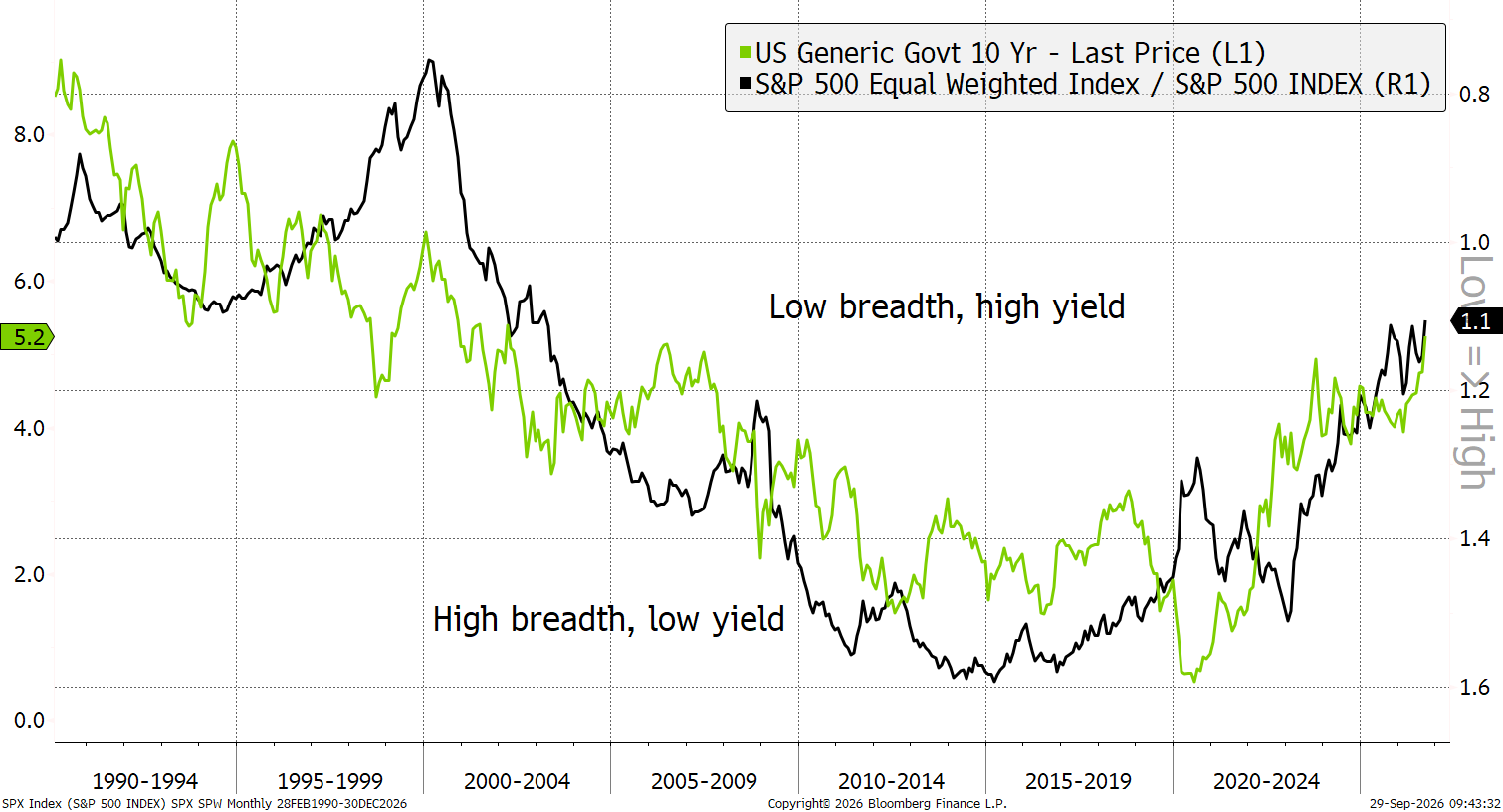
If the US government is offering a 5.2% yield on Treasuries for the next 10 years, many investors will take that opportunity, rather than facing the uncertainties of the stock market. That takes capital away from stocks, which puts them under pressure. It makes sense that tech outperforms when bond yields rise – provided their growth is strong enough.
As rates rise, low-growth companies are priced as if they were bonds, and so as bond yields rise, their share prices fall. All else equal, the higher the growth rate of a company, the less sensitive its share price is to the bond market.
I can illustrate that using the black line from the first chart, inverting it, and showing it alongside bond yields (green). Bond yields were high in 2000, which was also a buoyant period for growth stocks. As bond yields fell in the 2000s and 2010s, breadth exploded, with the S&P equal weight index comfortably beating the S&P 500.
Stockmarket Breadth vs Bond Yields
So just pile into growth stocks and all will be well?
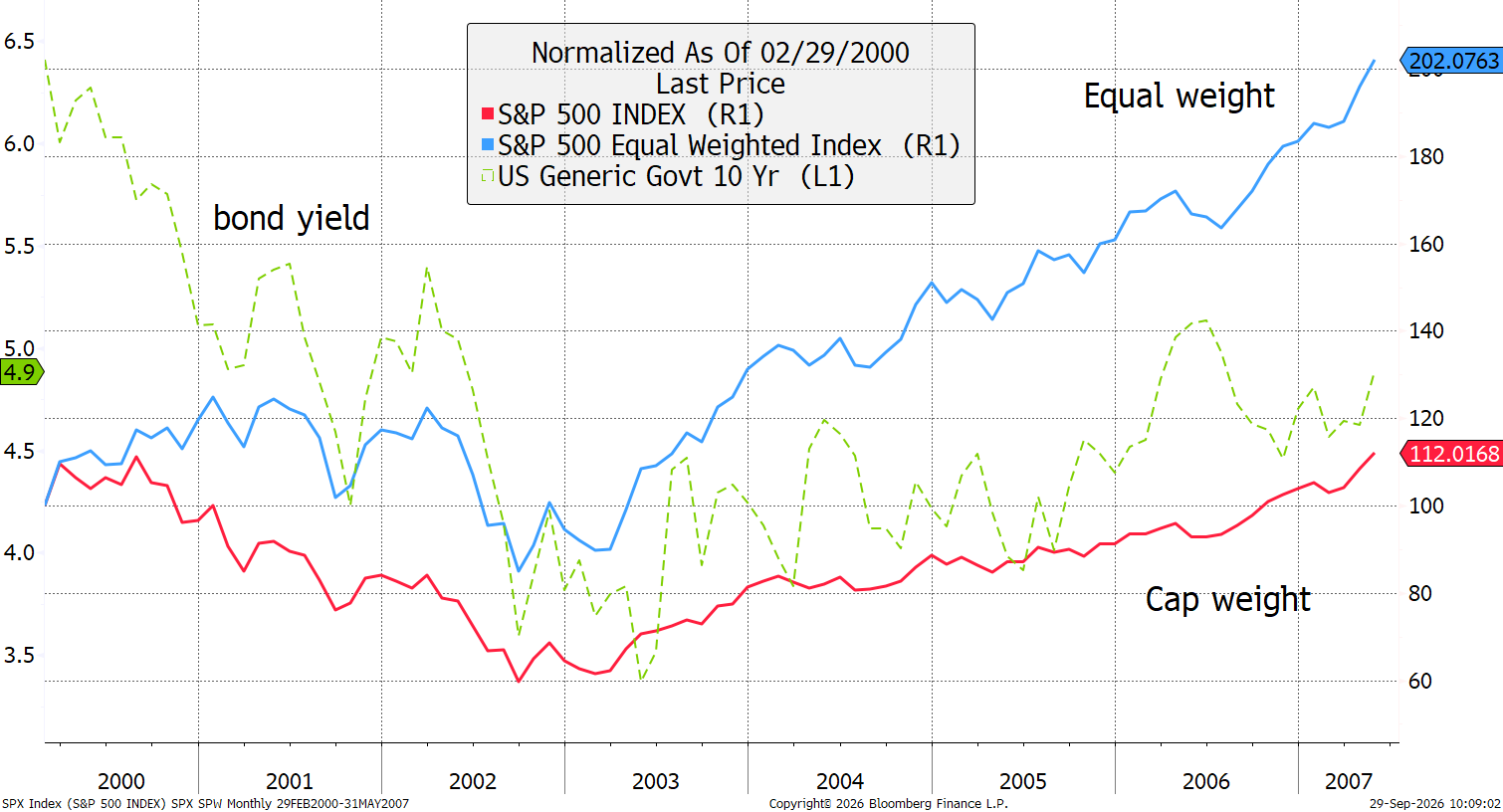
Except that in 2000, when bond yields peaked, the equal weight index did rather well, while the growth-heavy S&P 500 suffered, and the Nasdaq tech index did even worse. A portfolio of 500 stocks, with 0.2% in each stock, fared much better than a concentrated growth portfolio when the tide turned. By 2003, the bond yield had plummeted from 6.5% to 3.5%. The average company, with little growth to shout about, loved it, while the growth darlings slumped.
Breadth Wins When Yields Fall
High breadth is the norm in developed markets because surges in bond yields are the exception, rather than the rule. It is also why academics believe small caps should beat large caps in the long run in a phenomenon known as the size effect. We’ve been patiently waiting for small caps to move, despite offering good value. But I doubt it will happen until bond yields turn.
In financial markets, low interest rates with low inflation are known as a Goldilocks environment. The porridge is not too hot, and not too cold, but just right. Well-governed countries spend much more time with Goldilocks than crisis-prone emerging economies. You see it in places like Brazil and Turkey. Whenever the macroeconomic environment looks stable and promising, the markets soar. Having Goldilocks around is the prize of a well-managed economy.
Checking in on real yields, the 30-year is up to 3.3% in a recent surge. If inflation expectations were a concern, this would have remained flat, as the rising inflation would have absorbed the rising yield. They didn’t, and so real yields have soared, nearly to the levels of 26 years ago.
High real yields negatively impact gold and TIPS, and we hold some of each. Our exposure is not high by last year’s standards, when it was eye-popping at one point. The interesting thing about the current gold cycle is how gold has been shrugging off the rising real yields, especially in 2022. We have become used to gold surging when real rates fall and stumbling when they rise.
Gold vs Real Yields
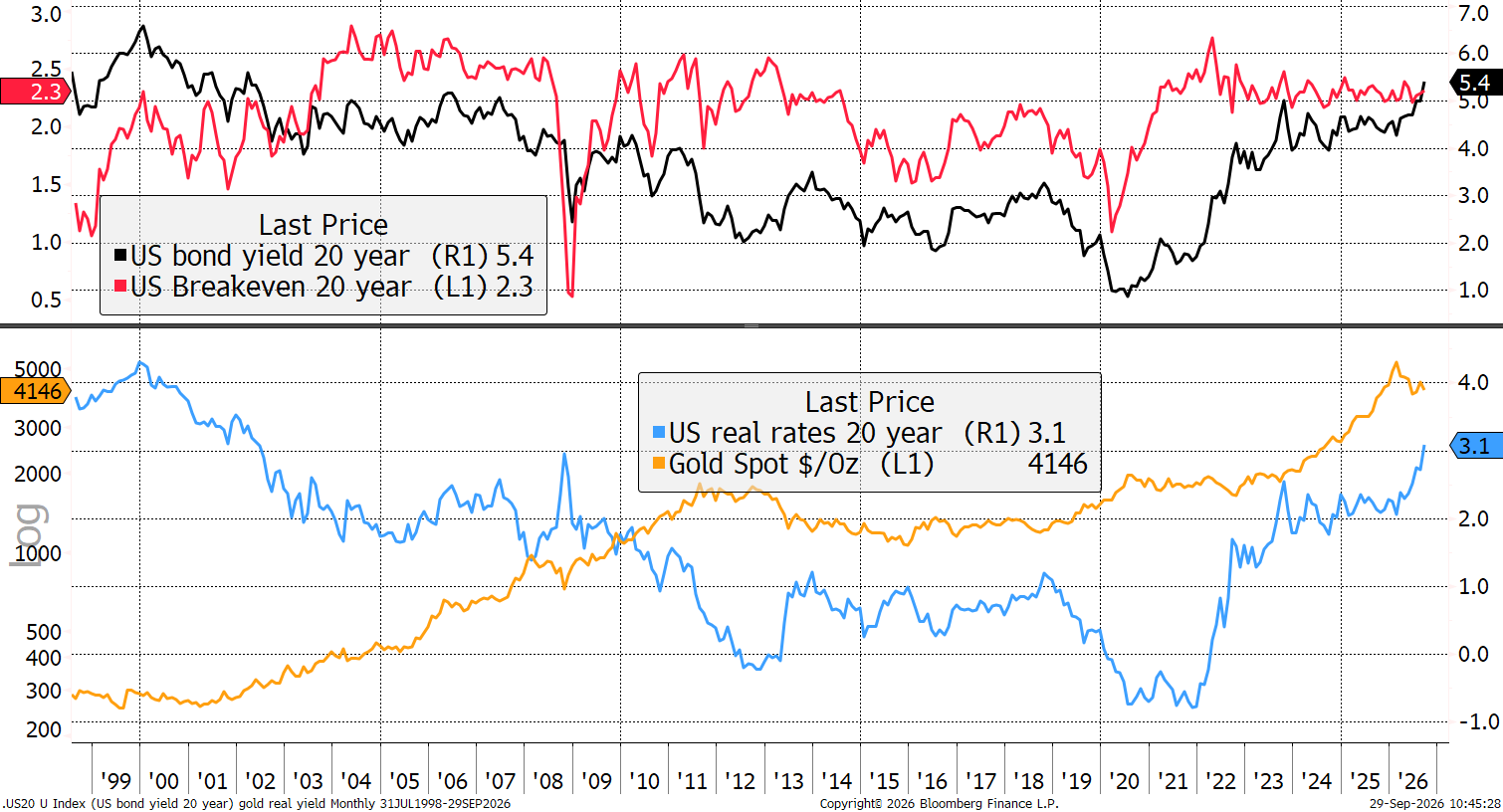
It is important to remember this relationship because real rates are rising strongly, and yesterday saw gold break. If real yields keep moving higher, it makes bonds ever more attractive in comparison. If, on the other hand, the real yield starts to fall, as it did in 2000, then the gold bull market will likely get back on track.
It is not just gold. Real estate, quality stocks, consumer stocks, small caps, and emerging markets are all feeling the pinch from this surge in bond yields, and more importantly, real yields. I’ll come back to that.
More importantly, we are going through one of those times when there is high confidence in equities and low confidence in bonds. This chart is worth taking time to absorb because many would be surprised. Between 1973 and the last moment in 2014 of high breadth I mentioned earlier, bonds and equities had delivered the same return after dividends. They touched one last time in 2020.
Equities vs Bonds
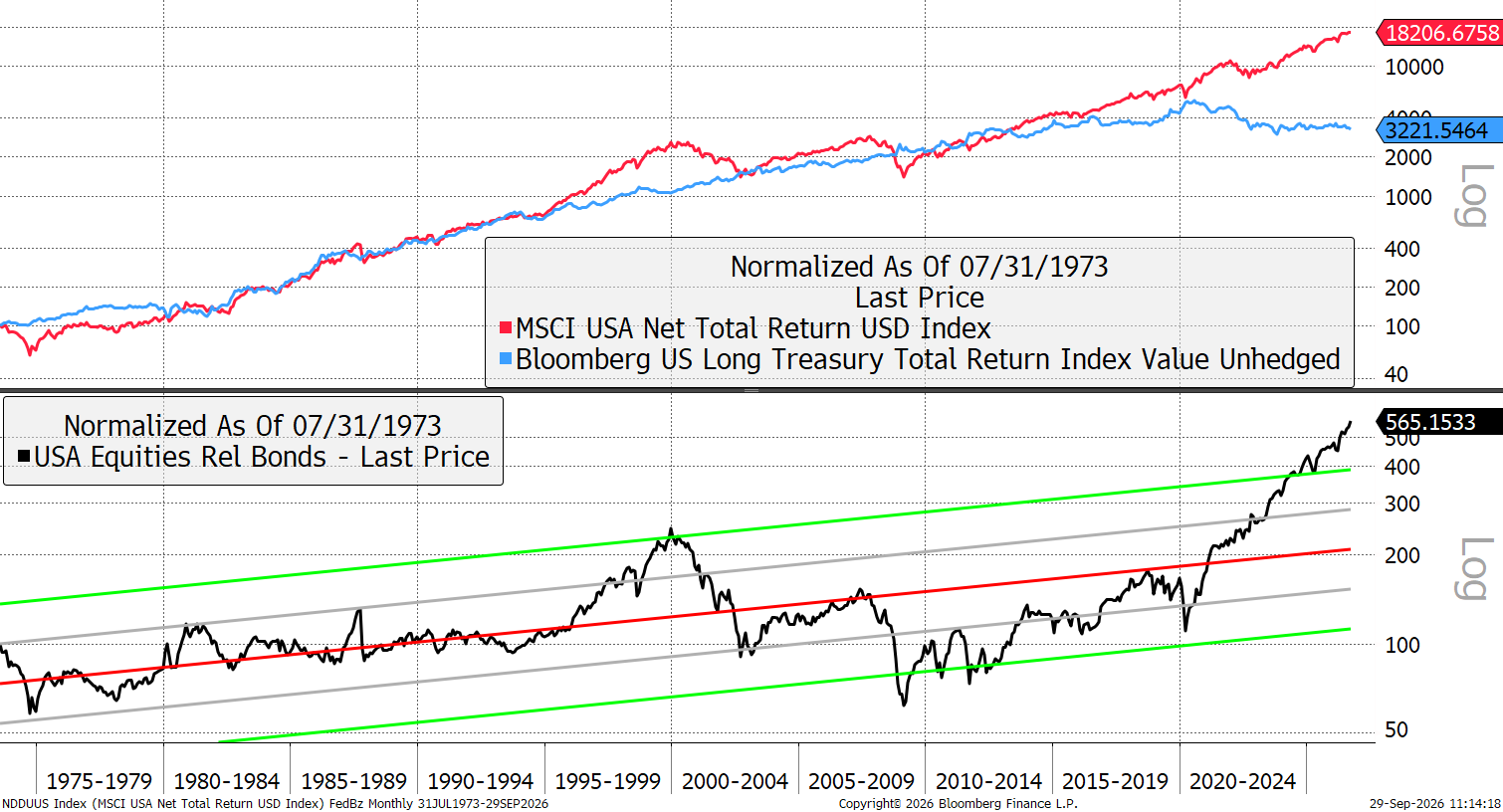
Looking at the chart above, the black line shows equities vs bonds since 1973. Equities were overcooked in 2000, and even more so today. 1987, which saw a stockmarket crash, was only slightly overdone. Stocks were oversold in 2003, 2009 and 2020. The current reading is literally off the charts.
Having fallen from 15% to near zero in 2020, bonds ran out of yield, after which there was no hope of a decent return. But that has now changed, as the 30-year pays 5.5%, which is a highly respectable number. The biggest issue for investors is: how much is enough?
Sooner or later, the bond yield will peak, and when it reverses, we will see growth stocks come under pressure, and money return to real estate, quality stocks, consumer stocks, small caps, and emerging markets. But until yields peak, these areas will remain under pressure.
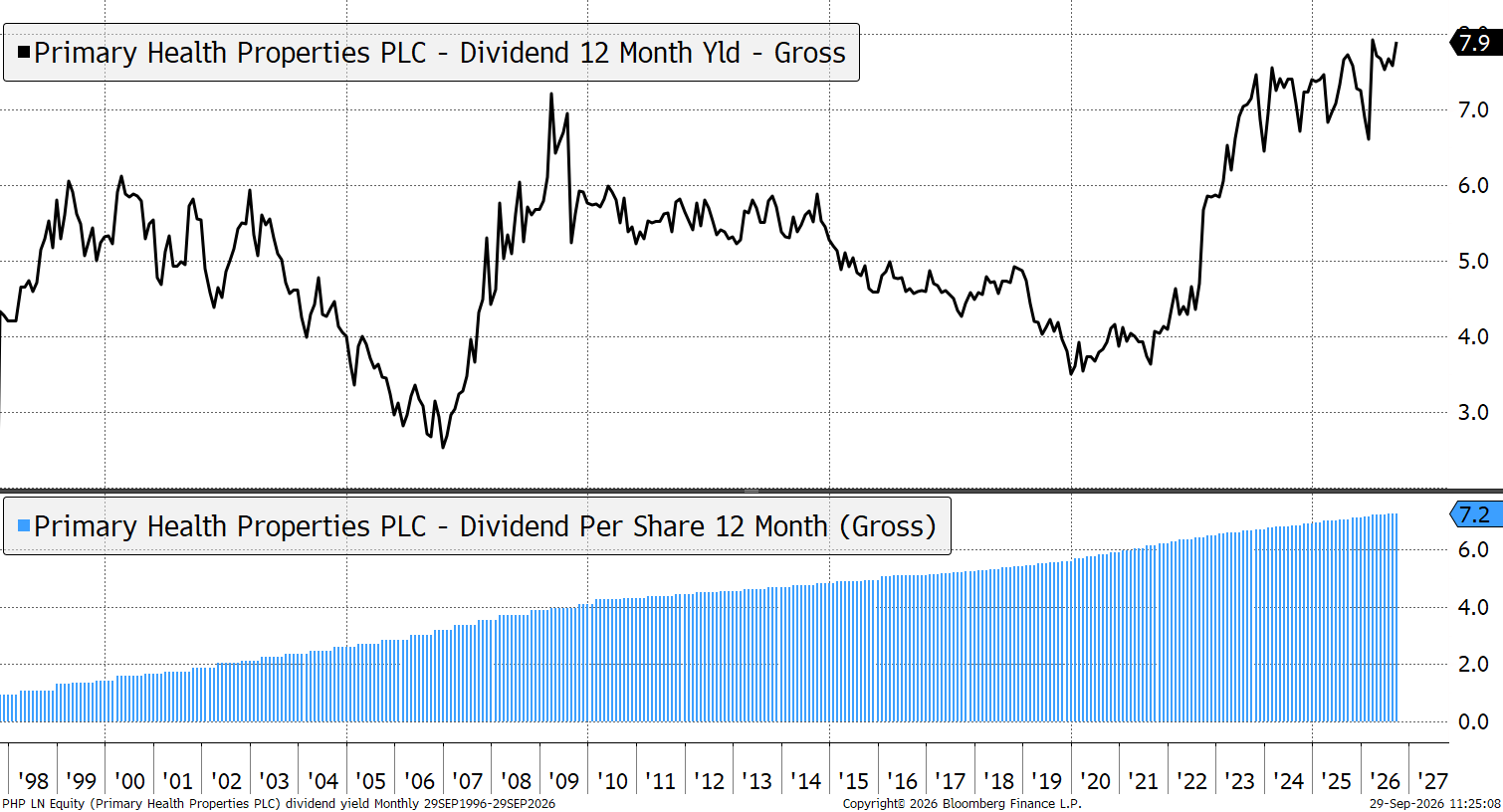
Being under pressure hurts today, but will end up being a good thing. For example, we owned Primary Health Properties (PHP) for a period, when I was taking advantage of the company being oversold. The rally never lasted, so I exited, but as the price falls and the rents rise, the yield gets even better. When rates turn, it will be a fabulous time for the value investor, and there will be many opportunities like this, and some even better.
Falling Price with Rising Rents
The trouble is that we are not there yet. The US economy is growing quickly, too quickly perhaps, and yields are unlikely to fall until the economy cools. Trump likes things red hot, so that may take time. Since high growth coincides with higher yields, Treasury Secretary Scott Bessent wants to cap yields because the debt interest bill is running out of control.
Some believe the interest bill will lead to a debt crisis, others disagree, but the real risk is that when the economy cools and the wars end, bond yields stay high. That is the scenario which keeps me up at night. Could it be that the large supply of government bonds means that yields stay high, lowering growth? It seems unlikely, but it’s the caveat to my scenario.
The more likely outcome is that excitement over AI fades, and growth comes down with it. That punctures bond yields, and the stock market rotates. It probably falls as well, because the big stocks have so much to give back, but market breadth improves just like it did in the 2000 to 2003 bear market. Value won’t need to slump.
As I said, we are not there yet, and until we are, I will assume that the pressure on low-growth assets remains until the tide turns.
General - Your capital is at risk when you invest, never risk more than you can afford to lose. Past performance and forecasts are not reliable indicators of future results. Bid/offer spreads, commissions, fees and other charges can reduce returns from investments. There is no guarantee dividends will be paid. Overseas shares - Some recommendations may be denominated in a currency other than sterling. The return from these may increase or decrease as a result of currency fluctuations. Any dividends will be taxed at source in the country of issue.
Funds - Fund performance relies on the performance of the underlying investments, and there is counterparty default risk which could result in a loss not represented by the underlying investment. Exchange Traded Funds (ETFs) with derivative exposure (leveraged or inverted ETFs) are highly speculative and are not suitable for risk-averse investors.
Bonds - Investing in bonds carries interest rate risk. A bondholder has committed to receiving a fixed rate of return for a fixed period. If the market interest rate rises from the date of the bond's purchase, the bond's price will fall. There is also the risk that the bond issuer could default on their obligations to pay interest as scheduled, or to repay capital at the maturity of the bond.
Taxation - Profits from investments, and any profits from converting cryptocurrency back into fiat currency is subject to capital gains tax. Tax treatment depends on individual circumstances and may be subject to change.
Investment Director: Charlie Morris. Editors or contributors may have an interest in recommendations. Information and opinions expressed do not necessarily reflect the views of other editors/contributors of ByteTree Group Ltd. ByteTree Asset Management (FRN 933150) is an Appointed Representative of Strata Global Ltd (FRN 563834), which is regulated by the Financial Conduct Authority.
© 2026 ByteTree Group Ltd


