


Supply Shock Drives Commodities

Commodities are not the greatest long-term investment. Since 1970, a diversified commodity basket in cumulative terms has done less well (8.6% p.a.) than global equities (9.5% p.a.). Still, that’s comfortably higher than consumer price inflation (3.9%) over the period.
Commodities versus the World Index
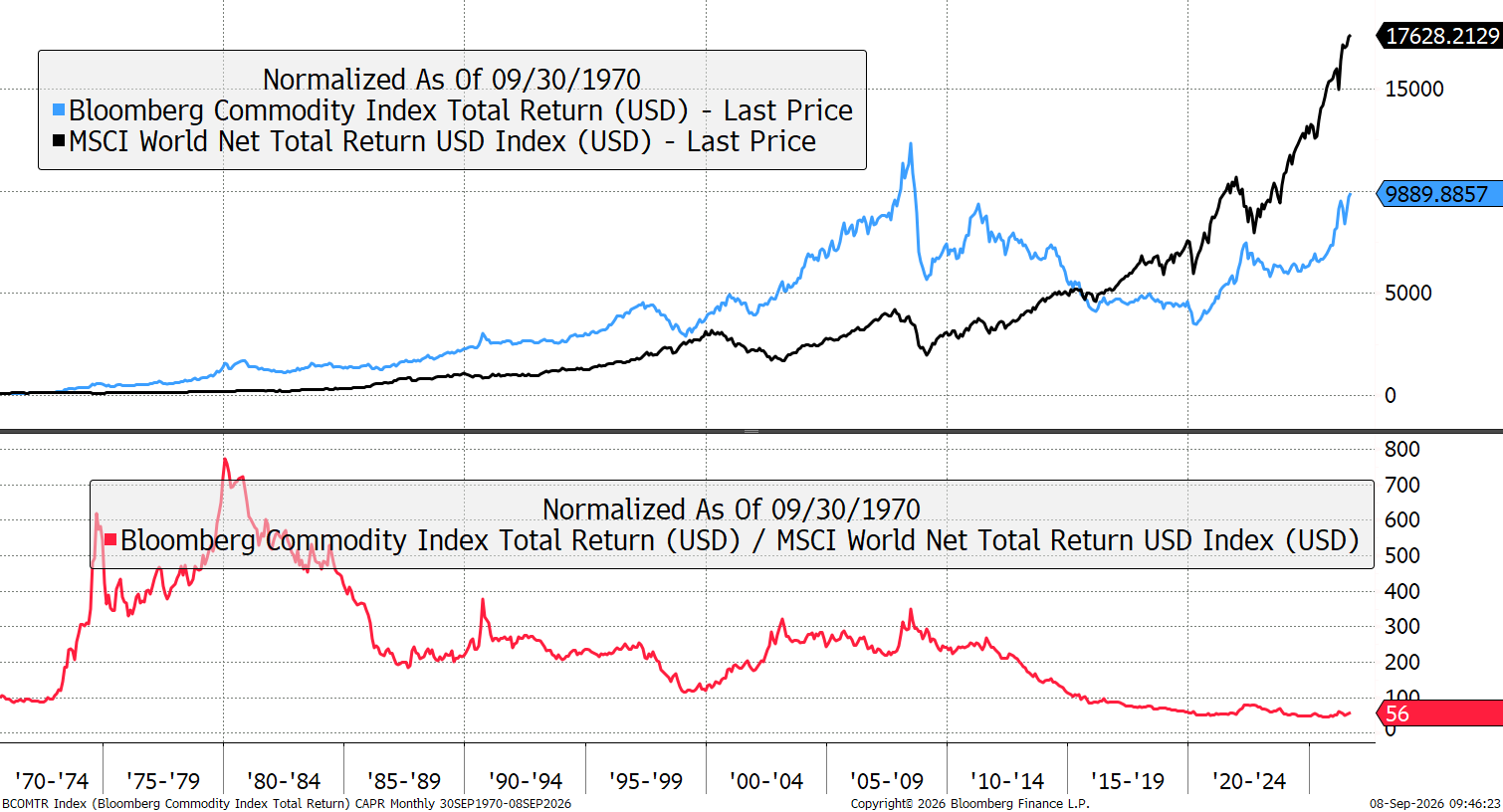
Yet there were times when commodities mattered. In the 1970s, there were supply shocks combined with powerful unions in the West. Strikes became frequent, destroying both their employers and the economic power of the manufacturing heartlands. The result was high inflation.
Then commodities soared on the back of China’s growth in the 2000s. This time wasn’t a supply shock but a surge in demand. Global growth had never had it so good, as economic growth spread far and wide, causing global poverty levels to collapse.
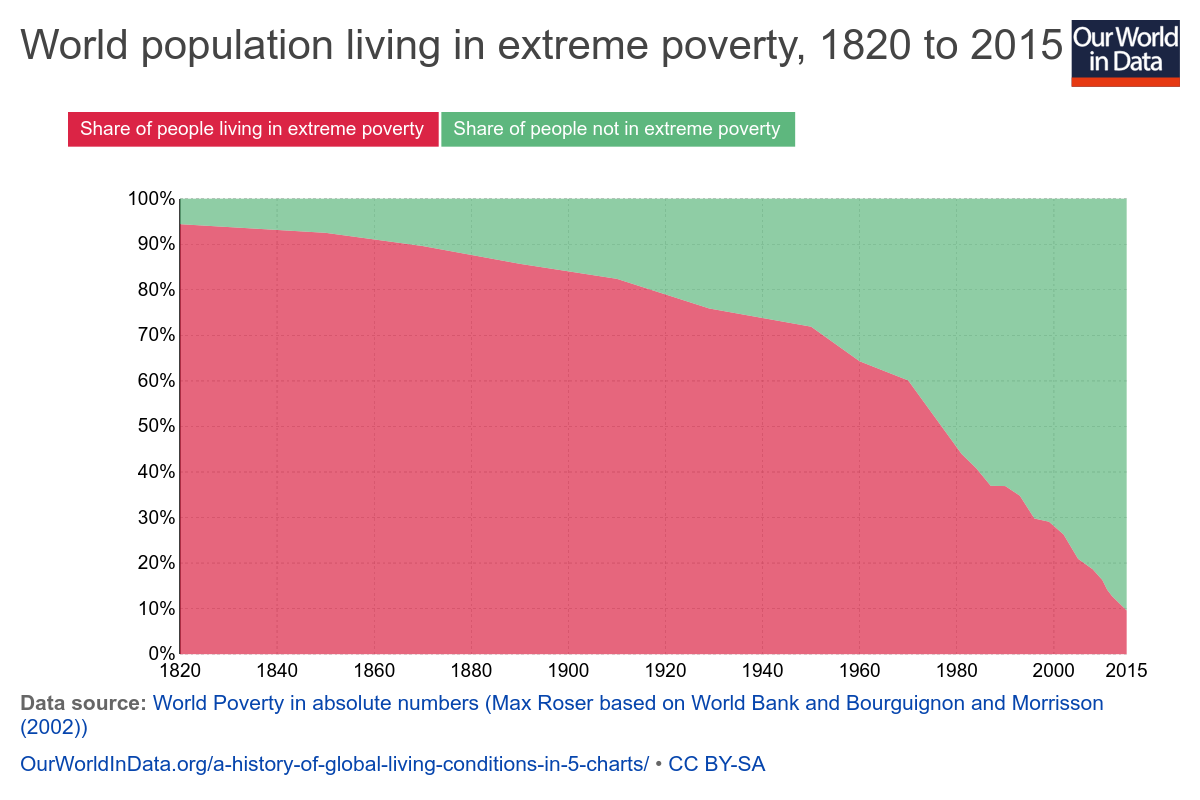
It is only since the 2008 financial crisis that commodity prices have been so subdued for so long. Since January 2011, the commodities index is up just 14% while equities have risen 417%. Yet shift the starting point to the bottom of the pandemic in 2020, and equity and commodity returns are approximately the same.
This time there is no global growth splurge, at least outside of data centres, but there have been supply constraints starting with the Ever Given debacle in 2021, which blocked the Suez Canal.
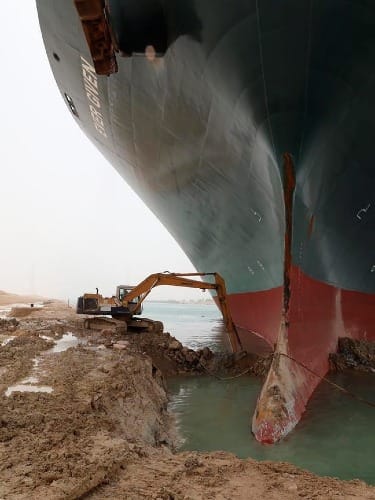
It seemed funny at the time, but was a serious problem. Move forward to today, and there are other supply pressures building from unrelated sources.
Houthi Rebels
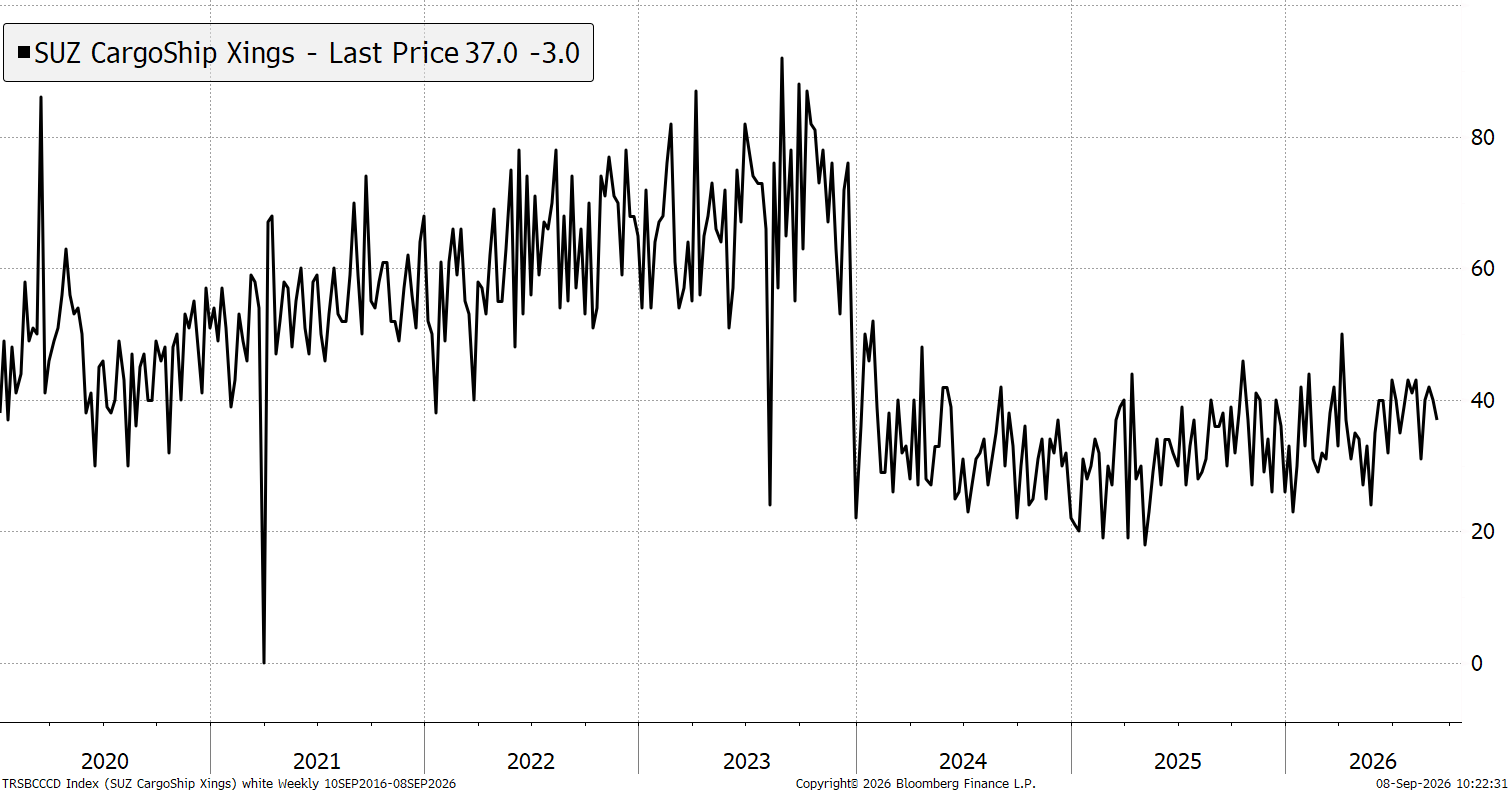
Vessels passing through the Suez Canal were delayed in 2023 as a result of the Ever Given blockage but soon recovered. But since late 2023, sea traffic through Suez has fallen again as Yemen’s Houthi rebels began attacking commercial ships in the Red Sea and Bab el-Mandeb Strait. They framed the attacks as solidarity with the Palestinians.
Suez Canal Traffic
Straits of Hormuz
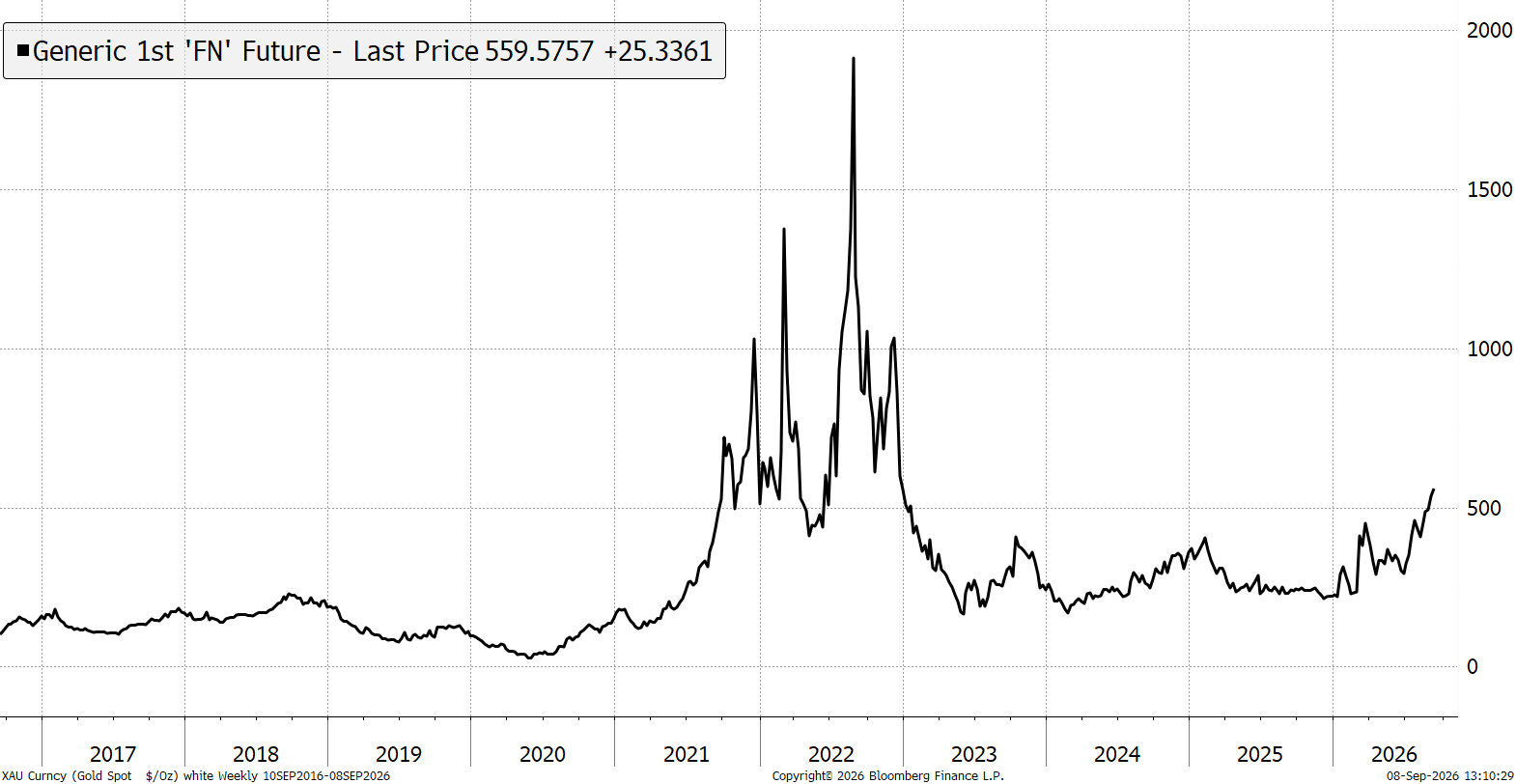
We’ve discussed the Straits of Hormuz several times in recent months, and the situation looks hopeless. I believe the collapse in LNG exports from Qatar is a major driver behind the surge in North Sea natural gas prices, which I discussed last week. There is also disruption to fertilisers, sulphur, ethanol, aluminium and polymers, and it is all starting to bite. Recall that North Sea Gas drives the price of UK electricity.
North Sea Gas
Ukraine
Ukraine has broadened its Russian offensive deep into enemy territory. Their main target has been economic, focused on oil refining, transportation terminals, and shipping. This began in 2024 and intensified last year with some innovative attacks that were a long way from home. This has led to higher domestic fuel prices in Russia and queues at petrol stations, which must remind them of the good ‘ol days of the USSR.
Officially, Russia doesn’t seem to supply anyone, especially with the elevated sanctions. But in practice, they seem to supply more than they should. Then we have the boy.
El Niño
El Niño comes from Peruvian fisherman who noticed unusually warm coastal waters. It translates from Spanish “the boy”. According to Grok, it is the warm phase of the El Niño-Southern-Oscillation (ENSO).
In normal conditions, easterly trade winds blow warm surface water towards Australasia. This allows nutrient-rich cold water from the Antarctic to move along the South American coast. During El Niño conditions, the trade winds weaken or reverse. Warm water moves eastwards, hitting South America and moving major weather systems eastwards.
It comes around every 2 to 7 years and lasts for a year or so during the Northern Hemisphere winter. Sometimes it is mild, and sometimes it is major. In the past, it has had a positive impact on food prices but tends not to do much alone. It is when it has been combined with other factors that the largest impact has been felt. And that is why we should take note, as a major event is forecast for this winter. Deutsche Bank say:
“Current forecasts point to one of the strongest El Nino events on record in Q4. That matters because El Niño events can act as a multi-dimensional supply shock, with a causal link to higher food and energy prices, alongside broader supply-chain disruption. This would be problematic at any point in time, but it’s a particular issue today because of existing supply-chain stresses and the backdrop of above-target inflation.”
Past Strong El Niño Events
- 2023-4: 2024 was a regular El Niño, and still the warmest year on record. The Panama Canal had its 3rd driest year on record in 2023, meaning that authorities had to cut shipping passing through.
- 2015-16: A very strong event, which saw the biggest upward global temperature anomaly to date.
- 1997-8: The “El Niño of the century” caused floods in Peru and East Africa, droughts and fires in Indonesia, and widespread coral bleaching. Peru saw 16x its average rainfall.
- 1982-3: Heavy droughts and fires. Storms and heavy rain in California. This led to the creation of the modern ENSO monitoring system.
- 1972-3: Contributing factor in the 1973 oil shock and global food price spike.
- 1877-1878 is frequently ranked as the strongest event of the last 150 years. It is linked to famines in India and China and the Grand Seca (drought) in Brazil.
The 2026–27 event now underway is forecast as very strong and possibly historic. Its full impacts will not be known until after it peaks, somewhere between November and February. But it comes on top of the aforementioned supply shocks, and others as well.
For example, the water levels in the Panama Canal are once again low, and according to the FT, Global Shipping Rules are Collapsing:
“The shipping industry has for decades been protected by laws that ensure free navigation and the neutrality of commercial vessels, but the collapse of those principles is posing a severe risk to global trade, according to a group of 18 shipping superpowers.”
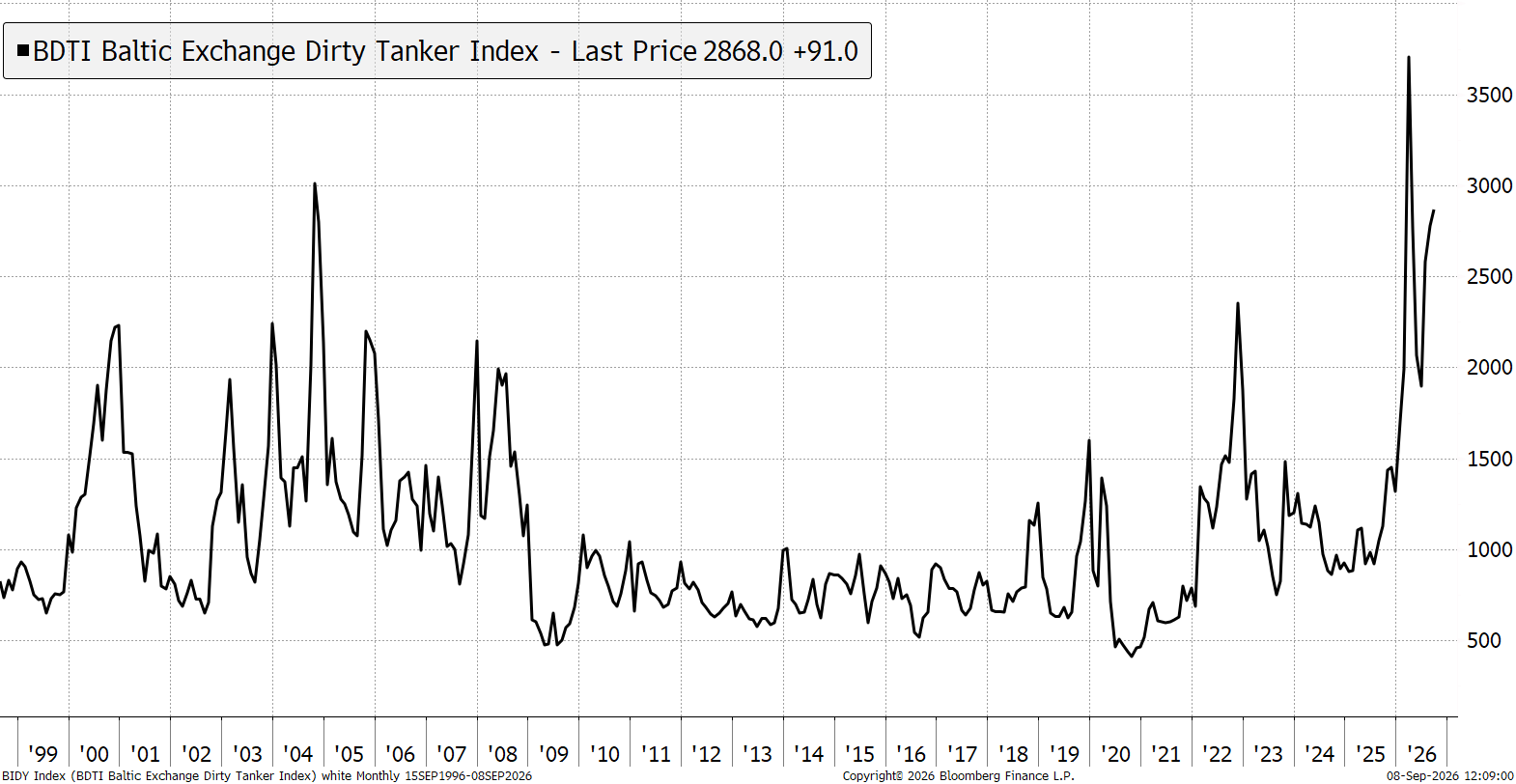
Put it all together, and shipping rates are going through the roof. I show the Dirty Tanker Index for fuel oil, which has been heavily impacted by the Iran War.
Baltic Dirty Tanker Index
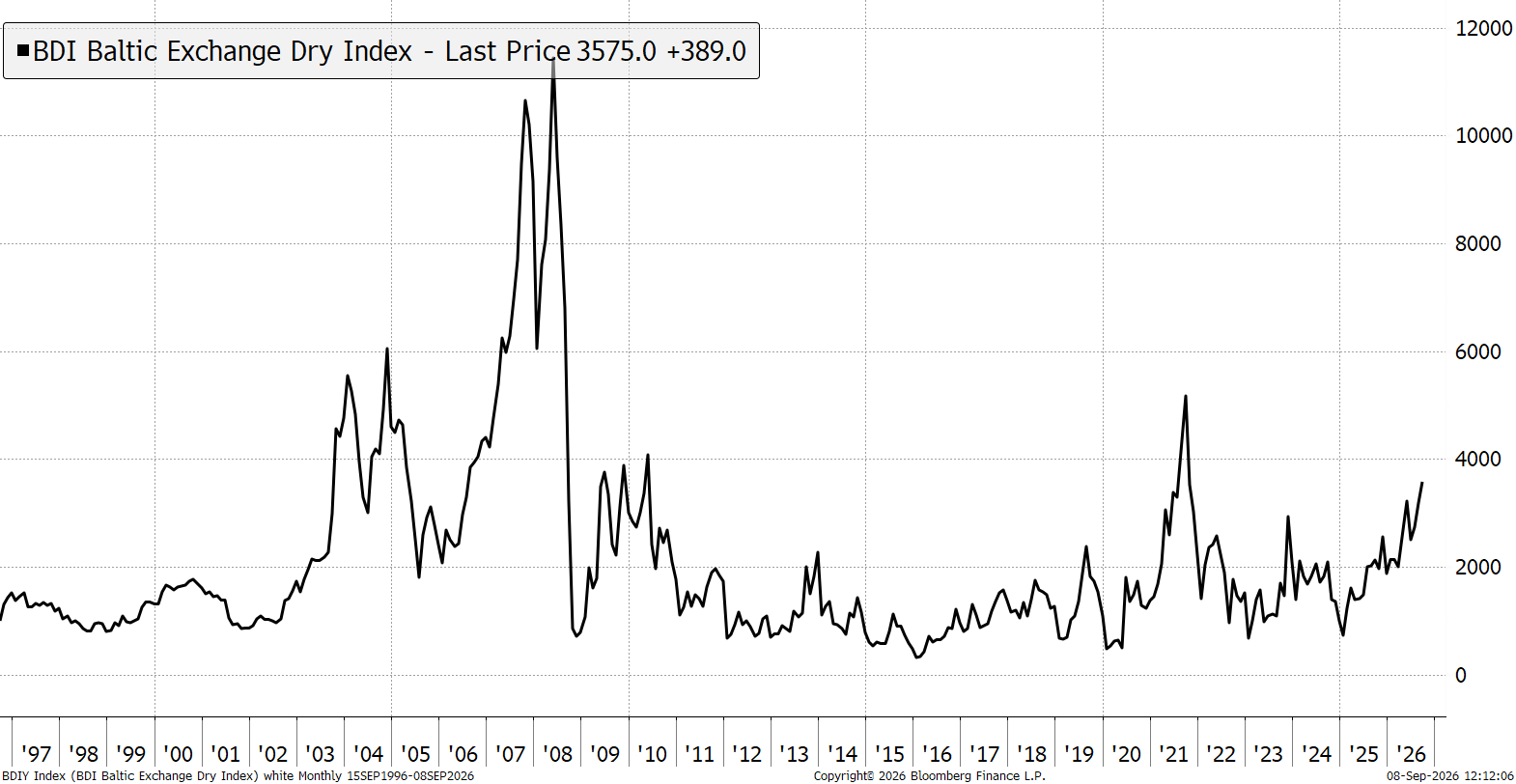
That is now spilling over into the Dry Index, measuring the freight costs of iron ore and coal. Despite seemingly being far removed from the Middle East, everything is connected. The last time this index surged was in the pre-2008 China growth boom. It’s happening again.
Baltic Dry Index
It all comes back to the idea that commodities are real assets that cannot be created out of thin air. They need to be mined, drilled or harvested, processed and transported over long distances. The global system of transport and trade works well until it doesn’t. The risk isn’t Hormuz, Panama, Suez, Navigation, War, or El Niño; it is that all of them are happening simultaneously.
Gold Versus Commodities
I have often said that gold is the investors’ commodity, as it is the one that does the heavy lifting over time. Most commodities can be ignored, but oil can be important at times, especially if the risk of an oil shock is high. It’s not just about profiting from higher oil prices but ensuring value creation at a time when many asset classes and sectors go wrong. In that sense, oil is a hedge rather than an investment. That said…
General - Your capital is at risk when you invest, never risk more than you can afford to lose. Past performance and forecasts are not reliable indicators of future results. Bid/offer spreads, commissions, fees and other charges can reduce returns from investments. There is no guarantee dividends will be paid. Overseas shares - Some recommendations may be denominated in a currency other than sterling. The return from these may increase or decrease as a result of currency fluctuations. Any dividends will be taxed at source in the country of issue.
Funds - Fund performance relies on the performance of the underlying investments, and there is counterparty default risk which could result in a loss not represented by the underlying investment. Exchange Traded Funds (ETFs) with derivative exposure (leveraged or inverted ETFs) are highly speculative and are not suitable for risk-averse investors.
Bonds - Investing in bonds carries interest rate risk. A bondholder has committed to receiving a fixed rate of return for a fixed period. If the market interest rate rises from the date of the bond's purchase, the bond's price will fall. There is also the risk that the bond issuer could default on their obligations to pay interest as scheduled, or to repay capital at the maturity of the bond.
Taxation - Profits from investments, and any profits from converting cryptocurrency back into fiat currency is subject to capital gains tax. Tax treatment depends on individual circumstances and may be subject to change.
Investment Director: Charlie Morris. Editors or contributors may have an interest in recommendations. Information and opinions expressed do not necessarily reflect the views of other editors/contributors of ByteTree Group Ltd. ByteTree Asset Management (FRN 933150) is an Appointed Representative of Strata Global Ltd (FRN 563834), which is regulated by the Financial Conduct Authority.
© 2026 ByteTree Group Ltd


