


Risky Markets and Another PM

Trades in Soda and Whisky;
After months of speculation, Sir Kier Starmer has resigned as the UK prime minister. It looks like Andy Burnham will take his place unopposed, perhaps within a month, and he might call for an early election.
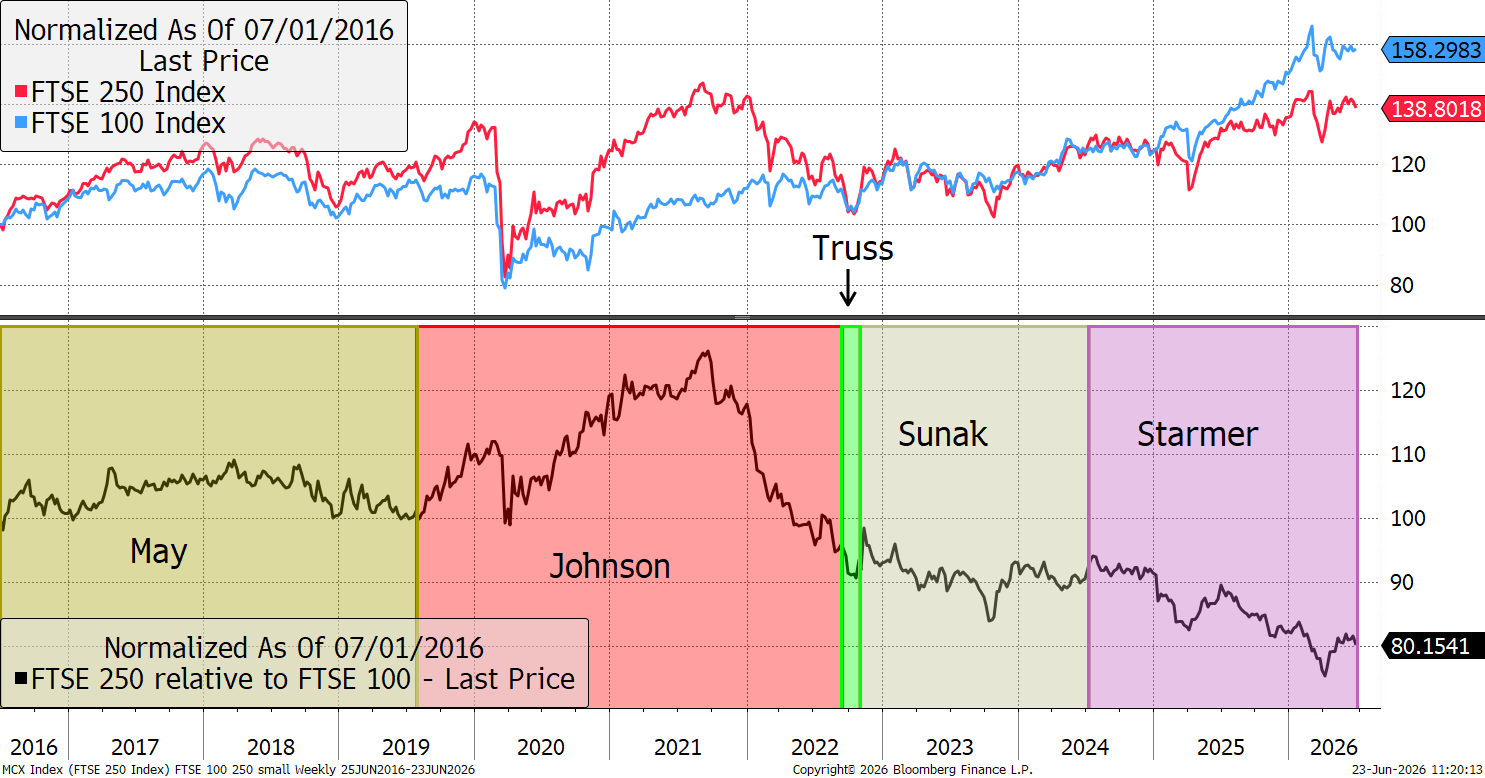
With Cameron, May, Johnson, Truss, Sunak, Starmer, and likely Burnham, that is the seventh in a decade, demonstrating how tough the job has become. What did the UK stockmarket think of them?
The idea is that the FTSE 100 (blue) hosts the UK’s more international companies, and the FTSE 250 (red), the domestic companies. The 250 has lagged the 100 by 20% over the decade. From the perspective of domestic economic policy, the stockmarket hasn’t backed up the UK since 2021.
FTSE 250 versus FTSE 100 – past decade
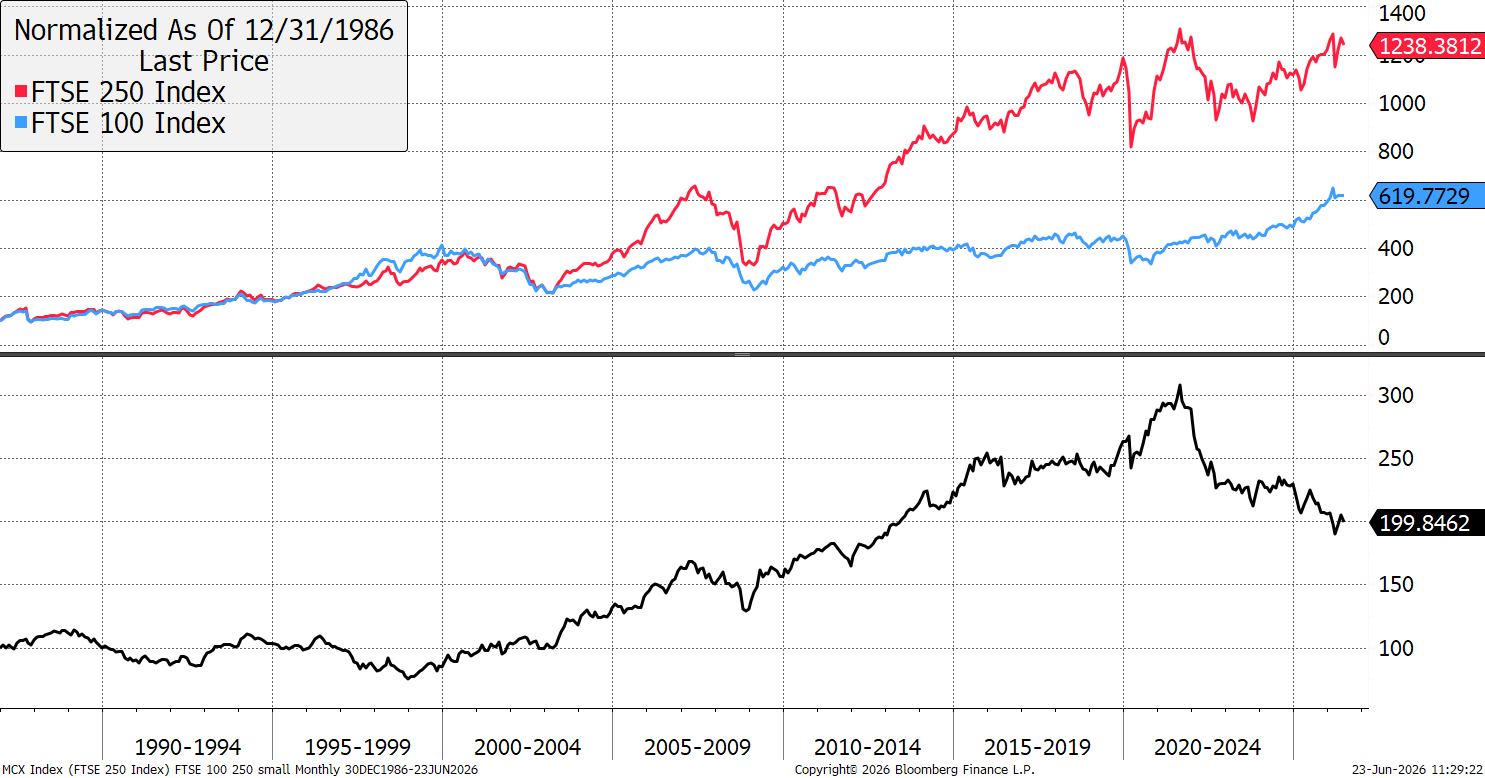
The longer-term view shows things differently, where our domestic companies were beating the international companies hands down. Blame Brexit perhaps, but the 250 carried on outperforming until 2021. It has been the past five post-pandemic years in particular that have caused the slump. There was a lag in the early 1990s, when there was a recession, and a dip in the late 1990s, when the almighty telecoms stocks dominated the FTSE 100, but the prevailing winds were that in the UK, the mid-caps beat the large caps, which was a sign that the economy was growing.
FTSE 250 versus FTSE 100 – since 1986
Let us hope that Burnham has a positive impact on UK business, but that is hopeful. He is left-leaning but pragmatic. I was pleased to read about his economic advisors:
- Jim O'Neill, the former Goldman Sachs chief economist, who coined the term “BRIC”, an acronym for the major nations, Brazil, Russia, India, China, which 25 years ago made up much of the world’s population, with a sub 1% weight in the world index.
- Andy Haldane, one of the better figures to come out of the Bank of England and now the CEO of the Royal Society of Arts (RSA).
- Richard Hughes, the former head of the Office of Budgetary Responsibility.
If Burnham listens to these guys, we’ll be ok. If he doesn’t, we may have a problem. After all, Burnham said the UK should “stop being in hock to bond markets”. He later clarified, I suspect after a reprimand from Jim O’Neill, saying he “never said Britain should ignore the bond market”.
Gilts
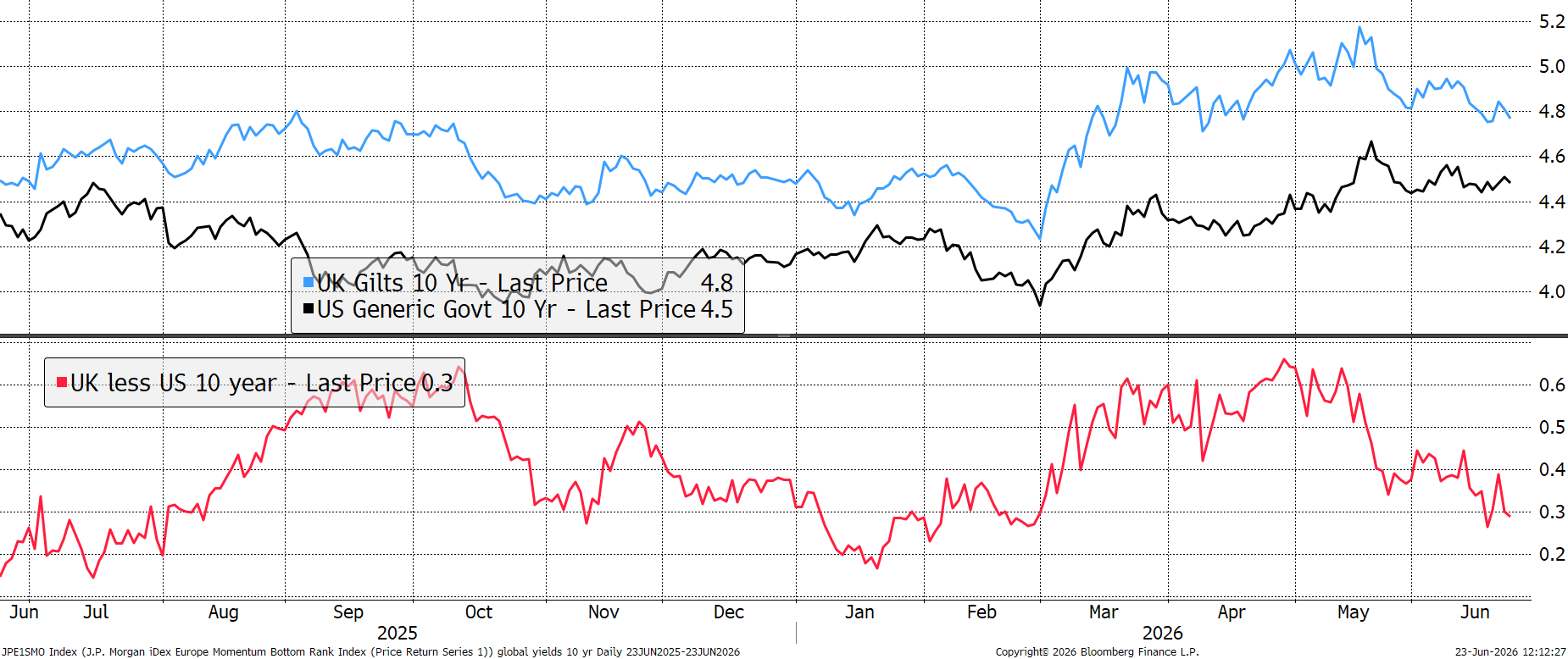
They can’t ignore the bond market because it rules everything. The good news for Burnham is that the gilt crisis has cooled with spreads returning to US levels. The trigger has been the fall in oil prices since the peace deal.
UK and US 10 Year Bond Yield
What does Burnham Stand for? We don’t really know, but here are some thoughts:
- Favours large-scale public investment in council and social housing, supporting “the biggest program of council house building since the Second World War".
- Wants stronger local powers for councils and city-regions.
- A desire for lower rents, lower water bills, and lower energy bills.
- He has signalled support for replacing stamp duty (transaction-based) with a land tax (asset-based).
Chancellor of the Exchequer
There’s also the question of who becomes the Chancellor of the Exchequer? The betting odds point to Wes Streeting, who is centre left, which would be fine. Ed Miliband is the runner-up, which would likely be dangerous. Other candidates include Shabana Mahmood and Yvette Cooper, both competent and preferable to Miliband. In fact, I cannot think of anyone who would not be preferable to Miliband.
UK politics will remain eventful, and if a leader can make the FTSE 250 beat the FTSE 100, they’ll have my vote. I would be amazed if Burnham can.
The FTSE 250 market cap is £340 billion. Yesterday, SpaceX shares fell by 10%, or $400 billion, after a good start. 10% of SpaceX is the same amount of value as the whole of the FTSE 250.
Forward Guidance at the Fed
It’s been a big week not only for UK politics but also at the Fed, where Kevin Warsh took over as chair from Jerome Powell. In his first meeting, he kept rates on hold, which came as no surprise, but in a major change since the 2008 financial crisis, he has put an end to forward guidance. This means the central bank will cease to signal to markets where interest rates are headed.
Warsh believes the markets should be sending signals to the Fed rather than the Fed sending signals to the markets. You may recall, from time to time, hearing about stockmarkets rallying on bad economic data such as higher unemployment. This led to the “bad news is good news” mantra, which came about because bad news meant lower interest rates.
In Walsh’s world, he wants to keep the markets guessing and act in the best interest of the real economy rather than the financial markets. That is a welcome change, but will almost certainly lead to crunch points.
Alan Greenspan
They say a new Fed Chair gets tested by the markets, but the evidence is inconclusive. The former Fed Chair, Alan Greenspan, nicknamed maestro, was certainly tested, with a 33% fall after his appointment preceding the 1987 crash. I was sad to hear that he passed away yesterday at the ripe old age of 100. The joke, which I am sure he would have appreciated, is that he died at par.
The Straits of Hormuz
The Straits have reopened and the number of recorded crossings has started to rise after nearly four months. Intermittent oil production has resumed at Kharg Island, but insurance rates are not yet discounting war risk.
Hormuz Crossings
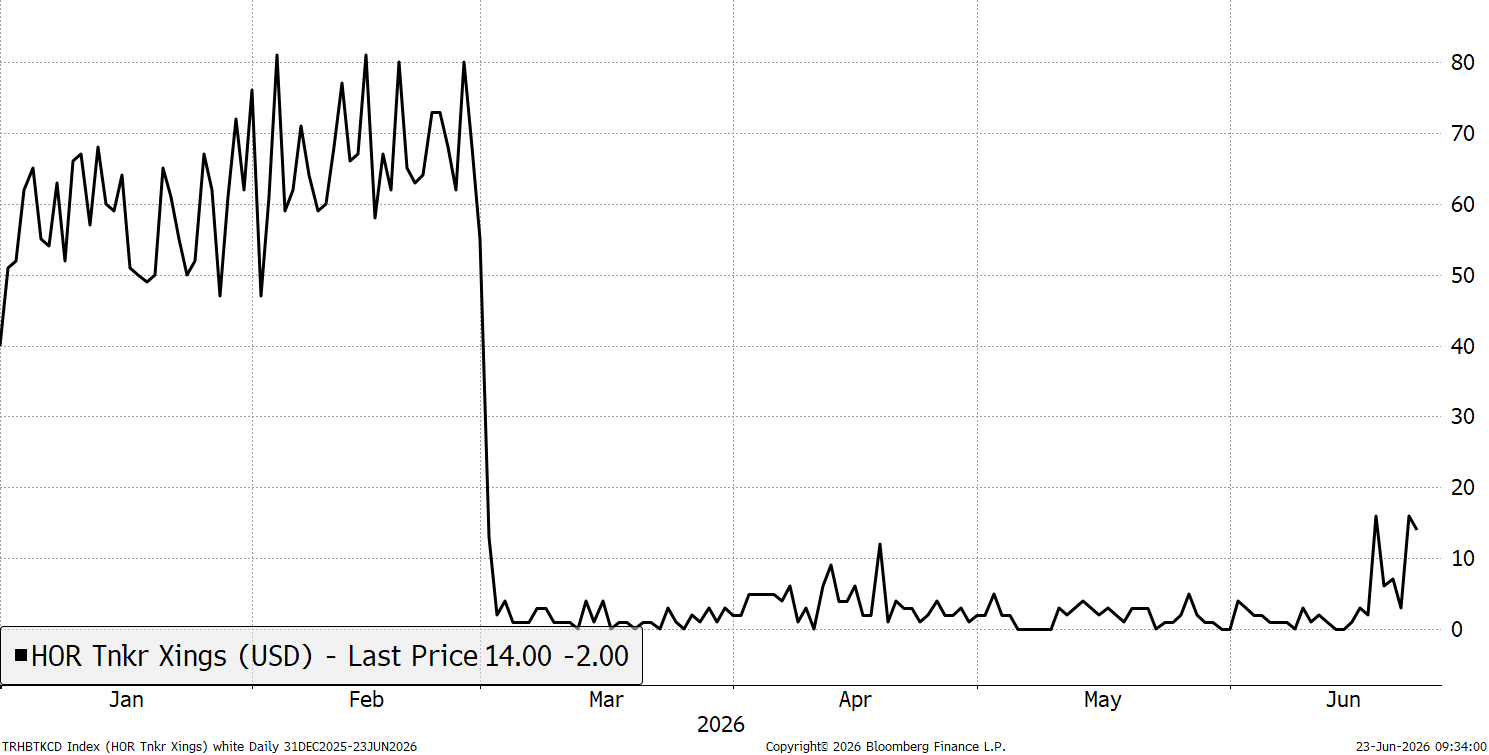
I am less optimistic than the markets, as it will take time to normalise, and there is plenty of room for things to go wrong from here. US and Chinese inventories cannot be drained indefinitely.
But the message from the bond market is loud and clear. Inflation expectations, especially short-term, have collapsed. That has cooled yields, and will be welcome news for Burnham, as low inflation should avert a bond crisis.
Inflation Expectations Have Collapsed
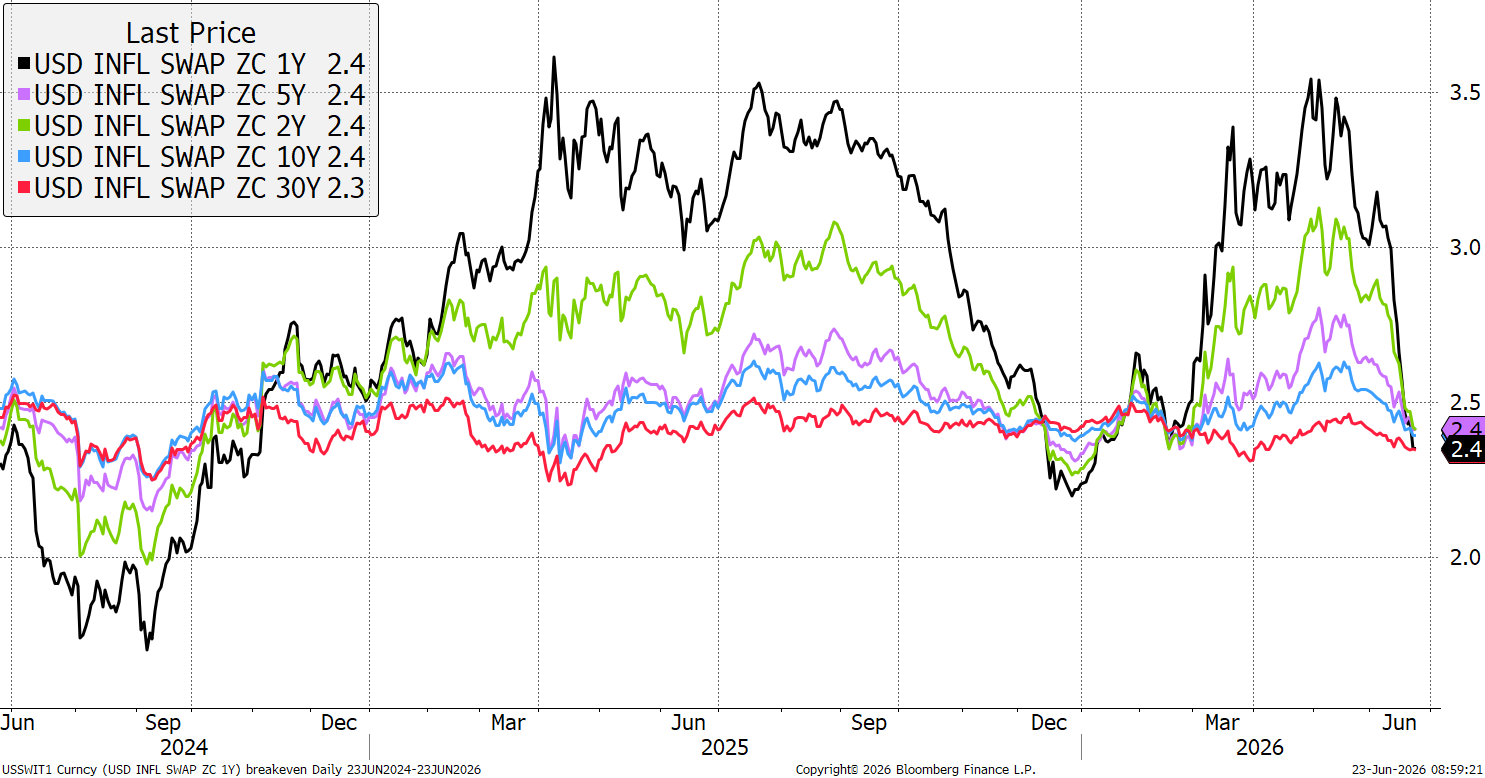
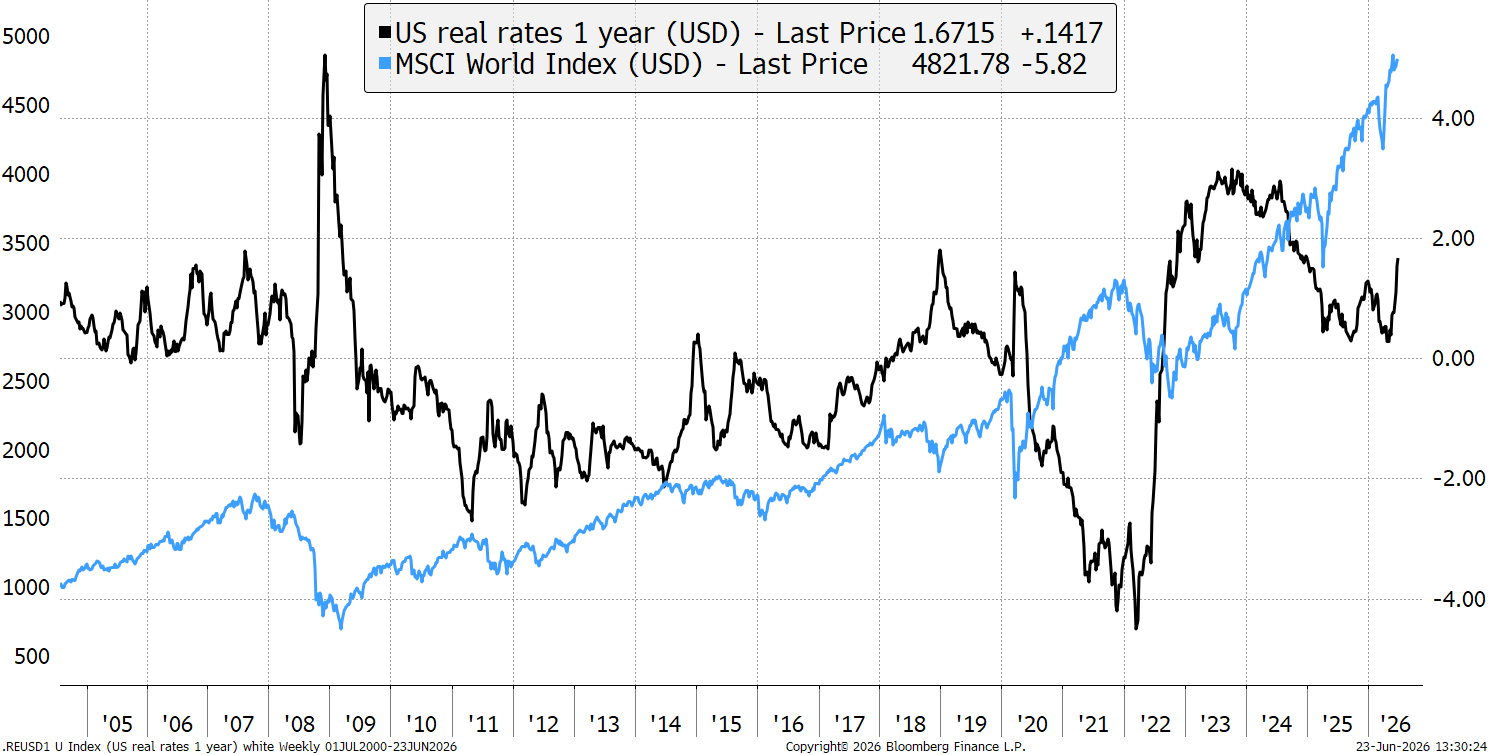
Notice how the longer-dated expectations have moved little, thus maintaining real yields at historically high levels that I wrote about recently. At the short-end, real yields have spiked and that has generally been a headwind for the stockmarket. See 2014, 2018, 2020 and 2022 where a sharp rise in short-term real yields caused a setback for stocks. Not to forget 2008.
Equities and the One-Year Real Yield
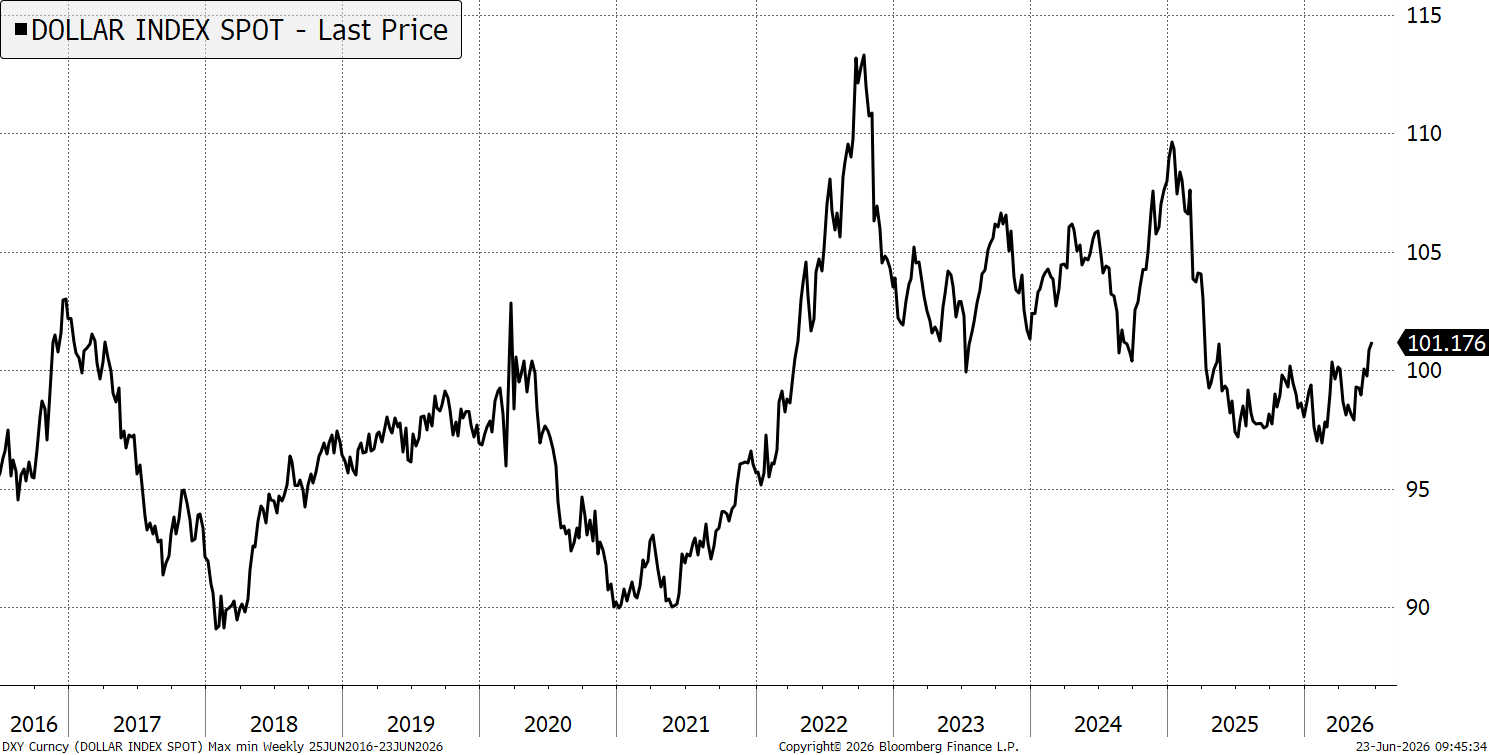
A spike in the real yield also pushes up the dollar, which is another thing stockmarkets don’t like very much. The pound is down, but I don’t believe that is UK-specific, as it is stable against a basket of currencies.
Dollar Index
Momentum
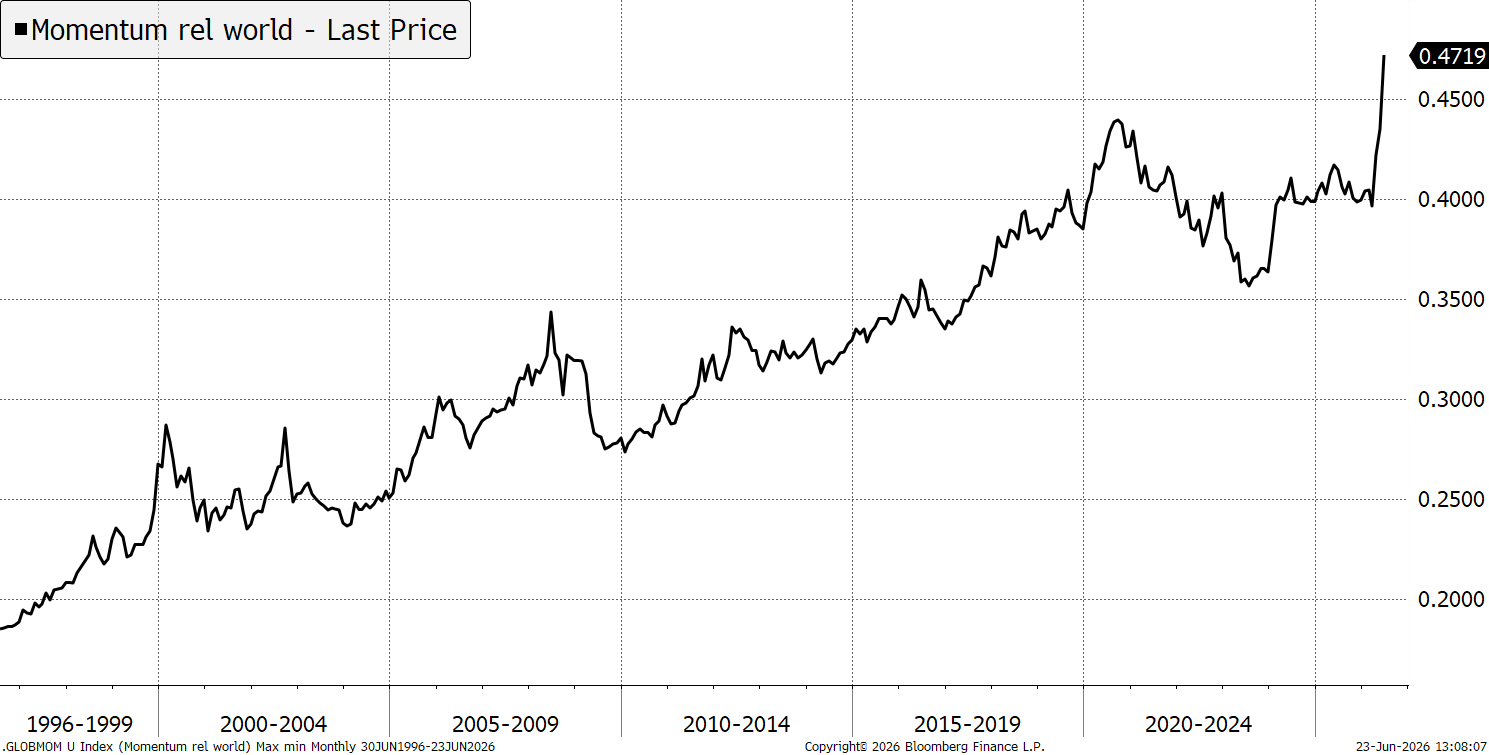
I added the momentum ETF to the Soda Portfolio in April, which was a timely call. My crime was not buying much more, but instead adding emerging smaller companies and emerging internet stocks alongside. Somehow those two other trades seemed to miss the semiconductor trade, and Soda only captured it through momentum. Sometimes, you have to put these things down to bad luck. In any event, momentum has surged and is now historically overbought.
Global Momentum Relative to the World
What I thought would happen in months, or perhaps years, has happened in weeks. Then consider that it wasn’t just SpaceX down 10% yesterday, but also Korea’s KOSPI Index. What is interesting here is that the market has surged, mainly due to the semiconductor stocks, while breadth (red) has collapsed. That means the percentage of stocks held in the KOSPI Index that are rising, is deteriorating rapidly. It is unusual for breadth to be so weak during such a strong market run.
KOSPI
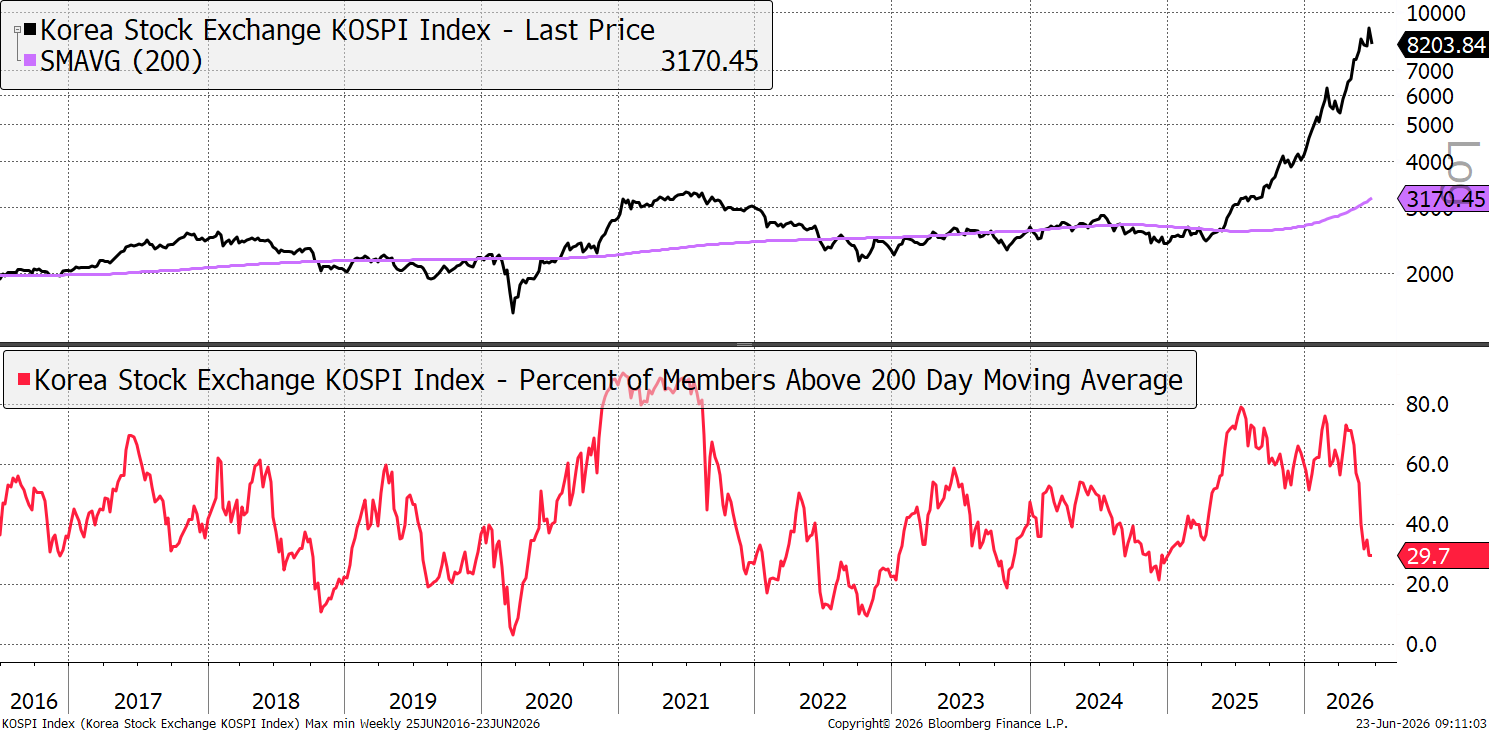
This is what we have been picking up in ByteTree Global Trends, which I publish on Mondays (still free). The number of stocks driving this bull market keeps on declining.
General - Your capital is at risk when you invest, never risk more than you can afford to lose. Past performance and forecasts are not reliable indicators of future results. Bid/offer spreads, commissions, fees and other charges can reduce returns from investments. There is no guarantee dividends will be paid. Overseas shares - Some recommendations may be denominated in a currency other than sterling. The return from these may increase or decrease as a result of currency fluctuations. Any dividends will be taxed at source in the country of issue.
Funds - Fund performance relies on the performance of the underlying investments, and there is counterparty default risk which could result in a loss not represented by the underlying investment. Exchange Traded Funds (ETFs) with derivative exposure (leveraged or inverted ETFs) are highly speculative and are not suitable for risk-averse investors.
Bonds - Investing in bonds carries interest rate risk. A bondholder has committed to receiving a fixed rate of return for a fixed period. If the market interest rate rises from the date of the bond's purchase, the bond's price will fall. There is also the risk that the bond issuer could default on their obligations to pay interest as scheduled, or to repay capital at the maturity of the bond.
Taxation - Profits from investments, and any profits from converting cryptocurrency back into fiat currency is subject to capital gains tax. Tax treatment depends on individual circumstances and may be subject to change.
Investment Director: Charlie Morris. Editors or contributors may have an interest in recommendations. Information and opinions expressed do not necessarily reflect the views of other editors/contributors of ByteTree Group Ltd. ByteTree Asset Management (FRN 933150) is an Appointed Representative of Strata Global Ltd (FRN 563834), which is regulated by the Financial Conduct Authority.
© 2026 ByteTree Group Ltd


