Bitcoin’s Quantum Threat, Anti-Bubble, or Energy Costs?


ByteFolio Issue 212;
Bitcoin’s ByteTrend Score remains a 0 following the signal given last week. We wrote that the bear had returned, and the past week has been tough with the price down 18% since the May peak. In this update, I will explore some of the reasons behind the Bitcoin price weakness.
Bitcoin
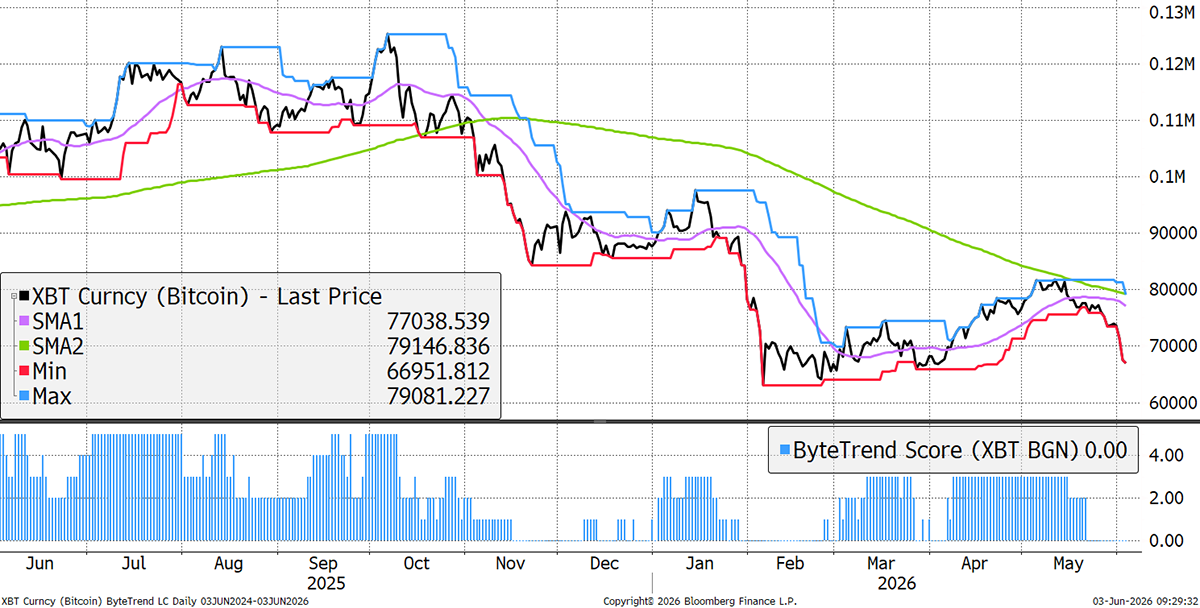
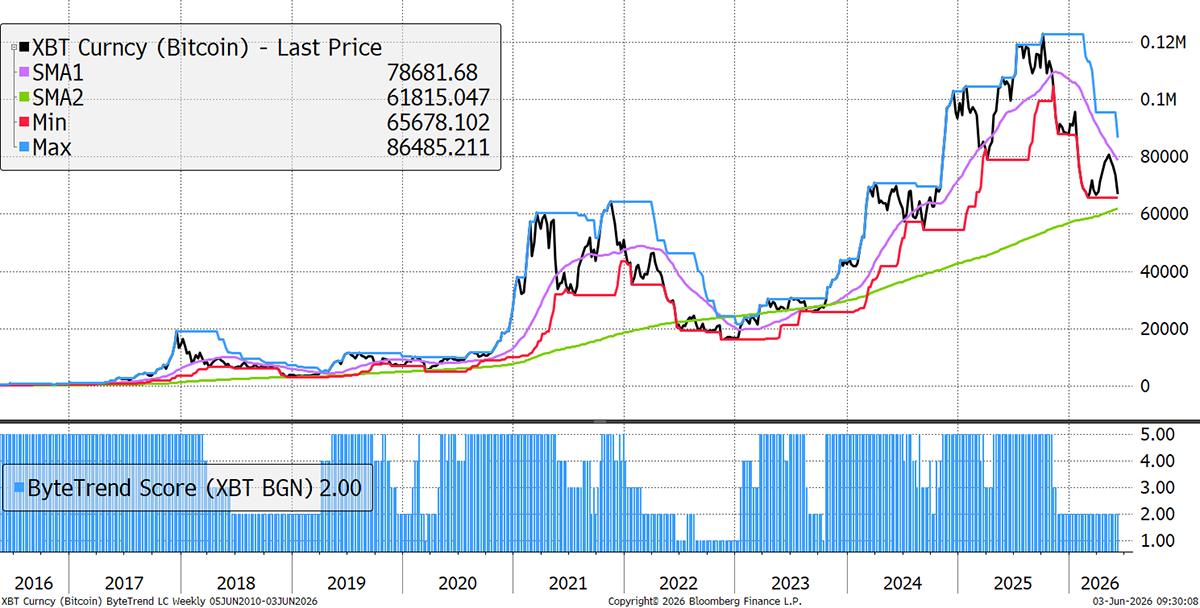
But first, let’s not forget that the weekly chart is in better health. The ByteTrend Score is a 2, as the 200-week moving average is still rising, and the price trades above it. The level is $61,814, and the gradient is a 25% IRR, which is exactly the number I use to think about for Bitcoin’s long-term expected return. A new low would be most unwelcome, but the price did touch $60k intraday in February.
Bitcoin Weekly
The Anti-Bubble
The AI boom is all about semiconductors, materials, and energy, as computing touches the real world. Bitcoin was correlated with semis, albeit slightly, but since 2024, they have broken apart. Over the past year, you could say that their correlation has become negative.
Bitcoin and Semis
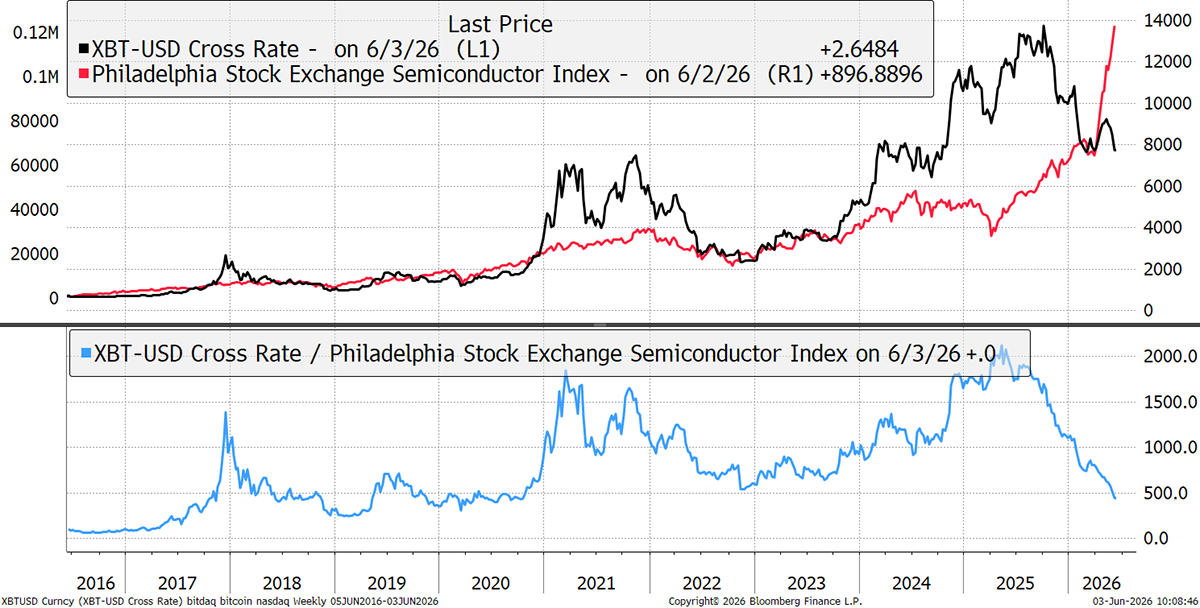
As the race accelerates, the current move in semis is sucking the capital out of everything else. Global semi stocks alone are worth $17 trillion, doubling over the past year. Add in hardware and others, and you are soon talking real money. This theme is driving financial markets, and capital is being withdrawn from other areas to fund it. Bitcoin is clearly being seen as an AI loser in the current environment.
The bullish twist is that when the semi surge flops, Bitcoin will be an anti-bubble asset and finally catch a bid. We saw this in the late 1990s, where defensive stocks had been dumped for tech. When the party ended, the defensives did well for years to come. Could Bitcoin be a defensive in the new world?
The Quantum Threat
There are perceptions that this AI boom accelerates the quantum threat to Bitcoin. We have covered this before and cited the work by Nic Carter.
At ByteTree, we have our expert coder and co-founder, Mark Griffiths. According to Mark, AI is “amplified mediocracy”, i.e., it is not a genius, nor is it stupid. Rather, it is very good at being mediocre at everything. Like a salesman trying to please its customer, it answers every question with confidence, regardless of accuracy. The facts come second. To break Bitcoin, computers will need scale, speed, and precision. This is not AI, and besides, Mark thinks quantum is years and years away. This is what he said during our morning team call:
“The headlines want you to believe quantum is behind this week's drop. It isn't. The quantum threat hasn't moved an inch — a machine capable of breaking Bitcoin's cryptography is still years away (Grayscale, who are not quantum sceptics, put it firmly beyond 2030 and call it a "red herring" for this year), and that work is happening in the open, not in some black hat's basement. What's actually moving the price is dull and structural: ETF outflows, forced liquidations, and old Mt.Gox supply hitting the tape. Quantum is simply the scariest story lying around, and a falling market always wants a villain with a face. Real threat, distant timeline, survivable — just not the one selling the headlines today.”
To Mark’s point, there are also no black hats (bad hackers) in quantum. The baddies in Russia and North Korea that spam us each day won’t have quantum. When it comes, it will be in the hands of the white hats (good hackers), and breaking Bitcoin won’t be their highest priority. Still, if the market believes quantum is a threat, then it is a threat, at least to the price.
Energy Costs
Another issue could be increasing energy costs. The hashrate, the amount of compute thrown at Bitcoin mining, has been rising for years, but has now stalled.
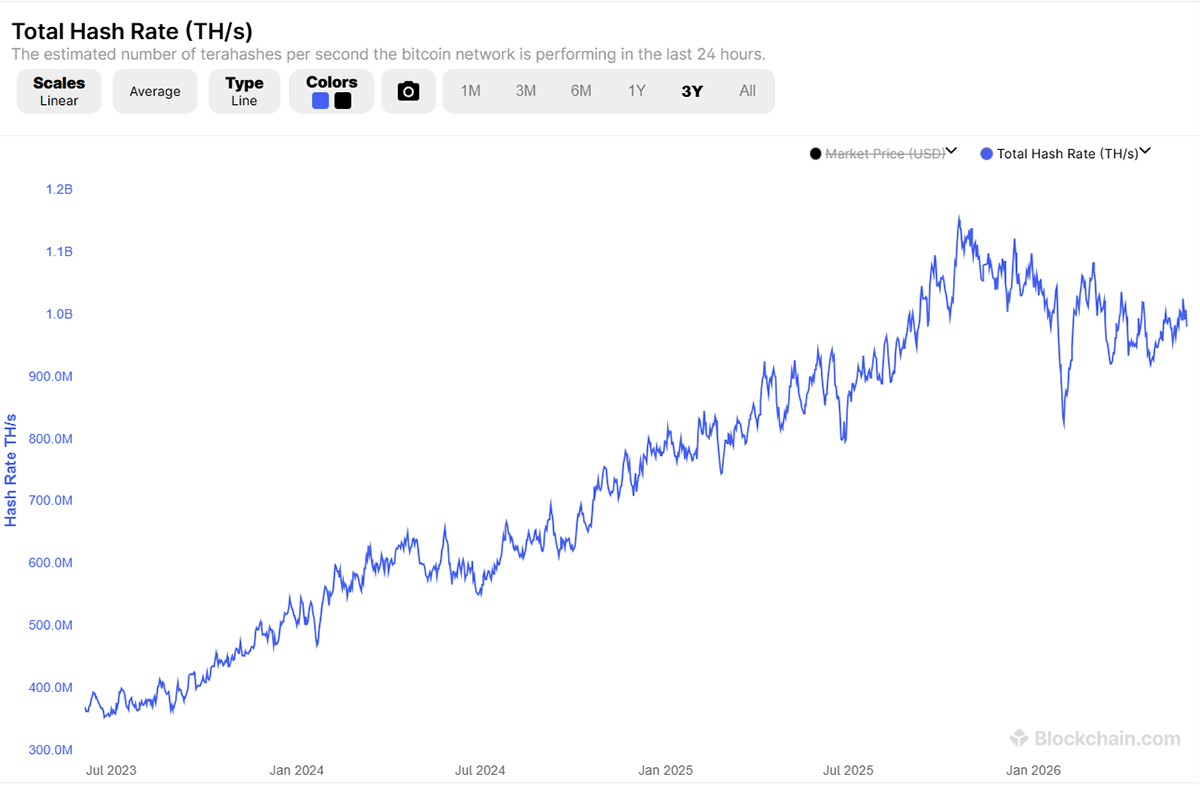
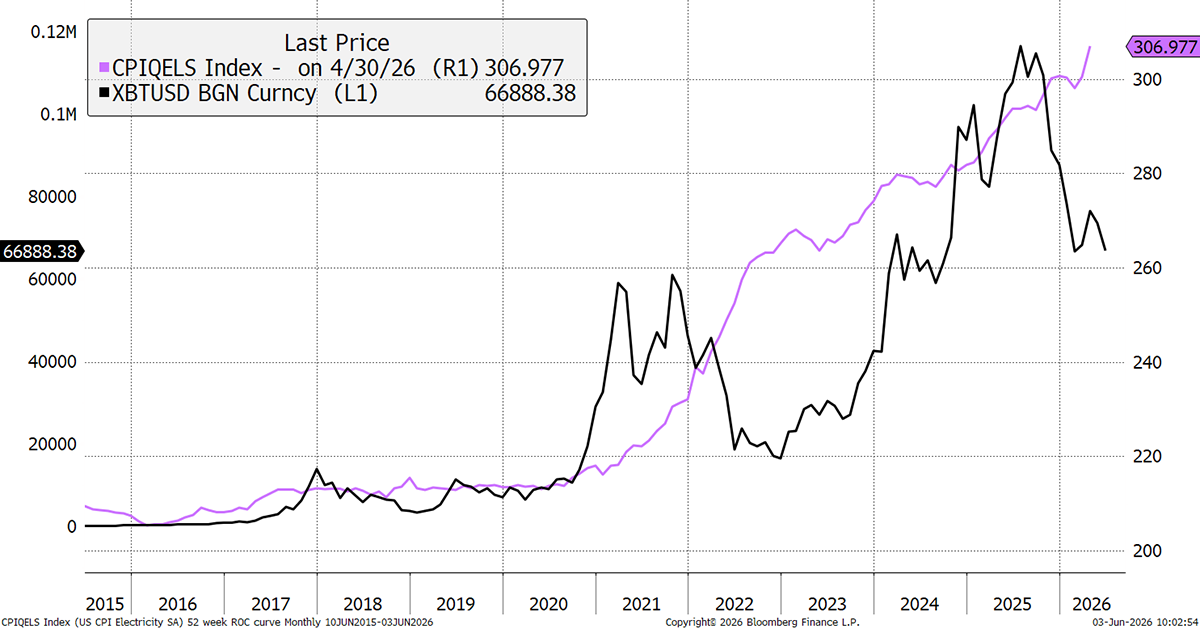
Using the US CPI Electricity, I wondered how much rising energy prices were affecting it.
Bitcoin and Electricity Costs
The view is perhaps clearer on a 12-month rate of change (below). Maybe rising electricity costs in 2022 were a factor in the bear market at the time, and perhaps they are again. In 2026, we have an energy supply disruption, this time from the Strait of Hormuz, while we also have an AI-induced demand boom.
Bitcoin and Electricity Costs - Rate of Change
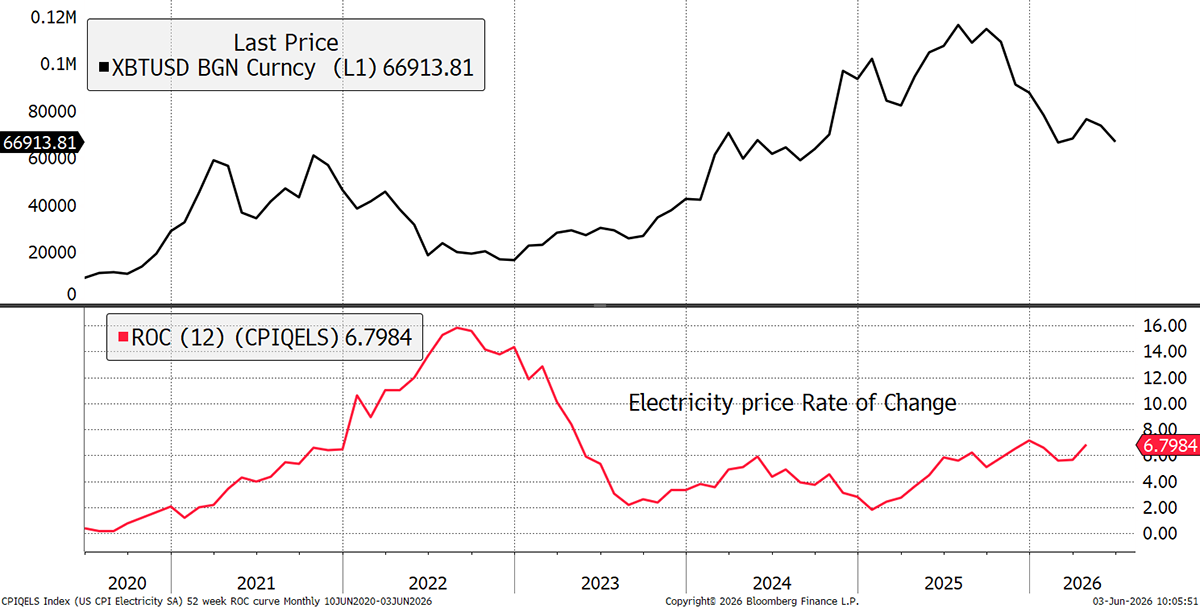
Maybe higher energy costs negatively affect Bitcoin's price, which is logical given that they increase its production costs. After all, in recent weeks, Bitcoin has fallen on oil price spikes.
Saylor Sells
I can’t go without mentioning Strategy’s Michael Saylor, who sold 32 BTC. He owns 843,706 BTC, so 32 BTC is not much. I believe he did it because he wanted to normalise the idea of Strategy buying and selling. To maximise BTC per share, it would be rational to sell BTC when the mNAV (premium in English) is low, and buy back stock. In contrast, when the mNAV is high, he should sell stock and buy BTC. Keep on doing that, and BTC per share will rise ad infinitum.
This is a sensible long-term strategy for Strategy, but it would take time and yield modest gains. Saylor would end up in the Investment Trust Sector, surrounded by wise old men. Surely not for him?