


Client Feedback on the Venture “Portfolio”

I recently converted ByteTree Venture from a tip sheet to a portfolio. This moves Venture away from a list of ideas to a weighted portfolio, which is in line with ByteTree’s other portfolios, Soda, Whisky, Quality, and ByteFolio. The portfolio will make Venture more accountable and transparent, so that our clients can judge us on our returns.
Thank you to ByteTree Pro clients who shared their questions and suggestions. In this short note, I have responded to your feedback.
Client Feedback
I did say that, but things change. The logic behind turning Venture into a portfolio became compelling as the group of opportunities expanded more globally. I felt it had become increasingly difficult to objectively measure success or failure through individual stock returns, especially when portfolio management is all about running winners and cutting losers.
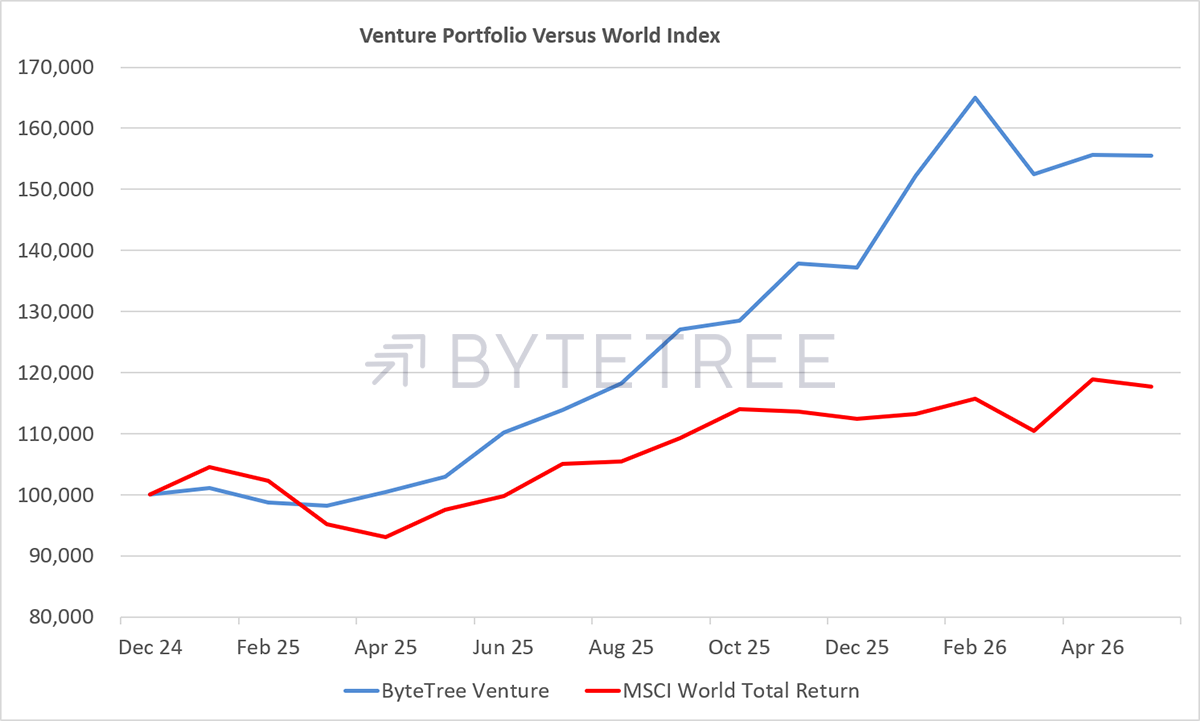
The returns have been reverse-engineered, with every position treated as 3% to start, with the weightings following from that. The following chart shows the Venture Portfolio vs the World Index since January 2025 in GBP.
Thank you, I hope all agree that the flexibility remains possible for those who liked the old approach. If I were following a model portfolio for selective ideas, I bet I would choose the wrong ones. Often, the quieter ones do best.
This is an age-old question that keeps coming up. The reality is that all positions are a buy until they are sold. I understand this is unhelpful, but the thesis would involve price limits and so on. The best stocks often shoot above those limits, and the worst, which are within the price range, tend not to perform as well. If I knew which were the best of the best, they would have massive weights, and I wouldn’t worry so much about diversification.
The problem is that a good process can identify value, momentum, quality, catalysts and so on, but the future will always be unknown. The longer you follow the Venture Portfolio, the less this matters, as you will soon see the new ideas as they come along. Venture should move much more quickly than the other ByteTree portfolios.
I was trying to gauge the performance of the riskier stocks in Venture with those in Whisky. To that end... Is there any way that you could give me an annual performance percentage in the way that you do with the other portfolios? It doesn't have to be methodologically scrupulous. It could be a back-of-a-napkin affair. But I would be interested to compare the performance of Whisky and Venture in the last two financial years, just to get a sense of the returns of the two quite distinct strategies. Might that be possible without putting you to too much trouble? Always appreciate your company in the markets.
From the end of 2024 to the end of Q1 2026, matching the timeframe for the chart above, Whisky returned 44%, while Venture returned 55.2%. I would show a chart, but I record Whisky weekly on Tuesdays, while this Venture back calculation is monthly so far. Going forward, I will start recording weekly data for Venture on Mondays, which will be included in the update. This will also be a useful audit trail, as we have with the other portfolios.
I understand that portfolios have real-life costs that fall with size. There are also potential taxes to pay. I am showing gross performance in total return, which is the industry standard. Fees and costs should be deducted from that amount, depending on individual circumstances. These deductions are important in high-turnover portfolios, but less so with medium-term investing, especially in liquid stocks.
On the flip side, being a portfolio now means I record transactions at the end of the day after publication. That means whatever price is booked is realistically achievable by clients.
Thank you. The shift to a portfolio is indeed an important development at ByteTree. Making the link to Global Trends broadens our scope and also improves suitability. That means clients who want to go on a more adventurous global journey can do so, and we will not be shackled by the limitations of certain cumbersome retail investment platforms.
Global Trends is exciting, as we make a major upgrade to our ByteTrend.io website. The new, fully audited, on-screen version should be ready in the coming weeks. It will cover 2,500 socks and calculate daily and weekly trend scores on a daily basis. You will also be able to plug it into AI!
Get ready, because I’ll be calling on ByteTree PRO clients to help us test it. The data junkies among you will love it. As for the rest of you, just sit back while Kit and I do the hard work.
1) Is the weighting for each purchase always roughly equal at around 3% of the then portfolio size?
2) I presume the portfolio will have a maximum of around 30 investments based on the size of each holding and the remaining cash element. Is this correct?
3) Would it be a good idea to have markers next to the holdings indicating whether holdings are still a buy in your view for clients who are not yet in (or not fully in) various holdings? I came to Venture recently, and much of the portfolio from pre-2026 has moved up quite a bit (good, but maybe no longer a buy from a value or current momentum perspective). My inclination is to build up my replication of the portfolio over time, starting with recommendations from the last 2-3 months, where the prices are still roughly in the ballpark of when they were added to the portfolio. Pre-2026 recommendations that have moved up a lot, I will probably leave, although I am not sure whether older recommendations that are still in the vicinity of their entry price still count as recommendations (?).
4) The last point leads me to wonder what principles lie behind the hold & sell strategy - my understanding is that the GTI momentum methodology plays a significant part in the selection process - does this mean we should expect rotation out of a lot of positions in a short period as momentum shifts, or are you aiming for some particular type of diversification/balance within the portfolio?
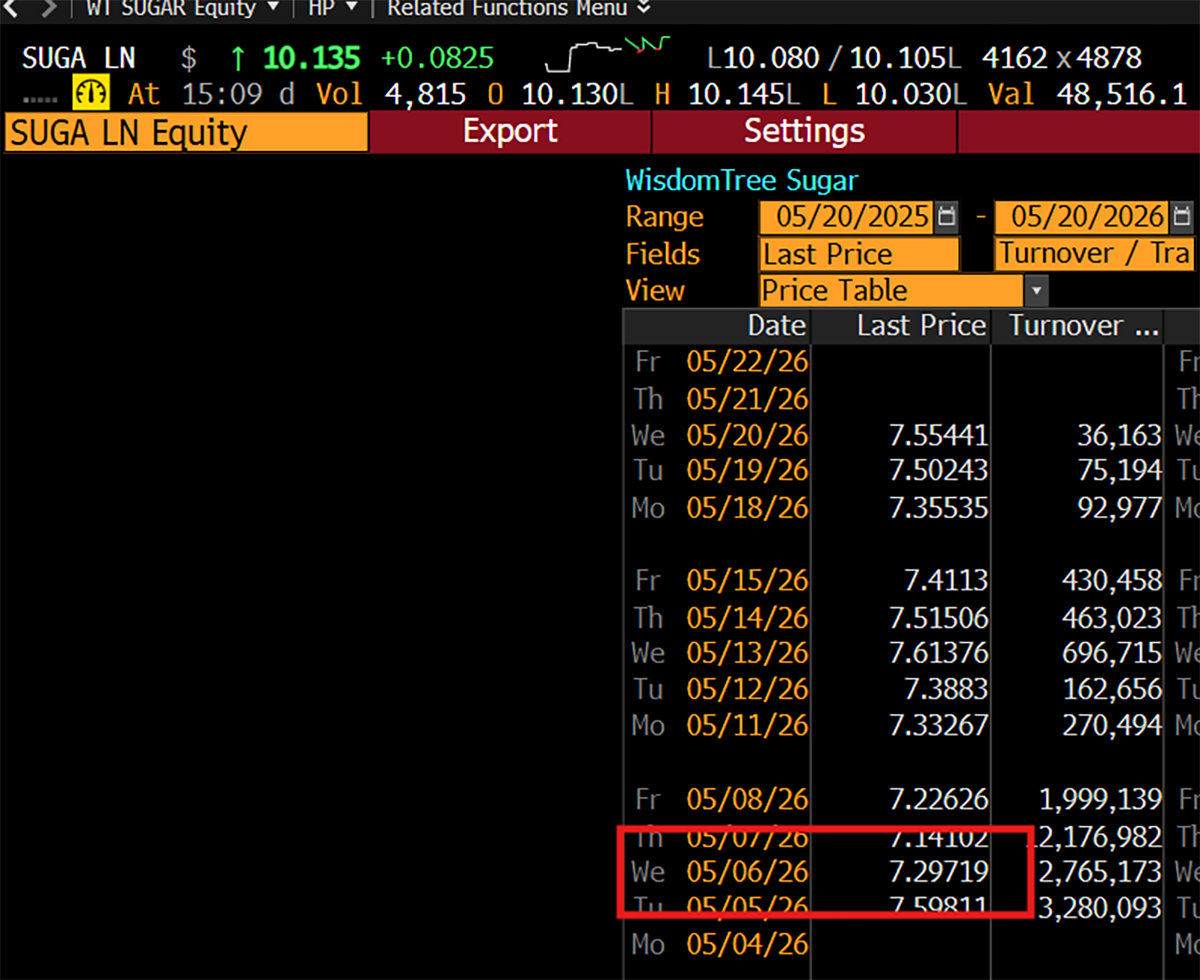
5) Finally, could you clarify/check the entry price in the portfolio for SUGA - I have 2 variants of it on Trading View (LSE and Euronext), but the 7.30 paid price shown in the Portfolio doesn't square with either chart - on 6th May for the LSE listing, the price range was roughly 9.7 - 10.3.
I will answer point by point.
1) Generally speaking, yes. A 3% weight implies a 33-stock portfolio. The alternative could be 25 stocks at 4%, like Whisky. I feel that if we want to move quickly, 33 stocks work better. That said, last week, the grains trade was 6% because I felt 3% would have a low impact for a potentially important allocation.
2) Yes. Cash is the residual pending reinvestment. Of course, a tip sheet has no cash, but a portfolio does.
3) Please see the answer given earlier.
4) The sell discipline is harder than the buy, which is an age-old issue with investing. There are two main reasons to sell. The first is that the trend turns down, or events turn for the worse. The other, and probably more important one, is capital recycling. If the Global Trends models identify potential winners, they each have a good chance of success. Old stocks that have stalled are sucking up precious capital that could be put back to work more effectively. A value signal can have a long shelf life, but a momentum signal much less so.
5) I record the prices in GBP. SUGA closed on 6 May 2026 at £7.29719, or US$9.9125.
SUGA
Absolutely. Clients are free to do what they like. There will also be occasional overlap with the other portfolios. My initial rationale for a tip sheet at the outset was that it would be less formal. I saw these value opportunities that were unsuitable for Whisky and wanted an outlet. That has advanced over the past (nearly) three years, and the time has come to formalise this. But as with all of our portfolios, some clients appreciate them for ideas, others for replication. Some clients admit they just enjoy the chat! I don’t feel my occasional jokes are funny enough for that.
Summary
Thank you for your feedback, which I am pleased was positive. The shift to a portfolio will not change much for those looking for ideas, but at least it allows us to be measured, which becomes more important as time grinds on.
ByteTree Quality is a slow-moving portfolio, while Whisky is more active. It stands to reason that Venture will be the most active portfolio we offer. Without Global Trends, I would struggle to do this, but it really has been a game-changer. I look forward to sharing it with you all soon.

Add the Venture model portfolio to your investment toolset by upgrading to ByteTree Pro today!
Many thanks,
Charlie Morris
Editor, Venture
General - Your capital is at risk when you invest, never risk more than you can afford to lose. Past performance and forecasts are not reliable indicators of future results. Bid/offer spreads, commissions, fees and other charges can reduce returns from investments. There is no guarantee dividends will be paid. Overseas shares - Some recommendations may be denominated in a currency other than sterling. The return from these may increase or decrease as a result of currency fluctuations. Any dividends will be taxed at source in the country of issue.
Funds - Fund performance relies on the performance of the underlying investments, and there is counterparty default risk which could result in a loss not represented by the underlying investment. Exchange Traded Funds (ETFs) with derivative exposure (leveraged or inverted ETFs) are highly speculative and are not suitable for risk-averse investors.
Bonds - Investing in bonds carries interest rate risk. A bondholder has committed to receiving a fixed rate of return for a fixed period. If the market interest rate rises from the date of the bond's purchase, the bond's price will fall. There is also the risk that the bond issuer could default on their obligations to pay interest as scheduled, or to repay capital at the maturity of the bond.
Taxation - Profits from investments, and any profits from converting cryptocurrency back into fiat currency is subject to capital gains tax. Tax treatment depends on individual circumstances and may be subject to change.
Investment Director: Charlie Morris. Editors or contributors may have an interest in recommendations. Information and opinions expressed do not necessarily reflect the views of other editors/contributors of ByteTree Group Ltd. ByteTree Asset Management (FRN 933150) is an Appointed Representative of Strata Global Ltd (FRN 563834), which is regulated by the Financial Conduct Authority.
© 2026 ByteTree Group Ltd


