


Ethereum: On Track for Mass Adoption

Token Takeaway: ETH;
ETH, and the broader crypto market, has been in a clear downtrend since the October 2025 flash crash. Prices across the board remain well below their highs, yet the underlying technology has never been stronger.
ETH in BTC
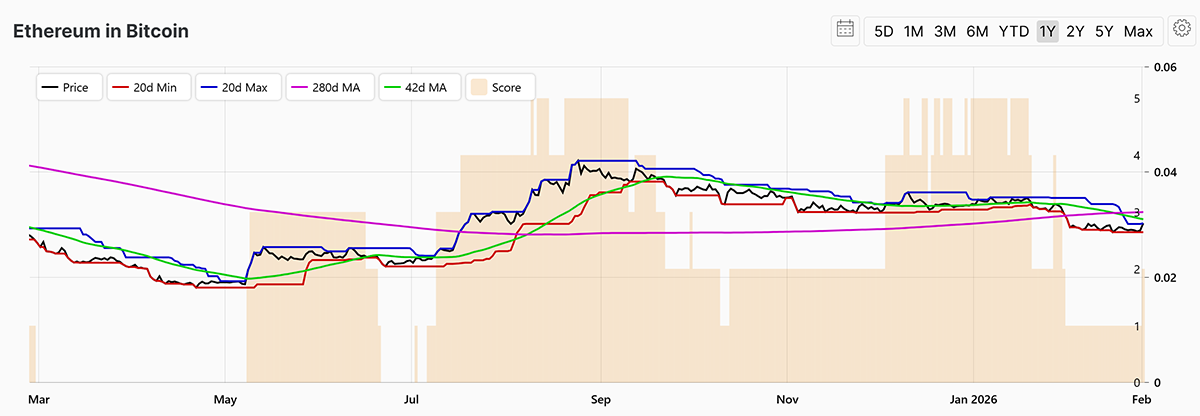
Ethereum today is cheaper to use and more scalable than at any point in its history. Development continues at a steady pace, even as sentiment remains weak. The Ethereum blockchain is positioning itself as the foundational settlement layer of the decentralised internet, spanning DeFi, stablecoins, real-world assets, prediction markets, and even the emerging AI agent economy.
This Token Takeaway explores Ethereum’s technical evolution, the growth of its Layer-2 ecosystem, and analyses ETH’s positioning as the default monetary unit of decentralised finance.
History
Ethereum was conceived by Vitalik Buterin in 2013. His whitepaper outlined a decentralised “world computer” capable of running programmable applications without intermediaries. Instead of building a single use case, Ethereum was designed as a base layer upon which anyone could deploy their own application governed by transparent rules.
Seven other co-founders later joined the project, including Gavin Wood, creator of Solidity, Ethereum’s programming language, Joseph Lubin, founder of ConsenSys, and Charles Hoskinson, who later founded Cardano. Few crypto projects have launched with a team of that calibre.
In August 2014, Ethereum raised roughly 31k BTC, around $18m at the time, in one of the earliest large-scale token sales. After launching the Olympic testnet in April 2015, Ethereum mined its genesis block on 30 July 2015. Smart contracts, i.e., self-executing programs that run automatically when predefined conditions are met, were now live. This marked the beginning of what would later be called Web3.
Over time, Ethereum grew into the dominant smart contract platform, attracting thousands of developers and becoming home to the majority of early decentralised finance activity.
Overview
What is Ethereum?
Ethereum is a global, immutable blockchain network secured by a decentralised set of validators distributed worldwide. It functions as a programmable platform that enables developers to build decentralised applications and services without relying on central authorities.
Today, Ethereum has over 389 million unique wallet addresses, with more than one million active daily addresses.
Ethereum: Daily Active Addresses
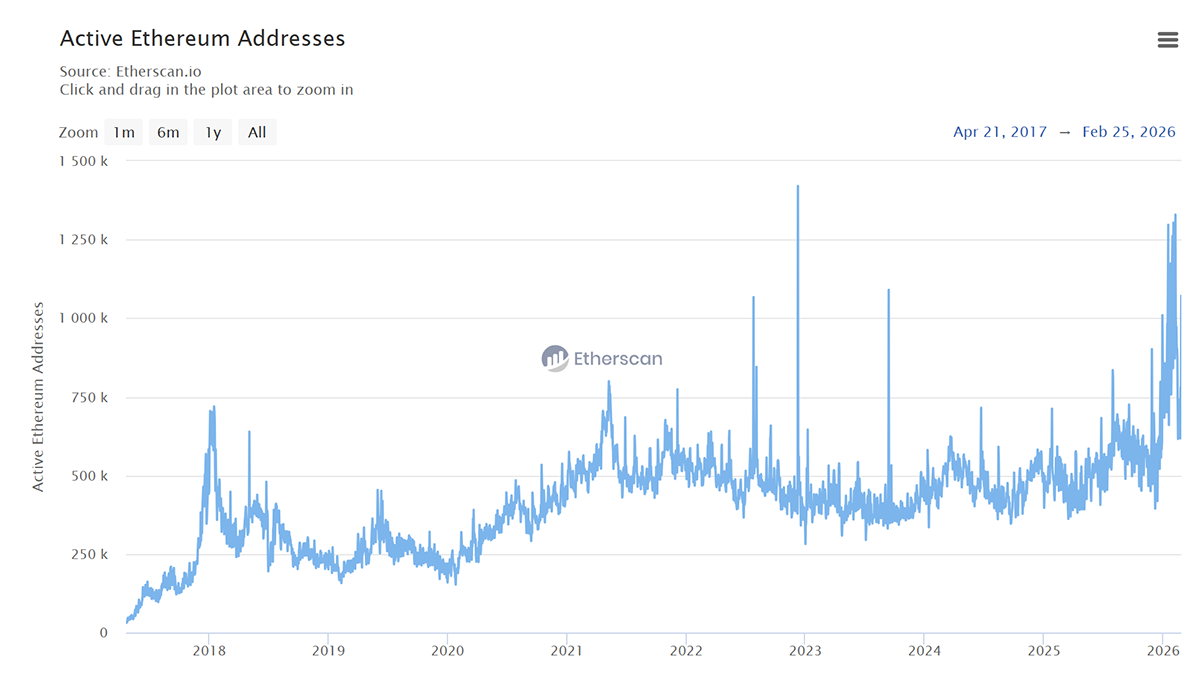
The ecosystem now includes thousands of applications, billions in total value locked, a thriving stablecoin economy, and over 100 active Layer-2 (L2) networks. Importantly, Ethereum is handling this scale of activity far more efficiently than in previous cycles.
That wasn’t always the case.
The Early Challenges
In its early years, Ethereum faced a series of structural challenges that tested both the protocol and the conviction of its community. Under the original Proof-of-Work (PoW) consensus mechanism, the network consumed significant amounts of energy, drawing criticism around sustainability. Simultaneously, periods of high demand frequently led to network congestion and sharp spikes in transaction fees, exposing clear scalability bottlenecks. Security incidents and smart contract exploits, such as the DAO Hack in 2016 and numerous dApp exploits, further complicated matters, highlighting the risks of operating an open, programmable financial system at scale.
At the heart of many of these issues was limited block space, i.e., the finite amount of transaction data that can fit into each block. Because every block has a maximum computational capacity, users must compete to have their transactions included. When demand rises, fees increase as participants effectively bid for priority.
The CryptoKitties era in 2017 brought this structural constraint into sharp focus. If Ethereum could be strained by the sudden popularity of collectable NFTs, it raised a far larger and more consequential question: could the network realistically support global financial infrastructure?
Ethereum’s Development Roadmap
In its early years, Ethereum’s primary challenge was scalability. High transaction fees and limited processing capacity repeatedly constrained the network during periods of intense activity. These bottlenecks became the catalyst for a new wave of alternative smart contract platforms, such as Cardano and Solana, often labelled as “ETH killers”, each promising faster speeds and lower costs. The pressure was real. Ethereum’s dominance was being tested not by theory, but by user experience.
In 2018, Vitalik Buterin proposed Serenity, later more widely known as ETH 2.0, a multi-phase roadmap designed to transition Ethereum from the energy-intensive Proof-of-Work (PoW) consensus mechanism to Proof-of-Stake (PoS), while introducing scaling improvements such as sharding. After extensive research and coordination, the Beacon Chain, Ethereum’s PoS coordination layer, launched in December 2020. Following nearly two years of testing and delays, the Ethereum mainnet successfully merged with the Beacon Chain in September 2022, completing what became known as “The Merge”. This completed Ethereum’s transition to a PoS network, reducing energy consumption dramatically and reshaping its economic structure.
Since then, Ethereum has continued to evolve through a series of major upgrades, including Shapella, Dencun, Pectra and Fusaka.
Shapella
Shapella, which went live on 12 April 2023, enabled validators to withdraw their staked ETH and accumulated rewards, introducing both partial and full withdrawal functionality. It also reduced certain gas costs and improved the efficiency of smart contract operations, strengthening confidence in the staking system.
Dencun
Dencun, activated on 13 March 2024, introduced blob transactions, a major step in Ethereum’s rollup-centric scaling strategy. Blob transactions allow L2 networks to temporarily post compressed transaction data to Ethereum at a significantly lower cost. That is, rather than storing this data permanently on-chain, it is kept for a limited period, reducing fees while preserving security guarantees. This upgrade materially lowered rollup transaction costs and improved the economics of L2 scaling solutions.
Pectra
Pectra, which went live on 7 May 2025, increased the maximum effective stake per validator from 32 ETH to 2048 ETH. This change improved operational efficiency for validators and enhanced flexibility within the staking ecosystem. It also expanded L2 blob throughput, increasing the volume of transaction data that Ethereum can process, reinforcing its role as a settlement layer for rollups.
Fusaka
Fusaka, implemented on 4 December 2025, introduced Peer Data Availability Sampling, improving how nodes verify rollup data. Instead of downloading entire datasets, nodes can now validate random portions of blob data, significantly reducing bandwidth requirements without compromising security. The upgrade also raised the default block gas limit to nearly 60 million.
Ethereum Gas Limit
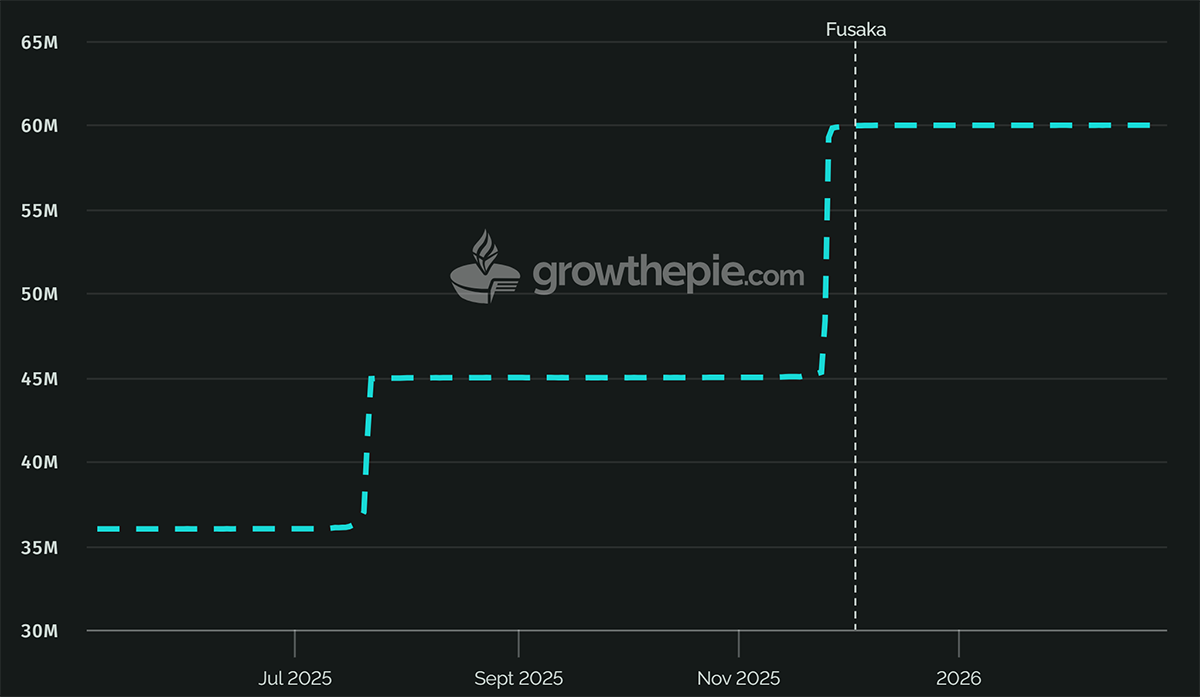
The gas limit has doubled since the Pectra upgrade, rising from 30 million to 60 million, effectively allowing each block to handle close to twice the computational work as before. In practical terms, this means a greater number of transactions, along with more complex smart contract interactions, can be processed within a single block. The direct outcome is improved throughput across the network. During periods of heightened activity, congestion is now less severe, and transaction fees tend to remain more stable because users are competing in a significantly larger pool of available block space rather than fighting over a constrained supply.
Notably, daily transactions on Ethereum have recently climbed to new all-time highs, which is an important signal. It indicates that the network’s recent scalability upgrades are not merely theoretical improvements but are efficiently functioning under real demand conditions.
Ethereum: Daily Transactions
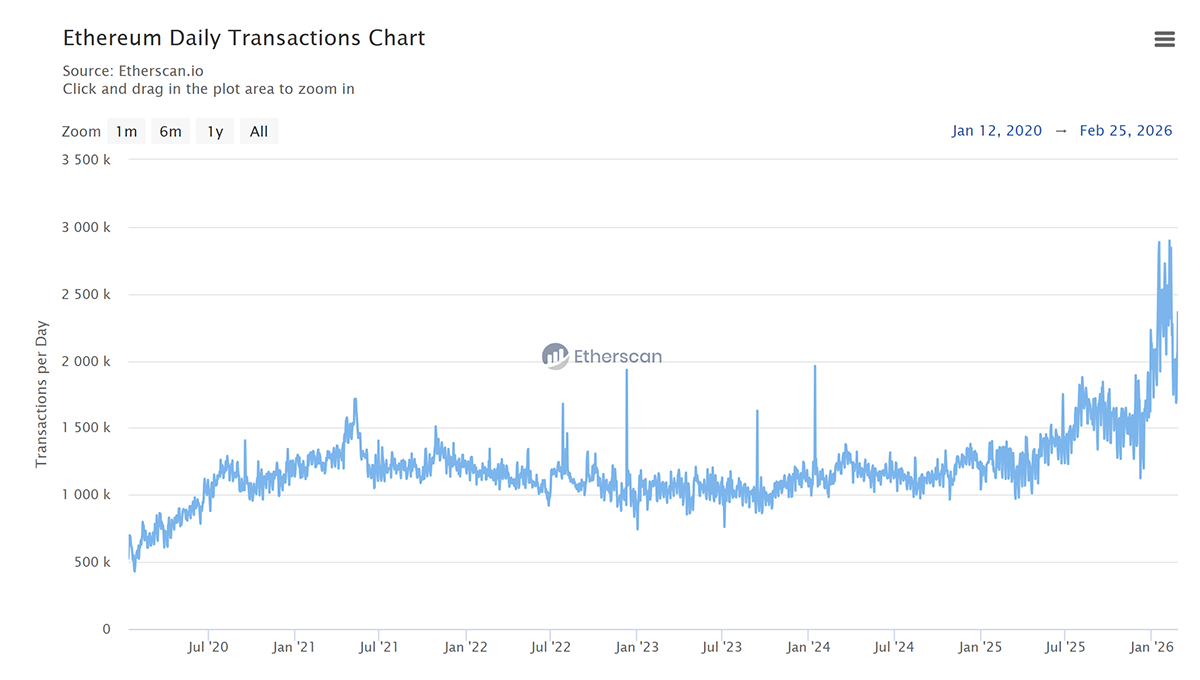
As gas costs have declined, there has also been a noticeable increase in dust transactions. These are very small-value transfers made viable primarily because fees are now low enough to justify them. Although this type of activity does not represent deep or meaningful economic use, it was an anticipated side effect of expanded block capacity and lower transaction costs.
According to Coin Metrics, from 3 December 2025, when Fusaka went live, through to late January 2026, dust transactions accounted on average for 11% of total transactions and 26% of active addresses on the Ethereum blockchain. While this may seem significant, dust transfers still account for only a fraction of the overall network activity and do not meaningfully distort the broader picture of usage.
Ethereum: Average Transaction Fee
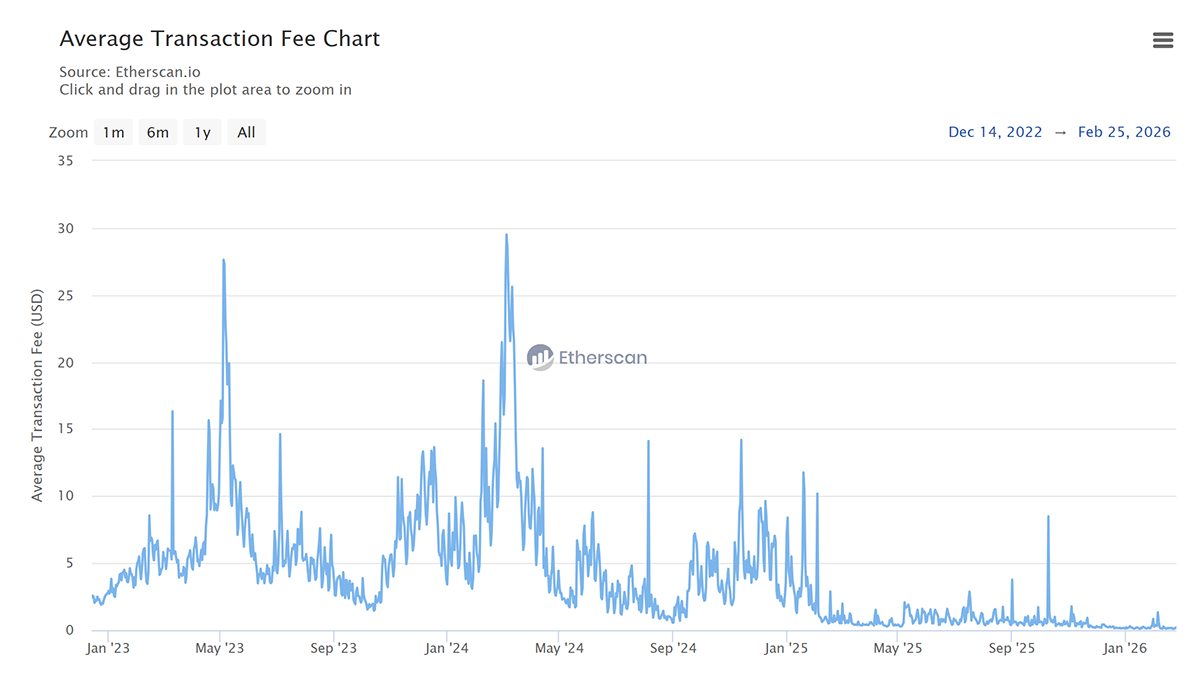
Despite record transaction counts, average transaction fees have remained relatively contained, something that would have been highly unlikely prior to the Ethereum 2.0 roadmap. The contrast highlights how materially Ethereum’s infrastructure has improved, even if price action has yet to reflect it.
Ethereum Layer-2s
The introduction of Ethereum Layer-2s in 2020 marked a decisive new phase in the network’s evolution. What began with early efforts, such as Loopring and Raiden Network, has expanded rapidly, with 101 active Ethereum L2s to date. The growth has been steady rather than explosive, reflecting increasing developer confidence in Ethereum’s rollup-centric roadmap.
Total Active Ethereum L2s
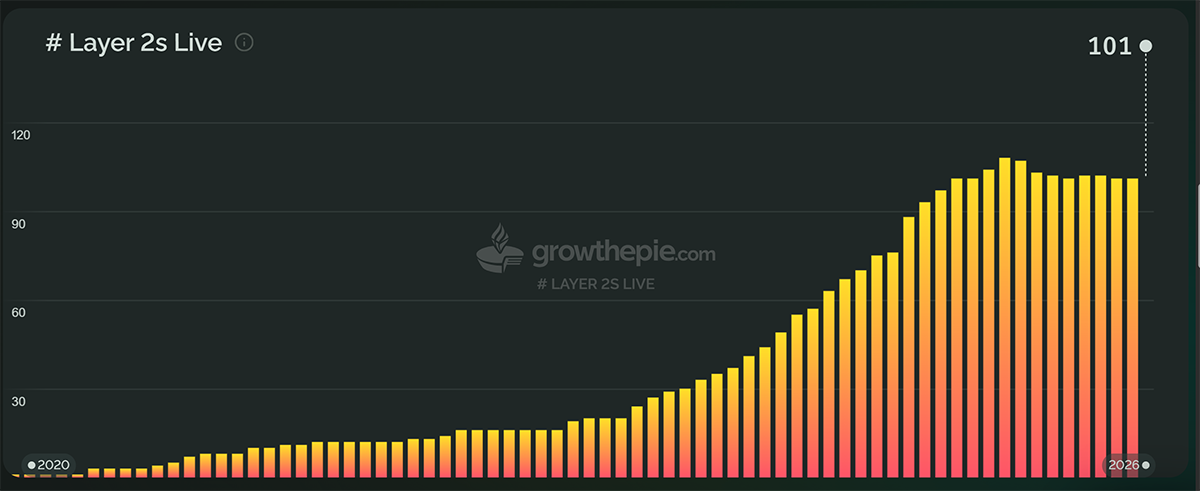
Ethereum L2s are scaling networks built on top of the Ethereum mainnet that process transactions off-chain while relying on Ethereum for final settlement and security. Instead of every transaction competing for limited block space on the main chain, L2s batch large numbers of transactions together and periodically post compressed data back to Ethereum. This significantly reduces costs while preserving the base layer’s underlying security guarantees.
Daily Transactions on Top 10 Ethereum L2s
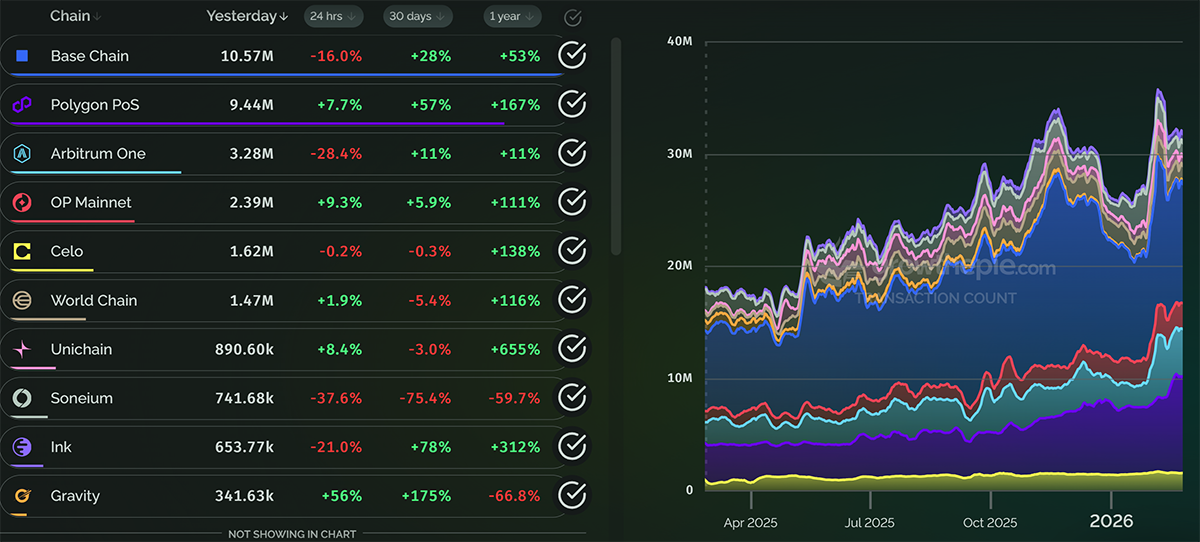
Base Chain (Base) currently leads as the most active L2, with 10.5 million transactions in the last 24 hours. Base is followed by Polygon PoS, with 9.4 million, and Arbitrum One, with 3.2 million. In total, the top 10 most active L2s have processed over 31 million transactions in the last 24 hours, which is nothing to scoff at. Furthermore, the trajectory of this activity is clearly trending higher, reflecting growing user engagement and application deployment across the ecosystem.
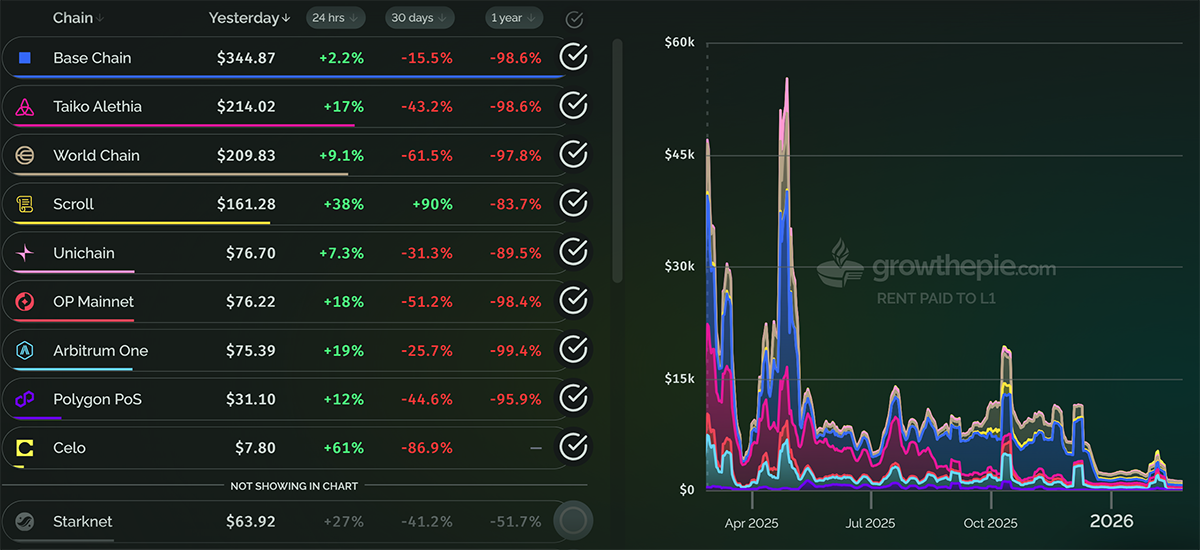
It is important to understand that this activity ultimately settles on the Ethereum network, and L2s pay a small portion of their transaction fees to Ethereum to anchor their data to the mainnet. At present, the aggregate fees paid to Ethereum remain modest because L2s are extremely cheap to use. However, the structural model is clear. If L2s eventually process a billion transactions per day, even a tiny fee per transaction would mean a meaningful yield for the base layer. The long-term thesis is not about today’s rent, but about future scale.
Interestingly, despite the steady growth in transactions processed by L2s, the rent paid to Ethereum has declined. This reflects how effective recent Ethereum upgrades have been in lowering L2 data costs.
L2 Rent Paid to Ethereum
Without diving too deeply into specifics, much of the activity on Polygon PoS is currently driven by Polymarket, which is widely regarded as the largest blockchain-based prediction market. Leave us a comment at the end of this article if you would be interested in a dedicated deep dive into Polygon.
While the total value secured by L2s has declined from $44bn in October 2025 to $32bn as of 26 February 2026, the value denominated in ETH has reached an all-time high.
Total Value in ETH Secured by L2s
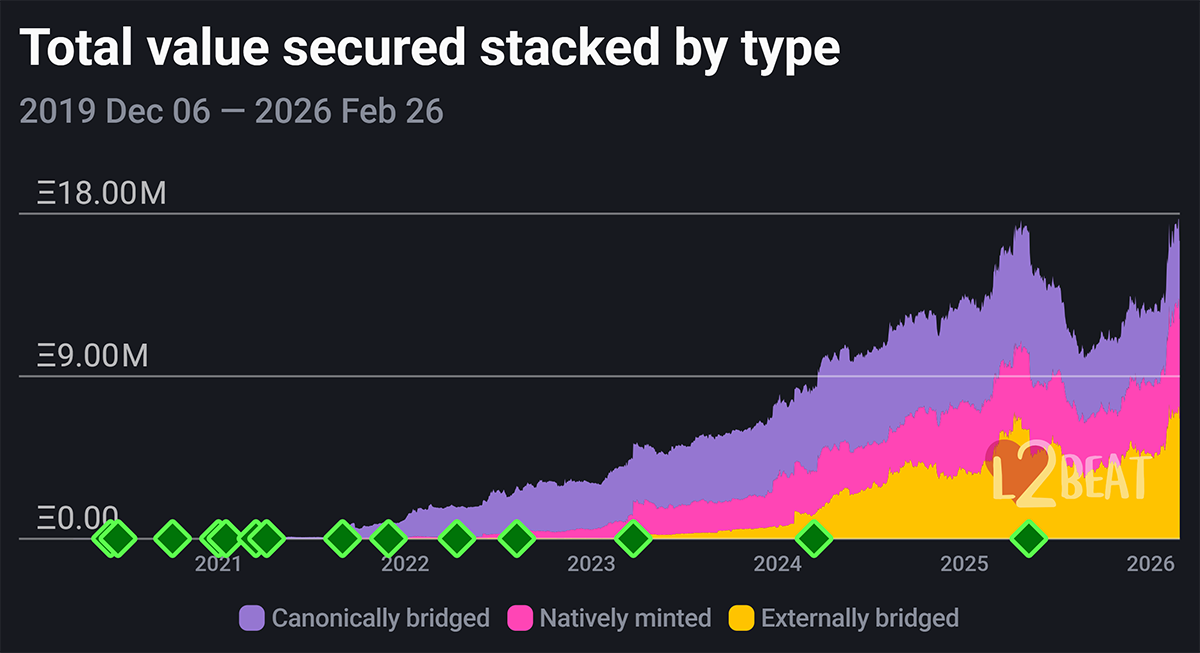
This distinction matters, as the decline in dollar terms reflects broader asset price weakness rather than a reduction in underlying participation.
At present, Ethereum L2s account for roughly 93% of total transaction activity within the broader Ethereum ecosystem. Although the Ethereum mainnet is scaling rapidly and may attract more direct activity over time, L2s are likely to continue handling the majority of execution demand. They are central to Ethereum’s long-term scalability roadmap and form the backbone of its mass adoption strategy.
However, there is an ongoing and nuanced discussion around the future of scaling. Recently, Vitalik Buterin suggested that while Ethereum’s L1 is scaling at an impressive pace, many L2s have struggled to fully inherit Ethereum’s security guarantees, stating that:
“the original vision of L2s and their role in Ethereum no longer makes sense, and we need a new path”
He also highlighted areas where L2s may differentiate beyond just scalability:
“ (i non-EVM specialized features/VMs around privacy, (ii) efficiency specialized around a particular application, (iii) truly extreme levels of scaling that even a greatly expanded L1 will not do, (iv) a totally different design for non-financial applications, eg. social, identity, AI, (v) ultra-low-latency and other sequencing properties, (vi) maybe built-in oracles or decentralized dispute resolution or other "non-computationally-verifiable" features”
This debate is evolving and reflects Ethereum’s willingness to reassess its architecture as it grows. We will continue monitoring these developments closely and provide updates through ByteFolio as the narrative progresses.


