


The ByteTree Broker Survey 2026

ByteTree clients often ask me: “Which is the best broker?” So, a year ago, we launched our annual Broker Survey. We are uniquely positioned to do this because ByteTree clients manage their investments across different platforms.
Which broker is the best depends on the investor’s priorities. Clients following the Whisky and Soda Portfolios in The Multi-Asset Investor manage their investments on the larger UK platforms, such as Hargreaves Lansdown and AJ Bell. These are good for funds and most ETFs, but they are UK-centric when it comes to dealing in equities. Our PRO clients, who trade ideas in Venture, which is more global, prefer platforms with much broader stock coverage.
A broker that is good at UK stocks might fall short when you want to trade in Germany or Japan. Similarly, a broker that can trade stocks seamlessly worldwide will likely struggle when it comes to dealing in UK-managed funds. The 2026 survey results confirm this even more emphatically than last year. Each of the brokers mentioned wins on something and loses on something else. There is no single best broker, only the best broker for you.
Which broker do you use?
Hargreaves Lansdown remains the most-used broker among ByteTree clients, at 27% of the total. However, it has lost a 4% share since last year, when it hosted 31% of clients. Interactive Investor remains in second place, and AJ Bell in third. Interestingly, Interactive Investor lost share while AJ Bell gained. Interactive Broker, not to be confused with Interactive Investors, grew from 6% to 8.8%, while Trading 212 grew from 2% to 5.6%, which was the largest gain in share.
ByteTree Client Brokers
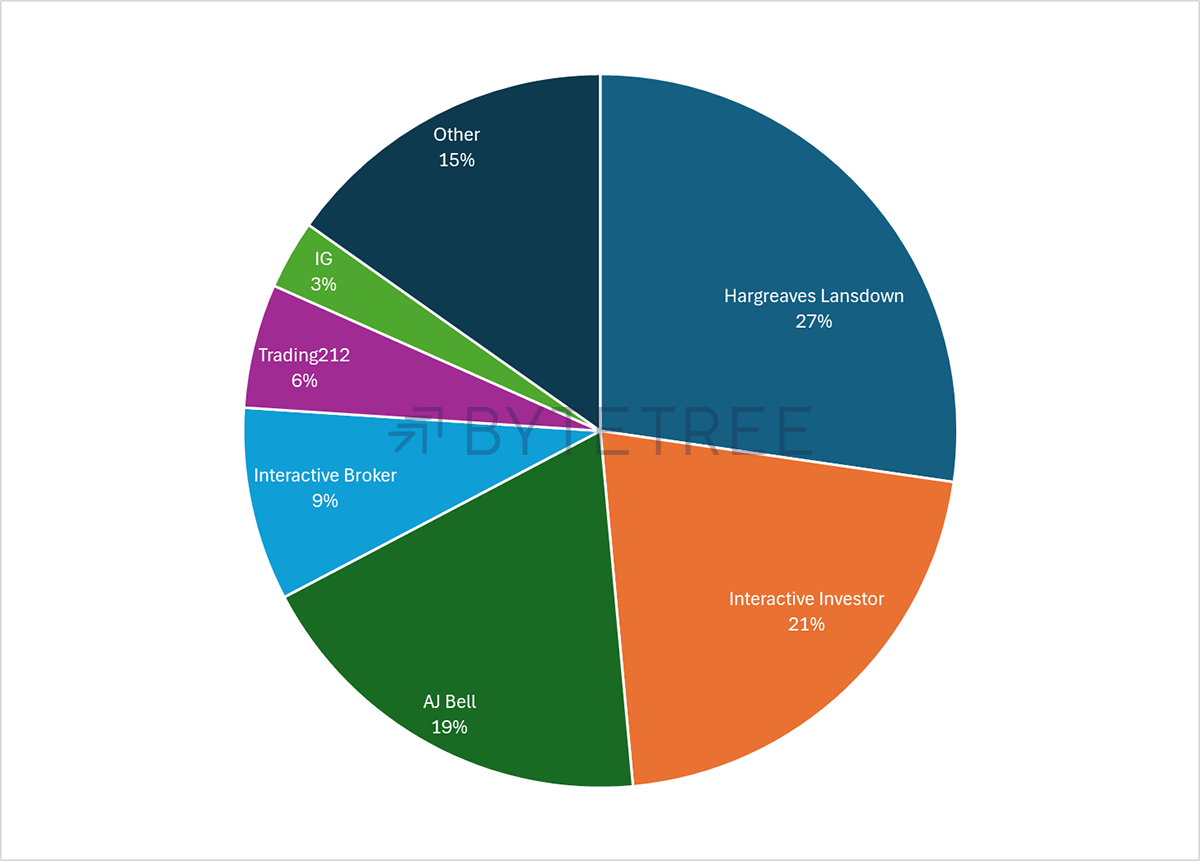
Looking at all the brokers covered in the survey, here are the results across all client responses:
| Broker | 2025 | 2026 | Change |
| Trading212 | 2.0% | 5.6% | +3.6% |
| Interactive Broker | 6.0% | 8.8% | +2.8% |
| AJ Bell | 17.0% | 18.8% | +1.8% |
| Swissquote | 1.0% | 2.1% | +1.1% |
| Fidelity | 1.0% | 1.7% | +0.7% |
| iWeb | 1.0% | 1.7% | +0.7% |
| IG | 3.0% | 3.1% | +0.1% |
| Saxo | 2.0% | 2.1% | +0.1% |
| Best Invest | 1.0% | 0.8% | -0.2% |
| Barclays | 2.0% | 1.7% | -0.3% |
| Killik & Co | 2.0% | 1.3% | -0.8% |
| Charles Stanley | 2.0% | 1.3% | -0.8% |
| Interactive Investor | 22.0% | 21.3% | -0.7% |
| Degiro | 3.0% | 1.5% | -1.5% |
| Halifax Share Dealing | 3.0% | 1.3% | -1.8% |
| Hargreaves Lansdown | 31.0% | 27.3% | -3.7% |
Given what I said earlier about a broker meeting your requirements, the preferred brokers for clients of The Multi-Asset Investor and ByteTree PRO differ. While most PRO clients still have an account on Hargreaves Lansdown, they are less likely to actively use it. For their second broker, they have skipped AJ Bell and headed straight for Interactive Investor and Interactive Brokers. They are also more likely to have accounts with IG, Saxo, and Killik & Co.
Broker Performance
In the survey, we asked clients to rate their brokers in each of these eight categories:
- Cost of trading assets
- Cost of holding assets
- Customer service
- User experience
- Access to foreign markets
- Access to funds and other assets
- Portfolio tools
- FX charges
Before I break down the survey results for each category, this is what a Pro client said:
"I have added IBKR to my chosen brokers following last year's survey results since they have access to the international exchanges that Venture recommendations require. Keep up the good work." — Pro subscriber
Another wrote
"Very recently signed up with Interactive Brokers for more access to foreign assets — thanks for the recommendation!" — Pro subscriber
Cost of Trading Assets
- Winner: Trading 212
- Runners-up: Interactive Brokers, Interactive Investor
- Wooden spoon: Hargreaves Lansdown
Trading 212 takes the cost of trading category for the second year running. Their model continues to be that they don't charge for trades, only spreads. Interactive Brokers and Interactive Investor are the runners-up.
The wooden spoon goes to Hargreaves Lansdown, with the lowest score for any broker on any single dimension in the entire dataset. More than half of HL users in the PRO cohort rate their trading costs as Poor or Fair. To HL's credit, they have recently made changes to their charging structure, and a few respondents noted that their personal fees have come down. The catch is that those reductions appear to have been negotiated individually rather than offered to everyone:
"Hargreaves Lansdown reduced my fees to align with what they were before, if not better, for dealing — I know not everyone got offered them." — Pro subscriber
And from a long-term customer who has decided to leave anyway:
"The primary reason for switching centred on cost and HL's intransigence on fees for years. I see shortly after I started the switch that they finally adjusted their fees…" — Pro subscriber
If you are paying full fare at HL because you have not asked for a discount, the data suggests you are paying more than your neighbours. That is not a sustainable arrangement, and HL knows it.
Cost of Holding Assets
- Winner: Trading 212
- Runners-up: Interactive Brokers, Interactive Investor
- Wooden spoon: Hargreaves Lansdown
Trading 212 takes both cost categories for the second year running. Holding costs are arguably more important than trading costs for the long-term investor. If you trade twice a year, the difference between a £5 commission and £10 commission is rounding error, but a 0.45% custody charge versus a flat £15 a month is the difference between a useful return and a haircut.
Hargreaves Lansdown gets the wooden spoon again. The comments here are pointed and consistent.
"I think the monthly costs are great value at £15/month for my portfolio of just over £100k. I'm not sure why so many use Hargreaves Lansdown — it seems really expensive at 0.35% unless you have a very small portfolio." — Multi-Asset subscriber
And from a Pro subscriber who simply does not like the structure:
"I mainly hold shares and do not trade much. I do not like ad valorem fees, so HL has gone down in my estimation recently." — Pro subscriber
The point about ad valorem versus flat fees is worth dwelling on. For a £200,000 portfolio, HL's 0.35% fund charge is £700 a year. AJ Bell, with its capped £100 annual charge on shares, costs roughly a seventh of that. The maths for anyone with a meaningful portfolio is brutal, and ByteTree clients tend to be exactly the people for whom it bites hardest.
Customer service
- Winner: AJ Bell
- Runners-up: Hargreaves Lansdown, Interactive Investor
- Wooden spoon: Trading 212
This is the first major change from last year. In 2025, the customer service category was won by Killik & Co, who I described as the old-school who answers the phone. I would say the same about them this year, but as I noted in the introduction, there are simply not enough Killik responses in the 2026 sample to award them the category fairly. So, congratulations instead to AJ Bell, who win customer service among both Pro and Multi-Asset Investor clients — and notably, they are the only major broker whose customer service score improved year-on-year.
A particularly cleanly framed comparison from a Multi-Asset subscriber:
"For me, Charles Stanley wins on price, AJ Bell wins on customer service, and HL wins on platform." — Multi-Asset subscriber
HL is the runner-up and has historically been a strong performer in customer service. But the 2026 numbers show a real decline over last year. The comments contain a worrying number of references to a recent service outage and a lack of explanation. One 25-year HL customer wrote:
"Had an account for 25+ years. Recently found them hopeless. Asked them the same question 8 times and received very poor and conflicting assistance, suggesting staff are not up to it or uninterested." — Multi-Asset subscriber
That is not a comment from someone who is naturally hostile to HL. That is a comment from someone who has stuck with them for a quarter of a century and is now reconsidering. There were several comments like this.
Trading 212 takes the wooden spoon, just as they did last year. Their model is digital-only, and they do not appear to answer the phone in any kind of hurry. If you are happy never speaking to a human, this is fine. If something goes wrong, less so.
User Experience
- Winner: AJ Bell
- Runners-up: Hargreaves Lansdown, IG Group
- Wooden spoon: Interactive Brokers
AJ Bell takes the trophy for user experience as well. Together with their customer service win, this makes AJ Bell the most well-rounded major broker in the 2026 survey. Several of you have switched to them in the past twelve months, and the comments are overwhelmingly positive:
"Aside from not allowing cash holdings in other currencies, AJ Bell is a great platform. It does most of what I want with excellent customer service." — Multi-Asset subscriber
HL is again the runner-up, which speaks to the strange duality of the platform. HL is not bad at the things you touch every day — the website is well laid out, the navigation is intuitive, and the fund and stock pages have some of the best presentation in the industry. It is bad at the things you check less often, like the fee statements. This comment from one switcher captures it neatly:
"I loved Hargreaves Lansdown's platform. It has a huge array of data and is very cleanly laid out in a spreadsheet style. AJ Bell's platform honestly isn't as good — it's reasonable but has less data easily available. My reason for leaving HL was the constant problems not being able to buy things on their platform, which just annoyed me too much." — Multi-Asset subscriber
So, the customer leaves the platform they prefer, because the things they cannot buy on it matter more than the things they can. That is a difficult position for HL to defend.
The wooden spoon this year goes to Interactive Brokers. This is a difficult result to interpret because Interactive Brokers actually scored higher on user experience in 2025. I do not think the platform has got worse. I think more of you have started using it. Pro subscribers who joined IBKR after last year's survey are now hitting the learning curve, and the score reflects that. The comments also support this reading, particularly this poignant example:
"Have stopped using Interactive Broker. It is brilliant for its coverage but too complicated for me. At 76 I'm trying to simplify my life. Would definitely use it if younger." — Pro subscriber
And another:
"Also use ii who are decent. IBKR are great, but their UI is very complex." — Pro subscriber
Interactive Brokers is an extraordinary platform, but it is built for traders who do this for a living, not for retail investors checking on their portfolio once a week. ByteTree intends to publish a getting-started guide for IBKR shortly to help readers across this learning curve. If you have opened an account and are struggling, stay tuned.
Access to Foreign Markets
- Winner: Interactive Brokers
- Runners-up: Trading 212, Interactive Investor
- Wooden spoon: Hargreaves Lansdown
Interactive Brokers is the clear winner this year, with 92% of Pro subscribers who use IBKR rating their foreign market access as Good or Great. As I noted in last year's article, this is the category that matters most for ByteTree's more international services, particularly Venture, and the data is unambiguous. If you need to trade outside the UK, US and main European exchanges, IBKR is the answer.
The wooden spoon goes to Hargreaves Lansdown. This is the dimension where HL's gatekeeping problem is most visible. They are slow to add new shares and ETFs, and even held back on Metlen (MTLN), which was a member of the FTSE 100 Index. I personally receive more client emails saying it’s not on Hargreaves Lansdown than for any other platforms, and the frustration is palpable:
"HL doesn't offer access to the ASX, crypto e.g. BOLD, and is fussy about shares that don't meet its criteria, e.g. AngloGold Ashanti." — Multi-Asset subscriber
"Share your frustration that certain ByteTree recommendations are not available via HL." — Pro subscriber
The most striking comment in this whole category, though, is this one from a Multi-Asset subscriber who decided to deal with the problem the brute-force way:
"I only use Trading 212 for those trades that I am unable to do with Hargreaves Lansdown." — Multi-Asset subscriber
That is exactly the multi-broker strategy I have been suggesting for two years now, but it is depressing that the reason for it is HL's reluctance to add stocks rather than any positive choice on the customer's part. If your primary broker forces you to open a second account just to trade some of your investments, the case for the primary broker is weakening, regardless of how good their customer service is.
Access to Funds and Other Assets
- Winner: Interactive Brokers
- Runners-up: Interactive Investor, AJ Bell
- Wooden spoon: Hargreaves Lansdown
Interactive Brokers takes funds access too. Interactive Investor and AJ Bell are close behind. The story here is that the brokers most willing to add new instruments are also the ones doing best on this dimension — ii, has been adding things that smaller platforms still won't touch, including BOLD shortly after we wrote about it:
"They offer the Bitcoin ETF, within a couple of days of Charlie announcing to us that it was available in the UK. I was able to invest immediately." — Multi-Asset subscriber
Meanwhile, HL's wooden spoon is becoming a pattern. Several comments specifically mention HL refusing to add Bitcoin or making it difficult through appropriateness tests:
"I am annoyed with Hargreaves Lansdown when they prevent trading on certain items because they think I might not know what I am doing and make me do a test." — Multi-Asset subscriber
HL's position appears to be that they would rather protect customers from products they consider unfamiliar than serve customers who have made an informed choice. That is a defensible position for some brokers and some customers. It is not a defensible position for a platform that markets itself to self-directed investors.
Portfolio Tools
- Winner: Interactive Brokers
- Runners-up: Interactive Investor, Hargreaves Lansdown
- Wooden spoon: Trading 212
Interactive Brokers wins portfolio tools, which will surprise no one, as it is built for traders. The runners-up are ii and HL, both of which have decent portfolio analytics for the long-term investor. But the broader point in this category is that no broker scores particularly well. None of the major UK brokers really do portfolio analytics well, and the comments make this clear:
"Been with AJ Bell for a long time. Only frustration is the portfolio analysis x-ray tool by Morningstar is bad. Also, info on securities isn't great, so I tend to look at them on Hargreaves Lansdown's site even though I'm not a customer." — Multi-Asset subscriber
That is a customer of one platform actively cross-referencing another platform for the data they need. However, the survey data confirms that it is also a sign of an industry-wide gap rather than a single platform's failure. ByteTree clients buy our research in part because their brokers do not provide this level of analysis.
Trading 212 takes the wooden spoon, which is consistent with the rest of their profile — they are a low-cost trading platform, not a portfolio management platform, and they do not pretend otherwise.
FX Charges
- Winner: Interactive Brokers
- Runners-up: Trading 212
- Wooden spoon: Hargreaves Lansdown
Interactive Brokers wins FX for the second year running. The runner-up is Trading 212, and the wooden spoon goes to Hargreaves Lansdown, who achieved the lowest single score in the entire 2026 survey results for this category.
FX charges came up unprompted in more comments than any other single topic. They are the visceral grievance of the 2026 survey. This is what clients had to say:
"In general, FX charges are a disgrace." — Multi-Asset subscriber
"FX charges tend to be hidden by both — quite deceptive really. Would like to know if there's a broker that doesn't secretly steal from us in this way." — Pro subscriber
These are not the most extreme comments in the dataset, just the most representative. For a Pro subscriber following ByteTree's Venture portfolio, the FX drag on a foreign round-trip can easily exceed 2% — e.g. £200 on a £10,000 trade – then multiply that across a portfolio of foreign positions held over several years. It is, as one subscriber put it, an industry issue rather than a single broker issue, but it is an industry issue that no one is fixing.
In the Multi-Asset Investor, I take great care to keep the majority of ideas priced in GBP to avoid rip-off FX charges. However, in the ByteTree Quality Portfolio, we own more global stocks and therefore pay the FX charges, but we also hold them for the long-term and trade infrequently. In ByteTree Venture, the stock recommendations are both global and more frequently traded. The high FX charges are unwelcome, but the stocks have tended to deliver the highest gains, as it is our more adventurous offering.
One way to reduce high FX charges is to use a broker that lets you hold foreign currency balances. Interactive Brokers does this and is the runaway winner of the category as a result. Interactive Investor does it now as well, and, as of earlier this year, so does Swissquote. The brokers that do not — including HL, AJ Bell and most of the high-street platforms — force you to convert in and out of sterling on every trade, and the costs add up. One Pro subscriber put it simply:
"I prefer ii and only use the others to diversify my assets. ii is better on costs, the service is similar, and the BIG advantage is that I can hold money in foreign currency, and get interest, so I don't need to pay FX fees every time I buy and sell. Why don't they make more of this benefit?" — Pro subscriber
The message to the brokers is loud and clear. High FX charges are a rip-off (alongside a low rate on cash). The FX markets are the most liquid in the world, especially in euros and dollars, where most trades take place.
ByteTree Broker of the Year 2026
- Winner: Interactive Brokers
- Runner-up: Interactive Investor
- Wooden spoon: Hargreaves Lansdown
Last year, I awarded joint Broker of the Year to Interactive Brokers and Swissquote. This year, with insufficient Swissquote responses to award them anything, Interactive Brokers takes the title alone. They are the highest-rated broker among ByteTree Pro clients as they win four of the eight individual categories.
They are the broker that more of you have actively switched to in the past twelve months than any other. The user experience problem remains, but it is solvable for anyone willing to put in the time. For ByteTree's more adventurous portfolios, IBKR is the answer.
Interactive Investor is the runner-up, reflecting its strong showing across both cohorts and particularly its position as the highest-rated broker among Multi-Asset subscribers. The recent improvements to their multi-currency handling have moved them up the FX rankings significantly and put them within striking distance of the cost-focused leaders.
Bytetree clients have not been gentle on the wooden spoon winner, Hargreaves Lansdown, in this year's survey. HL took the wooden spoon in five of the eight categories this year — cost of trading, cost of holding, foreign markets, funds access, and FX charges. That is the most wooden spoons any broker has collected in the two years we have run this survey, and it deserves more than a passing mention.
Three things changed in HL's relationship with our readers in the past twelve months. First, there was a service outage that knocked out trading for a day, with no proper explanation afterwards. Several of you mentioned it without being asked:
"The recent day's system outage was very unfortunate, with no explanation volunteered. Case for staying with HL eroding." — Multi-Asset subscriber
Second, HL restructured their charging in a way that several of you describe as opaque, and which was apparently applied selectively rather than universally. Third, HL changed ownership, which has clearly unsettled some long-term clients. Together, these three events have given customers permission to reconsider, and many of them have.
Of the respondents who told us they switched brokers in the past 12 months, half have left HL — more than from every other broker combined. The comments from the leavers are telling because they are not from people who recently joined HL and were disappointed. They are from customers of 20+ years standing who have decided they have had enough:
"Disappointed about recent outage, charging structure changing, reviewing brokers this year due to charging structure and change of ownership. Have used HL for over 20 years for ISA & Funds." — Multi-Asset subscriber
Now for the other side of the picture, because it would be unfair to publish only the negative comments. HL still has loyal advocates, particularly among customers in the drawdown phase:
"HL really went above and beyond with their customer service in a tricky income drawdown situation. I find this drawdown service outstanding compared with the competition." — Multi-Asset subscriber
HL is not falling apart. It is, however, drifting in a direction that is more nanny state and failing to serve active investors. My hope is that HL responds to this in the way the comments suggest they could: by reducing fees consistently rather than selectively, by being more transparent about outages and ownership, and by adding the products their customers are asking for. The platform itself is genuinely good. The business behind it is making it harder to recommend than it should be.
Popular ByteTree Broker of the Year
- Winner: AJ Bell
- Runners-up: Interactive Investor, Interactive Brokers
- Wooden spoon: Hargreaves Lansdown
As I did last year, I want to award a separate prize that reflects the brokers that most ByteTree clients use day-to-day, rather than the overall winners. The Popular Broker of the Year for 2026 is AJ Bell.
AJ Bell wins this prize on three counts. First, they take both the customer service and user experience categories outright. Second, they are the fastest-growing major broker among ByteTree clients. Third, the comments about AJ Bell are uniformly positive in a way that no other major broker can match. They are the broker that mainstream ByteTree clients are settling on, and the data supports the choice.
Hargreaves Lansdown takes the popular wooden spoon for the second year running. I gave them this award reluctantly last year and noted at the time that their score was the lowest of the popular brokers. This year, the gap has widened further, and not in a good way. Two years in a row of bottom rankings, with worsening scores, makes this a story rather than a snapshot.
Summary
As I wrote last year, I am often asked which broker is the best, and my answer is always the same: it depends on what you are trying to do. There is no broker that wins on everything, and the cost of pretending otherwise is that you end up either overpaying or being underserved. Better to think carefully about what you actually need and pick accordingly.
I believe that AJ Bell is the single best platform for Multi-Asset Investor clients, and they have just started trading Bitcoin ETFs, which is a positive. Interactive Brokers is the best for Pro clients. When I asked the clients how easy it was to change their broker, most said it was straightforward, so don’t be afraid to follow suit.
There is also the crypto question, which I have glossed over this year. Bitcoin ETFs are now both listed and legally accessible in the UK for retail investors, but some platforms still aren’t playing ball. Crypto and AI go hand in hand, and I find it extraordinary how these platforms allow Bitcoin treasury companies, such as MicroStrategy/Strategy, to be among their most actively traded stocks, yet fail to add much less risky Bitcoin ETFs. They were active in these products pre-2020 and need to step up.
Thank you to all clients who took part in the survey. I hope the findings are useful, and we can all look forward to the ByteTree Broker Survey in 2027.
General - Your capital is at risk when you invest, never risk more than you can afford to lose. Past performance and forecasts are not reliable indicators of future results. Bid/offer spreads, commissions, fees and other charges can reduce returns from investments. There is no guarantee dividends will be paid. Overseas shares - Some recommendations may be denominated in a currency other than sterling. The return from these may increase or decrease as a result of currency fluctuations. Any dividends will be taxed at source in the country of issue.
Funds - Fund performance relies on the performance of the underlying investments, and there is counterparty default risk which could result in a loss not represented by the underlying investment. Exchange Traded Funds (ETFs) with derivative exposure (leveraged or inverted ETFs) are highly speculative and are not suitable for risk-averse investors.
Bonds - Investing in bonds carries interest rate risk. A bondholder has committed to receiving a fixed rate of return for a fixed period. If the market interest rate rises from the date of the bond's purchase, the bond's price will fall. There is also the risk that the bond issuer could default on their obligations to pay interest as scheduled, or to repay capital at the maturity of the bond.
Taxation - Profits from investments, and any profits from converting cryptocurrency back into fiat currency is subject to capital gains tax. Tax treatment depends on individual circumstances and may be subject to change.
Investment Director: Charlie Morris. Editors or contributors may have an interest in recommendations. Information and opinions expressed do not necessarily reflect the views of other editors/contributors of ByteTree Group Ltd. ByteTree Asset Management (FRN 933150) is an Appointed Representative of Strata Global Ltd (FRN 563834), which is regulated by the Financial Conduct Authority.
© 2026 ByteTree Group Ltd


