


Crypto Needs Clarity

ByteFolio 199;
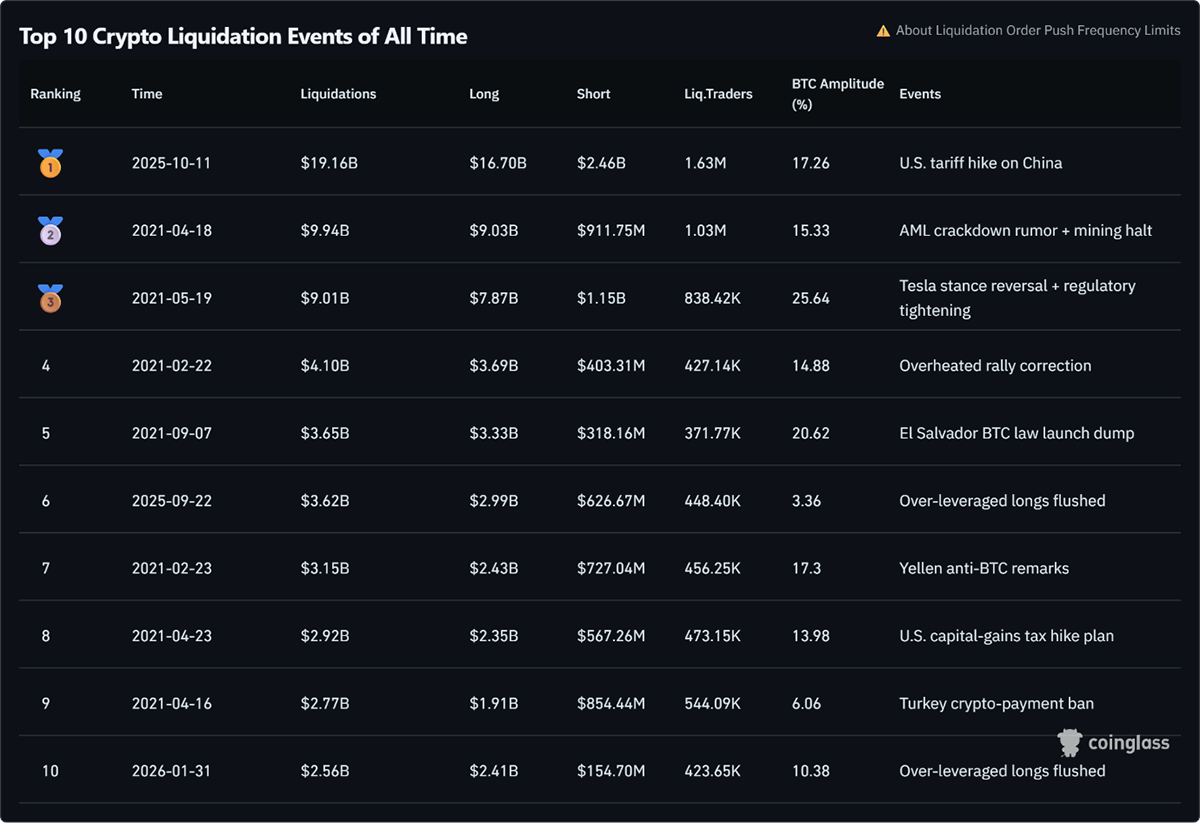
Crypto has struggled since the October 2025 flash crash, which wiped out roughly $20bn in value in a single day, making it the industry’s sixth-largest liquidation event. Since then, the market has continued to print fresh lows and has failed to stage any meaningful recovery. Each bounce has been sold, and confidence remains fragile.
Top 10 Crypto Liquidation Events
The recent air strikes on Iran have only added to the pressure. Crypto, a risk asset, does not thrive in times of geopolitical tension. While an improvement in macro conditions would certainly help sentiment, a far stronger and more durable catalyst would be regulatory certainty in the United States, specifically the CLARITY Act becoming law.
Introduced in July 2025, the CLARITY Act is a market structure bill designed to establish a comprehensive regulatory framework for digital assets in the US. Its central aim is to clearly define the roles of the Securities and Exchange Commission, SEC, and the Commodity Futures Trading Commission, CFTC.
It is worth remembering that the Guiding and Establishing National Innovation for U.S. Stablecoins Act, known as the GENIUS Act, became law in July 2025, when crypto was trading near its highs and enthusiasm from both retail and institutional participants was strong. The GENIUS law introduced strict requirements, including 100% reserve backing with liquid assets such as US dollars or short-term Treasuries, mandatory monthly public disclosures of reserve composition, and tight marketing standards to protect consumers from misleading claims.
For years, regulatory overlap and uncertainty have weighed on the industry, and this bill attempts to draw clean lines. Good regulation is generally welcomed within the crypto industry, as it provides a safer and more compliant foundation for long-term growth.
However, while GENIUS passed relatively quickly, the same cannot be said for the CLARITY Act. Disagreements between banks and crypto companies, particularly around stablecoin yield, have stalled progress for months.
Under the GENIUS framework, stablecoin issuers are prohibited from directly offering yield to holders. Yet third-party platforms such as Coinbase, a key participant in the CLARITY discussions, can still provide yield products to users holding stablecoins. Banks argue this creates a loophole. Their concern is straightforward: if stablecoins were allowed to offer yield directly, they could become a viable alternative to savings accounts, encouraging deposit flight from the traditional banking system. Naturally, that threatens their business model.
In January 2026, Brian Armstrong, founder and CEO of Coinbase, the largest crypto exchange in the US, posted on X that Coinbase could not support the bill in its current form. He cited several concerns, including DeFi user privacy, expanded SEC authority over crypto markets, and the unresolved stablecoin yield issue. His stance effectively delayed the bill.
Today, Trump made a post on his Truth Social account saying:
The Genius Act is being threatened and undermined by the Banks, and that is unacceptable — We are not going to allow it. The U.S. needs to get Market Structure done, ASAP. Americans should earn more money on their money. […] The Genius Act was the U.S.A.’s first big step to make the United States the Crypto Capital of the World, and getting The Clarity Act done is the next step to finish the job and, most importantly, keep this big and powerful Industry in our Country.
It is clear that the President wants the bill finalised as soon as possible. At the same time, it would be in the crypto industry’s long-term interest for the legislation to reflect feedback from market participants like Coinbase, rather than leaning primarily toward the concerns of traditional banks.
Polymarket, a blockchain-based prediction market, currently assigns a 74% probability to the CLARITY Act becoming law in 2026. That suggests a degree of optimism within the crypto community.
Polymarket: Probability of CLARITY Becoming Law in 2026
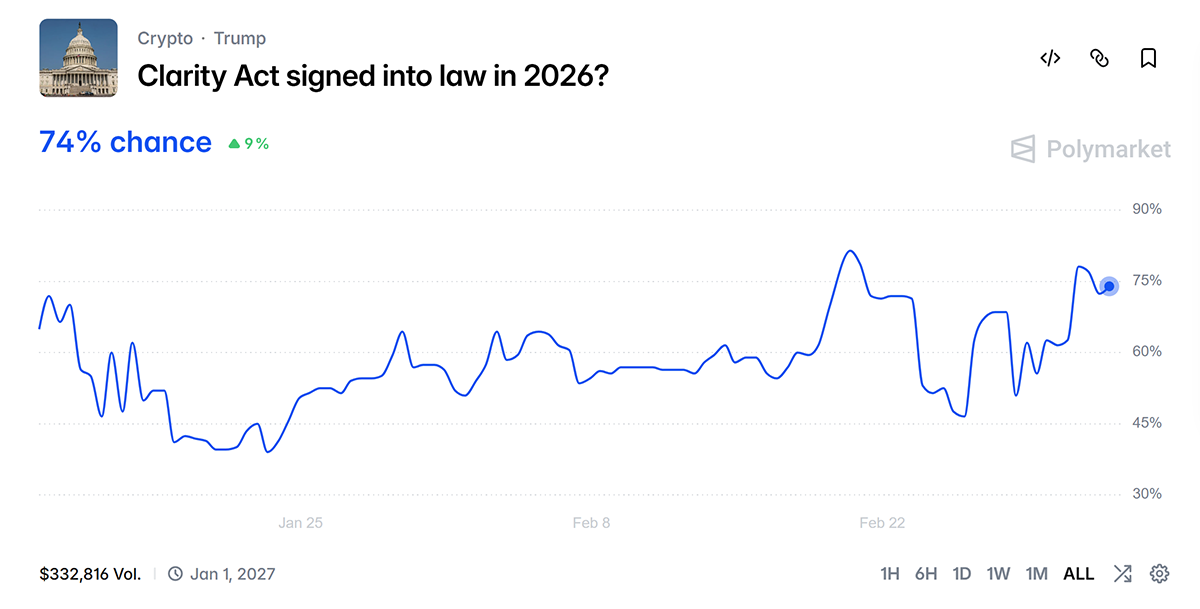
The fact that the bill stalled after Coinbase withdrew support in January 2026 also tells us something important. Lawmakers appear to be listening to industry feedback and taking it seriously. That is a constructive signal. Nothing is final yet, but we remain cautiously optimistic that the CLARITY Act will pass this year, potentially before the US mid-term elections in November 2026.


