


ByteTree Quality Quarterly Review: A Strong Start


Welcome to the first quarterly review for ByteTree’s Quality strategy.
We started building the ByteTree Quality Portfolio in September 2025 and added our last stock in July. In the next phase, we will provide detailed quarterly updates encompassing a written review and a live webinar, which clients are encouraged to attend.
Webinar: Quality Q2 2026 Review
The Quality Q2 2026 Review will be held on Thursday 20th August at 3 PM BST (10 AM ET). To attend the live event, please register by clicking the button below. We will also distribute a recording of the webinar afterwards.
Letter from Charlie Morris and Kit Winder
The last month marked a significant milestone as we added our 25th and final stock to the Quality portfolio. Having published 175,000 words of research on these companies and written many more on companies that didn’t make the cut, we are proud of the result.
Company selection was paramount, combined with timely entry points. All of our companies have undergone a correction, in some cases major corrections, making these attractive times to buy. We balanced geographic and industry exposure, resulting in a diversified portfolio of high-quality companies acquired at low valuations.
The Portfolio
The ByteTree Quality portfolio contains 25 stocks, diversified by industry and geography, but united by two things: high quality and low prices, which has proved to be a timeless and resilient strategy over the years. We look for:
- Large, liquid, low volatility
- Resilient
- Predictable growth
- High and sustainable margins
- Strong management/culture
- Pricing Power
- Irreplicable assets
These are the characteristics of the average stock in our portfolio:
ByteTree Quality vs World Index
| Metric | Portfolio | Index |
|---|---|---|
| Market Cap | $126.8bn | $25bn |
| Revenue growth (7Y) | 10.8% | 9.3% |
| Free cash flow growth (7Y) | 10.5% | 7.7% |
| Free cash flow yield | 7.9% | 3.7% |
| P/E ratio | 17.3x | 29.0x |
| Return on invested capital | 14.8% | 10.3% |
| EPS growth | 8.5% | 9.2% |
| Dividend growth | 3.6% | 7.5% |
| Dividend yield | 2.4% | 1.6% |
| Beta | 0.57 | 1.00 |
We take a different approach to the World Index, selecting not hundreds of companies, but 25. Conviction, such that holding a big winner will make a material difference, but enough diversification that a single loser cannot derail the portfolio. We hold more stocks in consumer staples and fewer in the IT sector. We have no energy stocks, mining companies, or banks because they are subject to factors beyond their control: commodity prices and interest rates. Instead, we prefer human-driven companies in control of their own destinies. More importantly, we eliminate bad companies.
Sectors Embraced / Rejected
| Embraced | Rejected |
|---|---|
| Healthcare | Materials |
| Insurance | Banking |
| Consumer Staples | Energy |
| Software | Cyclicals |
Income Growth
Our dividend growth looks weak at the moment because seven stocks haven’t been paying dividends for seven years, and two have cut theirs in recent years, distorting the data. We expect them to return to growth in the future, as they were specific, one-off cuts. For example, Diageo cut its dividend to focus on cutting leverage and investing for growth but had a long track record of dividend growth prior to that.
The continued growth in dividends is a crucial component of the compounding of total returns over the long-term. Overall, the portfolio shows a strong bias toward income growth.
Four companies in the portfolio have increased their dividends consecutively for more than twenty years, and only five do not yet pay a dividend. Without those five, the portfolio's yield would be 4.9%, and we expect that they will eventually join the majority in paying dividends. These are higher-growth, earlier-stage companies that may be large and high-quality, but still have so many avenues for growth that returning capital to shareholders is low on the priority list. As they mature, the dividends will come.
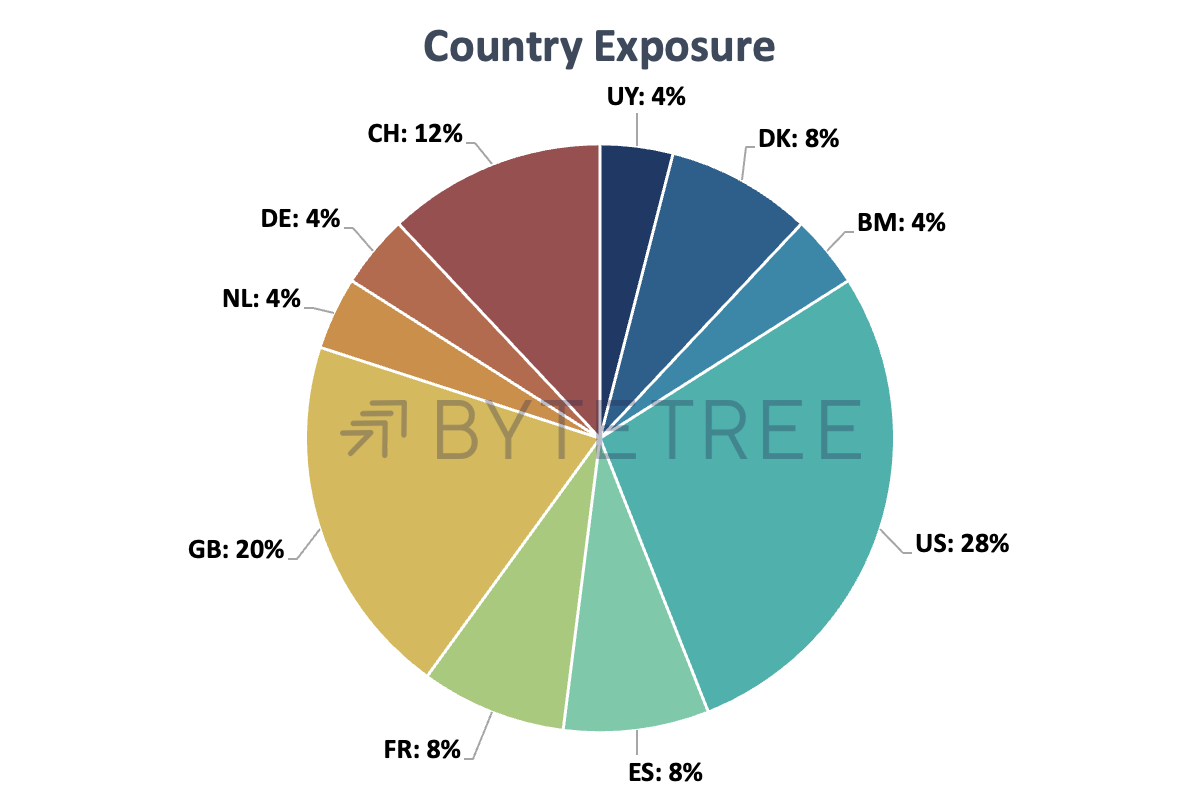
This is a highly profitable, steadily growing group of companies, paying a healthy and growing dividend, and generally buying back stock on top of that. Each company is highly diversified with global operations, but our exposure is also spread across developed markets.
Quality Industry Breakdown
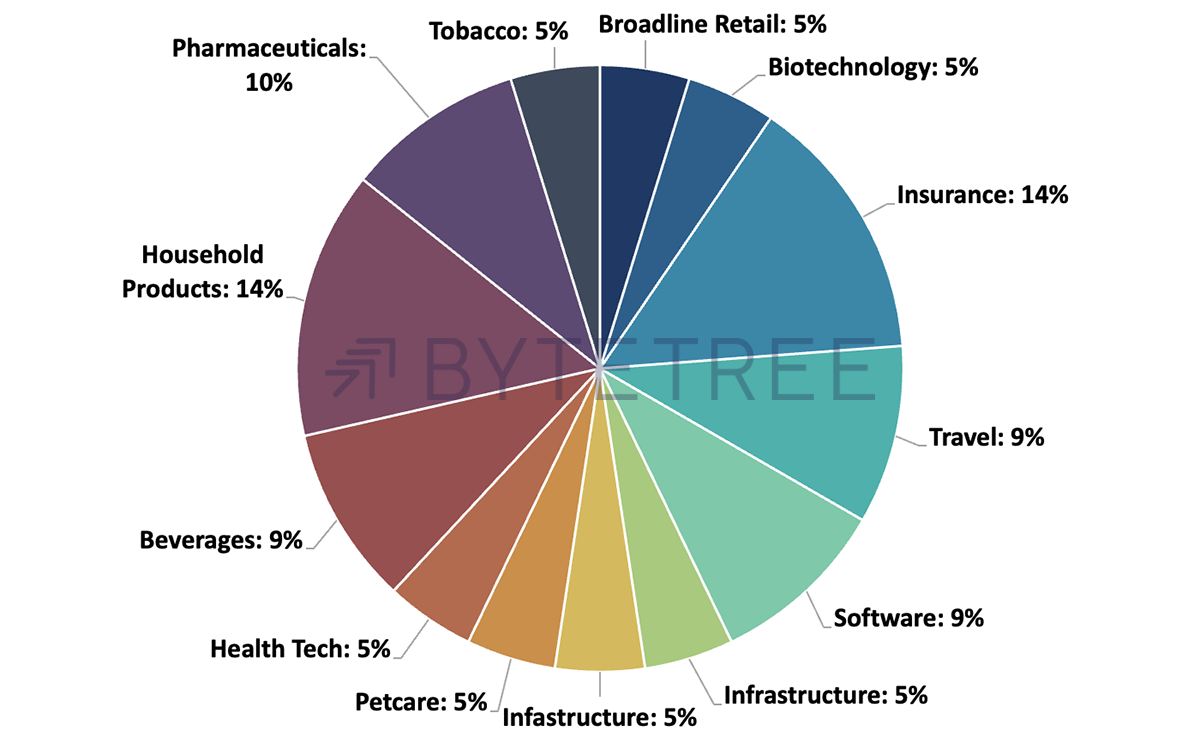
This group has had a terrible time over the past five years but is on the turn, and we believe we have timed this right. The companies have delivered good results so far, demonstrating they are operating smoothly. It was the overvaluation in 2021 that killed the investment outcome, due to a period of significant overvaluation, and that is behind us. The companies didn’t change, but the market got ahead of itself.
These are companies to hold for the long-term, in a portfolio designed to require minimal effort. It balances cash flow growth, profitability, value, and momentum, and is diversified across high-quality sectors and attractive geographies.
Geographical Breakdown
Low Correlation with Riskier Stocks
The average beta of our holdings is 0.57. This is a low number that means that for every 1% the index moves, they move 0.57%. Only three holdings have a beta above 1. While this is a crude measure and not something we specifically targeted, it reflects a portfolio that ought to outperform in a bear market. If the market falls, excluding all other factors (e.g. business performance, valuation), our portfolio should fall by much less. As we track performance over time, we will be able to measure the portfolio’s beta as a whole.
Bear Market Champions
This is also informed by studying the previous performance of each of our holdings in previous bear market environments (the dotcom crash of 2000-2002, the great financial crisis of 2007-2009, 2020, and the 2022 bear market). A number of our holdings qualify as “Bear Market Champions”, i.e. being in the top fifty companies in our broader universe of 2,500 that had the most stable performance across all eight relevant years.
The current set of holdings performed better in the 2000 scenario (tech/valuation bust) than in 2008, which was a broader recession.
- In the dotcom crash, the weighted average return of our holdings (those that traded at the time) was +20.4% in 2000, followed by falls of -0.6% and -2.2% in 2001 and 2002.
- In 2007-2009, they returned +10.3%, -22.2%, and +29.0%.
- In 2022, which was a crisis of inflation and rising interest rates, all 25 holdings were listed and returned an average of -11.7%.
For context, the S&P reported worse results in seven of the eight years studied. The outperformance of our quality basket is only simulated, and partially so (given not all stocks were trading), so this is not a scientific exercise. It does, however, illustrate the role quality can play in protecting investors from downturns in major indices.
Quality vs the Index, Bear Markets

Rotation
Since early June, a rotation has been underway in global markets. Growth, tech, semiconductors, memory, Korea – all these things were very strong in April and May, while the oil price was near its peak. Since 1 June, they have been weak, while things like healthcare, software, and consumer staples have picked up. Higher oil prices raise inflation expectations, implying higher interest rates. As a result, falling oil prices have benefitted quality and defensive stocks. The rotation is visible in the trend performance of growth vs value.
Growth vs Value
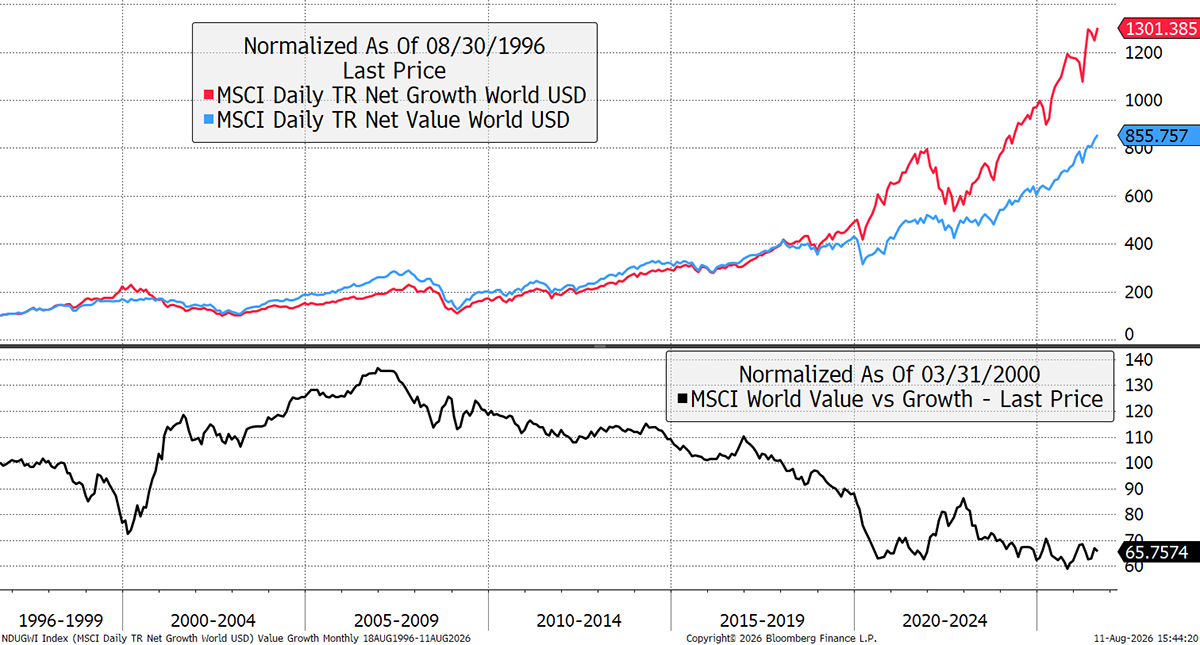
Quality stocks deliver predictable income streams. That makes them similar to bonds. So, when rates rise, their dividend yields become less attractive in relative terms. However, buying high-quality companies when they’re cheap still means that in a genuine oil crisis, we would expect our companies to outperform. The most vulnerable are the highly valued stocks that depend on immediate and incredible growth.
AI Beneficiaries
Investors primarily consider AI in terms of the companies building the language models or infrastructure, i.e. the AI Builders. Over the last nine months, we have spent a lot of time studying AI’s impact on existing industries to uncover the AI beneficiaries. While the AI builders are the clearest winners today, we believe they are popular because of their potential to deliver improvements to businesses and customers. Our holdings are the firms delivering solutions to customers, listening carefully to their every desire and concern, and developing products to meet those.
Much of the discourse around AI, which has driven tech hardware stocks to record gains, has been based on a single, panicky question: “What can’t it do?” This is deliberately open-ended, allowing narrative, hype, and optimism to fill the gap. As shown by the markets, such blue-sky thinking can be valuable.
However, as we built the Quality portfolio, we spent much more time thinking about a different question: “What is AI actually doing?” This allowed us to identify opportunities in software, insurance, consumer goods, pharma, and testing and certification, some of which were seen as AI victims. By looking at how and where AI is currently being deployed, we built a much better understanding of where AI is, rather than where it might one day be. Forecasting is famously tricky, and understanding the present day is hard enough. Quality keeps its feet on the ground.
To sum up our key findings:
- Testing companies are moving into model testing and digital assurance, which is proving lucrative.
- Consumer staples firms are using it to improve their marketing efficiency and precision, spending more with greater impact.
- Pharmaceutical firms are using it to develop better drugs and predict approval/reimbursement rates more accurately. The potential impact here is high, but the timeline is slow because discovery, trials, and regulatory approvals take 10-15 years.
- Software companies are adding new agentic capabilities and using that to charge even more. As models commoditise, key advantages in the Darwinian race to survive and thrive in the AI include: customer obsession, flexibility, a future focus, a culture of excellence, relationships, scale, and high-quality management.
- Insurance firms are using it to handle large datasets and price risks more accurately.
All holdings have their eyes wide open about the changing environment and possess cultures that seek to adopt the new thing faster than peers, rather than wishing it would go away. Some are incorporating it more into their products, others more into their operations, but all are already seeing benefits.
We still have 2.4% cash in the portfolio and will be allocating that to top up existing holdings in the coming weeks/months, where appropriate.
Consumer Confidence
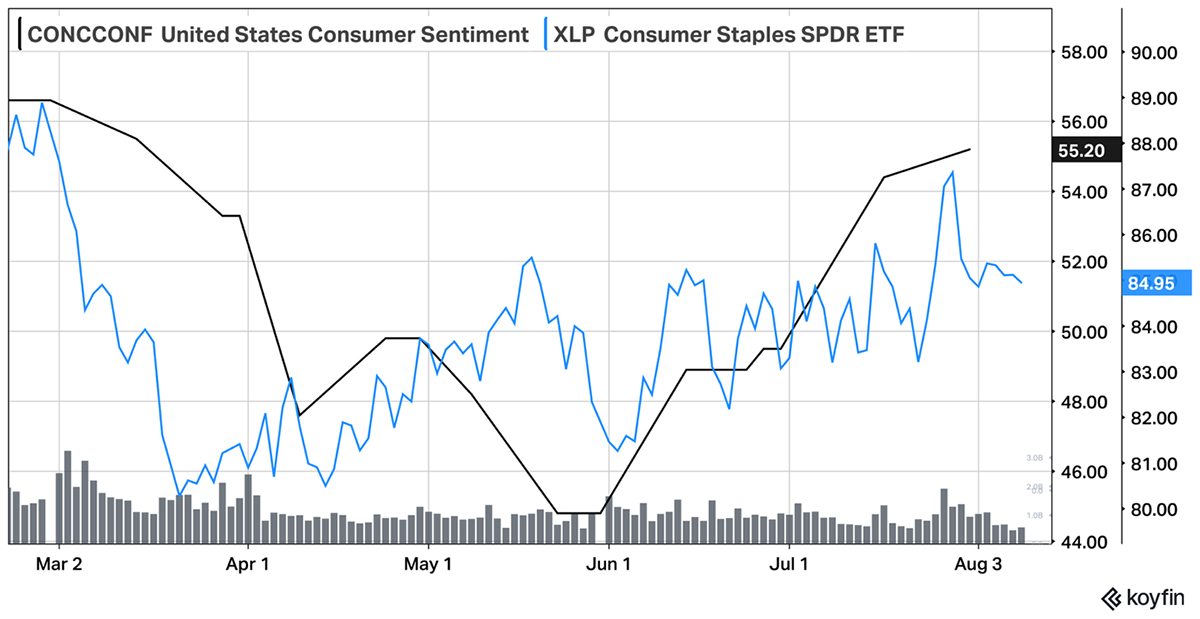
Consumer confidence reached record lows in US surveys in May. That has generally coincided with market lows. However, this time, it came amid market highs. That is because while Wall St loves AI, workers aren’t so sure. The two groups can read the headline “AI will take your job” and react very differently. As the AI trade weakened, consumer sentiment improved, and staples with it. The War in Iran and oil prices were also a factor.
US Consumer Confidence vs Staples
Studying Other Quality Managers
Terry Smith is an investor we admire for his thinking and communication. He has been a long-term holder of many companies we now own. However, during this quarter, he announced a major pivot. He sold several of his struggling positions, including Intuit and Unilever, and added hot stocks such as GE Vernova and AppLovin. Having preferred to focus on business quality above all, and choosing to trade only rarely, he announced a greater appreciation for momentum, and said he would be more active. So far, this pivot has not gone in his favour, as cheap software and staples have bounced as richly valued industrials and tech stocks have fallen.
“We will take more account of momentum — both fundamental and share price — in our investment decisions. In particular, we will be much less willing to deploy the time-honoured technique of buying quality companies when they hit a glitch.”
The full letter is here and is well worth a read. We wholeheartedly retain respect for the fund and its approach, and are firm believers in momentum. However, momentum helps investors act early, and we are not sure that is what is happening here.
Berkshire Hathaway saw a changing of the guard. Warren Buffett stepped back to Chairman, leaving Greg Abel as CEO, theoretically in charge of day-to-day investment management. However, the surprise purchase of $10bn of Google stock came from Buffett. Abel did leave his mark on the cash pile though, accelerating buybacks.
Unlike Fundsmith, Lindsell Train offered a robust defence for some of their struggling positions, including Intuit and Diageo. They said,
“Buying a consensus AI loser stock today doesn’t mean arguing no risk from AI (or anything else we haven’t yet seen coming). It means taking a calculated risk, based on likelihood and the trade-off with price, and accepting the emotional discomfort of appearing unconventionally wrong.”
Legendary philanthropist and fund manager Chris Hohn sold his stake in Microsoft, but appears to have held onto the likes of Vinci and Cellnex, among the more richly valued holdings he likes, such as Visa, S&P Global, and Moody’s. Like Berkshire, he bought Google.
Guinness Global Equity Income holds both quality growth and defensive quality in an equal-weight portfolio that rebalances every few months. This allowed them to capture some upside during the AI rally in Q2, while also positioning them to benefit from the rotation. Their rebalancing was well timed, adding to staples and cutting tech just before the rotation began.
Troy Global Equity Income followed the same approach as Lindsell Train, acknowledging the revolutionary changes AI can deliver while arguing that their holdings are beneficiaries and trading at low prices. They offered strong defences for Visa, Alcon, and Amadeus, and Google, and argued that narrative had taken markets too far from fundamentals:
“We maintain conviction in the companies that have been marked down to valuation lows, leaning in where appropriate, and leaning out when the facts change.”
Stocks: Resilience and Growth
Diageo
Link to Note: Spirits on Sale
One-line Investment Thesis: A brilliant new CEO working to revive the best portfolio of spirits brands in the world.
Diageo owns the world’s best group of spirits brands. It is well known and has been a stalwart of quality portfolios for years. This meant that for most of the 2010s, it was richly valued. We became interested in 2025, as the stock had fallen by more than 50% over four years. Its forward PE ratio fell from 30 to 13, reflecting a significant discount to its historical average of 18x. It had only gone below 12x once before – during the Global Financial Crisis of 2008. While we don't focus on the PE ratio, it illustrates the point here.
We became more interested when we realised that our view of its problems differed from the market’s analysis. The headline concern was that people were drinking less by choice, for health reasons, or because of weight-loss drugs (GLP-1s). In our view, this ignored the most important factor: price. During lockdowns, everybody drank more, and better, boosting sales for Diageo. When inflation hit in 2022, the company reacted, like so many others, by raising prices, but they went too far. Then, 2023-2025 brought a reopening and cost-of-living pressures, reducing volumes and bringing price sensitivity back, just as prices were at their peak. Diageo had pushed pricing too far, at the wrong time.
Luckily, the new CEO, Dave Lewis, shares our view. In his first year in charge, he has identified a similar problem on his global tour, where he listened to each product and international team, as well as partners and customers, to understand what Diageo needed. He is now getting to work, and the results are beginning to show. Its high debt burden is shrinking, free cash flow growth has returned, efficiency and execution are improving, and the share price is responding. Diageo is up by 30% in the last three months.
We leave you with a single, notable cultural moment from the last few months. Steven Bartlett, on his famous Diary of a CEO podcast, is a champion of the “optimisation trend”, which focuses on health, sleep, and performance. On it, he said that he had two glasses of wine one evening, and it ruined three days of his life. His sleep scores and metrics all dipped, which he described as if the world had ended.
A year ago, this might have resonated, but this year, it grated. The reaction was swift and strong – people cried out that this was madness. The unhealthy impacts of drinking were being over-promoted relative to its social benefits. Diageo’s brands have been bringing people together for centuries, and while we celebrate moderation, we believe they have centuries more ahead of them. Given the lowest valuation multiples in 15 years, Diageo offers great potential.
Nestlé
Link to Note: Cocoa and Cash Flow
One-line Investment Thesis: A portfolio of nutrition brands that has served humans and pets, at every stage of their life, for 150 years.
The nature of Nestlé’s competitive advantage is surprisingly simple: historic brands, strengthened by above-average marketing, on products developed by above-average innovation. Nestlé has repeated that cycle for many decades across product categories and countries, and has become incredibly hard to compete with as a result. As its cash flows grow, it has a bigger war chest to invest back into more marketing and product development, further strengthening its competitive advantage, or moat. This is exactly the same flywheel as at Diageo, but applied to chocolate, snacks, and nutrition, rather than spirits.
Nestlé has also been a long-term favourite of quality investors, due to its proven ability to grow brands, and therefore cash flow per share, steadily over long periods of time. It is a compounder. However, it too struggled with inflation in coffee, cocoa, and other input costs during 2022 and 2023. At the same time, it was hit by two scandals: one in its water business and another involving the CEO’s internal romance. This triple threat drove Nestlé down 40% in four years, to valuations last seen in 2011.
Free cash flow per share declined for 13 quarters in a row – the fall was justified. By the end of 2024, they had recovered, but the share price continued to fall into late 2025. This was our opportunity.
NESN Price vs Free Cash Flow per Share
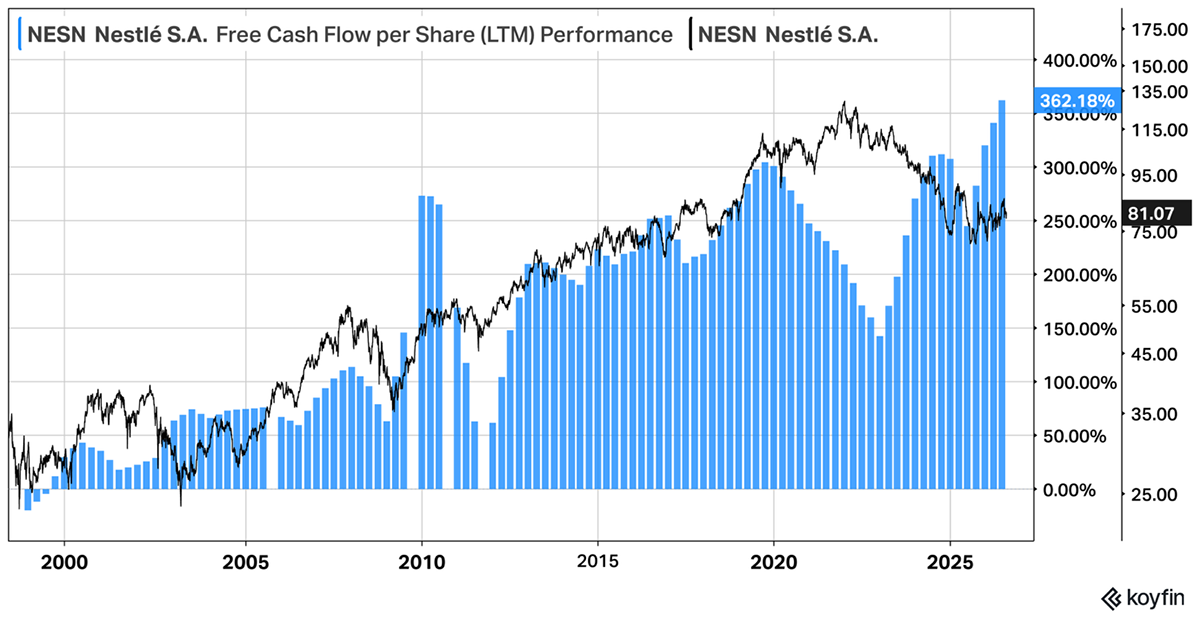
Like Diageo, we saw new management, reducing cost pressures, improving efficiency, and strategic improvements, and we saw the same flywheel that can drive growth for decades to come. A long-term winner that sold off for short-term reasons. A great company, at an attractive valuation. This is what ByteTree Quality was designed to identify.
We look forward to seeing you on the webinar next Thursday.
Many thanks,
Charlie Morris and Kit Winder
Editors, ByteTree Quality
ByteTree Model Portfolios
ByteTree offers three traditional investing services with model portfolios:
- Quality (quality + value)
- The Multi Asset Investor (absolute return)
- Venture (value + momentum)
The Multi Asset Investor is our flagship service and tracks the Soda and Whisky portfolios.
Venture is driven by our proprietary ByteTrend analytics, using momentum data paired with our fundamental analysis. Trading is more frequent, with a higher risk tolerance in pursuit of higher returns. It is only available to Pro clients.
Quality, on the other hand, is our lowest-cost service, the most focused on company quality, and has the longest time horizon, trading rarely and holding positions for years.
General - Your capital is at risk when you invest, never risk more than you can afford to lose. Past performance and forecasts are not reliable indicators of future results. Bid/offer spreads, commissions, fees and other charges can reduce returns from investments. There is no guarantee dividends will be paid. Overseas shares - Some recommendations may be denominated in a currency other than sterling. The return from these may increase or decrease as a result of currency fluctuations. Any dividends will be taxed at source in the country of issue.
Funds - Fund performance relies on the performance of the underlying investments, and there is counterparty default risk which could result in a loss not represented by the underlying investment. Exchange Traded Funds (ETFs) with derivative exposure (leveraged or inverted ETFs) are highly speculative and are not suitable for risk-averse investors.
Bonds - Investing in bonds carries interest rate risk. A bondholder has committed to receiving a fixed rate of return for a fixed period. If the market interest rate rises from the date of the bond's purchase, the bond's price will fall. There is also the risk that the bond issuer could default on their obligations to pay interest as scheduled, or to repay capital at the maturity of the bond.
Taxation - Profits from investments, and any profits from converting cryptocurrency back into fiat currency is subject to capital gains tax. Tax treatment depends on individual circumstances and may be subject to change.
Investment Director: Charlie Morris. Editors or contributors may have an interest in recommendations. Information and opinions expressed do not necessarily reflect the views of other editors/contributors of ByteTree Group Ltd. ByteTree Asset Management (FRN 933150) is an Appointed Representative of Strata Global Ltd (FRN 563834), which is regulated by the Financial Conduct Authority.
© 2026 ByteTree Group Ltd


