


Slow and Steady


175,000 words in nine months.
That’s what building the ByteTree Quality portfolio has required - and that wasn’t even the difficult bit.
The same effort, all over again, never made it to the portfolio. The deeper we dived into the companies, the more problems we found. Spare a thought for the many companies that didn’t make it into The Bytetree Quality Portfolio.
Today, we’d like to walk through two things. Firstly, the end result. What does the Quality portfolio look like now it is fully invested? Secondly, how we think, so you can see how we got here.
Building ByteTree Quality
The Quality portfolio is designed for patient and long-term investors. Those who want to compound their wealth with low stress and low effort.
We released our first ByteTree Quality recommendation in September, 2025, and our final one was published last week. Writing 7-8000 words on each company was a crucial part of the process, but the key was not the writing, it was the decision-making. We are proud of the portfolio we have built.
The ByteTree Quality Portfolio contains 25 stocks, diversified by industry and geography, but united by two things: high quality and low prices. These are brilliant businesses bought at discounted valuations. Buying the best companies (quality) and buying cheap companies (value) have both delivered strong returns throughout history, and the current state of markets has given us a rare opportunity to buy both: the best companies at unusually low valuations.
We will outline our thinking on valuation below, but first, here are the characteristics of the average stock in our portfolio:
- Return on Invested Capital (ROIC): 14.8%
- Free Cash Flow Yield: 7.5%
- PE Ratio: 16.8x
- Revenue growth: 10.7%
- Free Cash Flow growth: 10.0%
- Dividend growth: 4.9%
- Dividend yield: 3.2%
- Volatility: 26.7%
They are all large companies, with high liquidity, making them easy to trade under any circumstances.
This is a highly profitable, steadily growing group of companies, paying a healthy and growing dividend, and generally buying back their shares on top of that. Each company is itself hugely diversified, with global operations, but our exposure is also spread across developed markets.
Quality Industry Breakdown
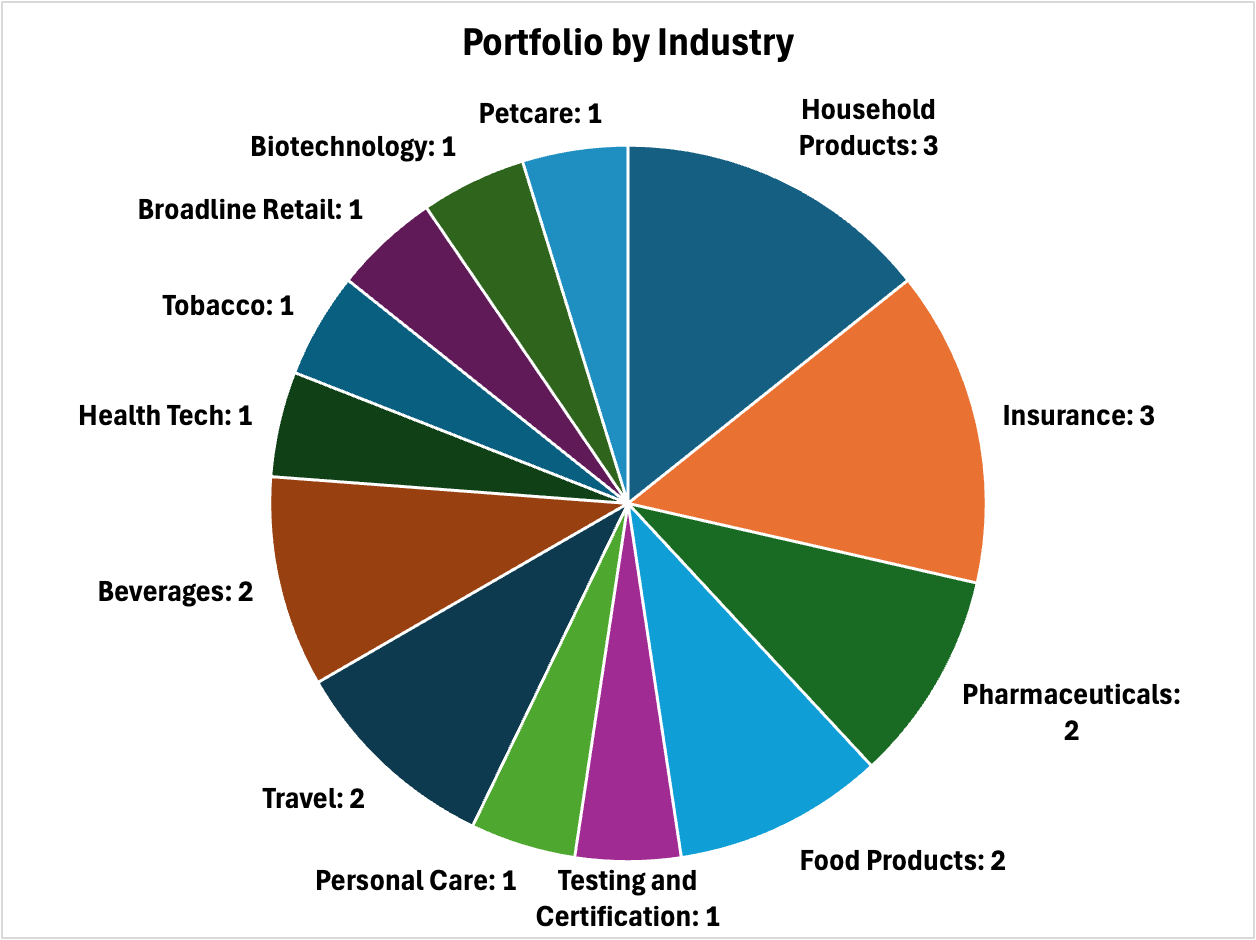
So far, it is performing how we’d like it to – with the companies delivering good results so far, and offering resilience during bouts of market volatility. These are companies to hold for the long-term, in a portfolio designed to require minimal effort. It balances cash flow growth, profitability, value, and momentum, and is diversified across high-quality sectors and attractive geographies.
Geog Breakdown
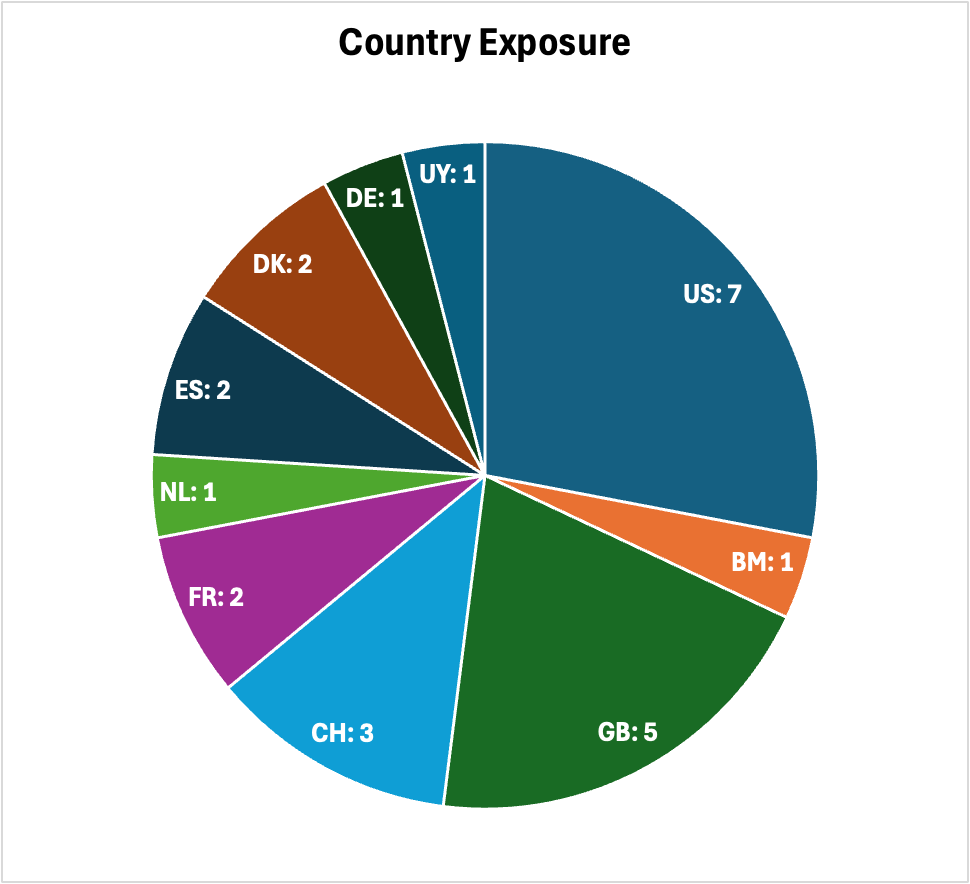
On our website, two of the stock recommendation notes have been made public.
Valuation
In the short term, momentum can be a powerful tool, and we incorporate it in our decision-making process. However, over longer periods, quality becomes the most important factor, followed by valuation.
- Short term: momentum > valuation > quality.
- Long term: quality > valuation > momentum.
When it comes to valuation, we consider several aspects. Most fundamentally, we focus on cash flows, rather than earnings, as they paint a truer picture of business performance and are less vulnerable to manipulation. This is well documented.
We then look at the price of the company relative to the amount of cash flow it generates – a yield like rental income or any other yield on an investment. We get an immediate sense of its value at an absolute level first – we would rarely consider companies trading on free cash flow yields below 5%, without very good reason. The yield can then be compared to its history, to see if it is unusually cheap or expensive relative to its past. It can also be compared to the average cash flow multiples of its closest peers, or global markets more broadly.
This exercise can be repeated for numerous indicators of value, from book value to sales, all in both absolute and relative terms, against peers and its own history. No one ratio completes an investment case, and none should be taken out of context.
Finally, value can only be considered in the context of growth. How fast is it growing, and how long can it continue to do so? Sometimes, the market prices a company as if it will never grow again, when we think it will. Other times, it prices them as if they will grow at incredible rates forever – these companies, we avoid.
We spend time unpacking implied market expectations from the current price of the stock, and evaluating our thesis against them. This way, we can compare our views to the market. Or, we can also estimate future cash flows and discount them back to the present – a DCF calculation – to sense-check the current valuation against reasonable expectations of future growth. However, we don't place too much store by detailed forecasts. It is difficult enough establishing the current state of a company and its competitive advantages, without predicting the future. Instead, we focus on what we can see.
Reinvestment Runway
As discussed, it isn’t simply about what its current multiples are, but how fast they are growing, and for how long that can continue. Sometimes it is easier to say what will last, and what will not. Humans will generally need food and drink, insurance, and healthcare. For regulatory reasons, products and services are almost all obliged to get tested and certified, something we don’t see changing either.
All of our holdings generally have space left to conquer in existing markets, or new markets to expand into. They have management teams who think creatively about growth, and the brands or products to compete everywhere. Strong cultures also continue through the decades, leading companies to continue innovating, leading, and growing, regardless of what the world throws at them.
Two numbers drive how fast a company can grow its profits: how much of its earnings it reinvests (the reinvestment rate), and how well those reinvested pounds are put to work (the return on invested capital, or ROIC). Multiply them, and you get the growth rate itself:
Earnings growth = reinvestment rate × ROIC
As an example, take two companies that both earn 10% returns on the capital they invest. If the first reinvests half its profits and the second reinvests all of them, the second grows twice as fast (10% a year versus 5%).
As part of our valuation work, we assess not only how profitably a company can invest, but how much it can invest, and for how long.
Resilience
We measured all of our companies’ performance in the 2000-2 (dotcom), 2007-9 (GFC), 2020 (pandemic), and 2022 (valuation) crashes. The vast majority outperformed the world index in those bear market years. Investors are partly Pavlovian – they return to trusted safe-haven ideas. We have generally sought out companies with low share price volatility, which reflects market trust. Stocks which are large, liquid, and low-volatility offer greater resilience.
In sector terms, this means healthcare, consumer staples, utilities, or tobacco. Not all are currently available to us: utilities in particular have been connected to the AI buildout due to its huge power needs, and so valuations are at the high end. Crucially, starting valuations are a mechanical driver of future performance. A stock or sector might have been defensive in previous crises, but if it stands at historically high multiples today, its ability to offer safety is compromised.
In currency terms, the Dollar, Swiss Franc, and Yen are typically preferred. Switzerland is a rich picking ground for quality investors – full of historic, market-leading brands and businesses, hence the three selections there.
Quality investing should be a more peaceful ride than owning the index, especially when it is highly concentrated and at extreme valuations relative to history. Our view is that the gap between the risk and return profiles of the quality stocks we own, and those of the concentrated, overvalued index, has rarely been larger.
This is the central reason why we launched ByteTree Quality, and why we launched it now: to provide investors with an approach that seeks to outperform over the long-term, with a smoother ride along the way. The fact that this style of investing is so out of favour right now only serves to make it more attractive.
Now The Hard Work Begins
Building the portfolio was a big effort, but it is only the beginning. We expect turnover in the portfolio to be low, outside times of extreme market stress when the best opportunities may appear more frequently. We are not bearish, merely valuation sensitive, and will be proactive and positive when circumstances allow.
This low-turnover approach will allow us to be incredibly selective about any changes. The portfolio is already strong, so additions have a high bar to clear to replace an existing position. We will be constantly monitoring the portfolio and our investable universe (a few hundred of the best companies in the world) to identify the most compelling opportunities. The future is bright.
We believe that Quality investing is not only a great approach long-term, but is particularly attractive right now. It will never be a bad time to buy great companies at low prices, but when the rest of the market is so extreme, the relative rewards for sensible investing are greater.
If you’re worried about the overvaluation of tech stocks, or the concentration of US stock markets.
If you want to build wealth without needing to check your brokerage account every day…
This is a service for you.
We launched ByteTree Quality at this time because we believe it’s the right time. The portfolio is now complete, and we have begun recording performance.
At just £19/month, it is our lowest-priced research service.
General - Your capital is at risk when you invest, never risk more than you can afford to lose. Past performance and forecasts are not reliable indicators of future results. Bid/offer spreads, commissions, fees and other charges can reduce returns from investments. There is no guarantee dividends will be paid. Overseas shares - Some recommendations may be denominated in a currency other than sterling. The return from these may increase or decrease as a result of currency fluctuations. Any dividends will be taxed at source in the country of issue.
Funds - Fund performance relies on the performance of the underlying investments, and there is counterparty default risk which could result in a loss not represented by the underlying investment. Exchange Traded Funds (ETFs) with derivative exposure (leveraged or inverted ETFs) are highly speculative and are not suitable for risk-averse investors.
Bonds - Investing in bonds carries interest rate risk. A bondholder has committed to receiving a fixed rate of return for a fixed period. If the market interest rate rises from the date of the bond's purchase, the bond's price will fall. There is also the risk that the bond issuer could default on their obligations to pay interest as scheduled, or to repay capital at the maturity of the bond.
Taxation - Profits from investments, and any profits from converting cryptocurrency back into fiat currency is subject to capital gains tax. Tax treatment depends on individual circumstances and may be subject to change.
Investment Director: Charlie Morris. Editors or contributors may have an interest in recommendations. Information and opinions expressed do not necessarily reflect the views of other editors/contributors of ByteTree Group Ltd. ByteTree Asset Management (FRN 933150) is an Appointed Representative of Strata Global Ltd (FRN 563834), which is regulated by the Financial Conduct Authority.
© 2026 ByteTree Group Ltd


