


Four Years of BOLD

Bitcoin and Gold – Better Together;
After much preparation and inspiration, the 21Shares Bitcoin Gold ETP (BOLD) started trading on the SIX Exchange in Zurich on 27 April 2022. Since launch, BOLD has returned 148%, Gold 147.8%, and Bitcoin 89.4%. BOLD not only beats the stronger asset, but also the Bitcoin and Gold average by a comfortable 29.4% after fees.
BOLD, Bitcoin, and Gold since BOLD’s Launch
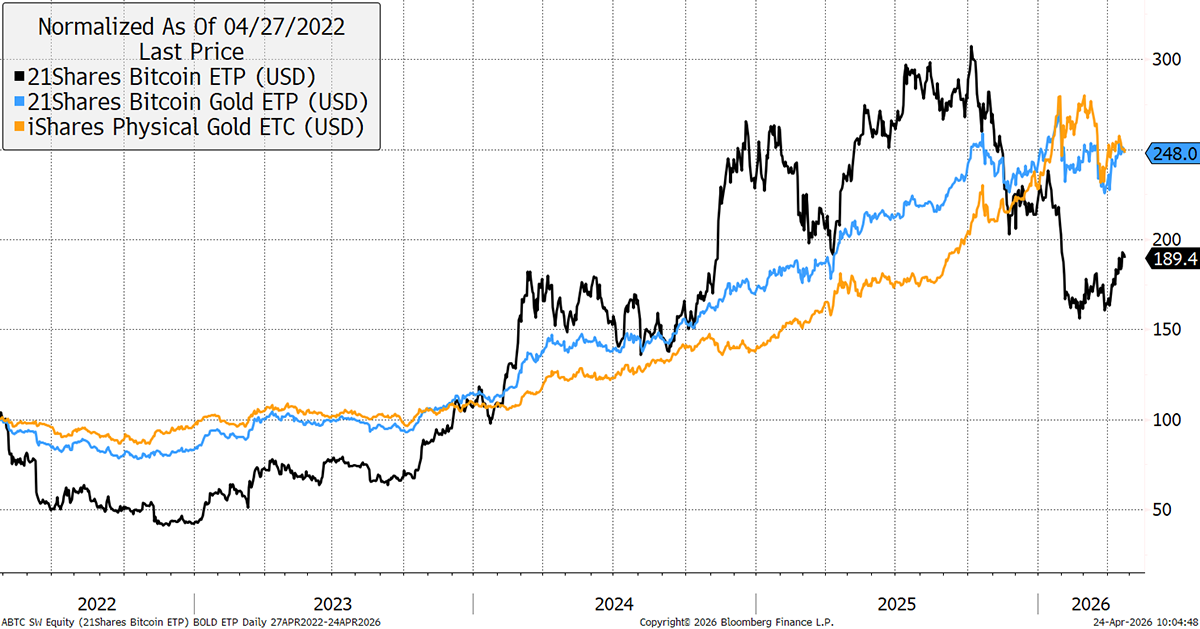
The curious thing about the four-year period is that Bitcoin was the laggard, with an unusually low return, mainly through bad luck. It was already trading 42% below its November 2021 high and kept falling into late 2022. Despite that, the trend rate of return since the 2017 high point has been 43% per annum, and much higher if measured from earlier or later start points. The reduced volatility can also be observed as the price range was two price bands, and these days, just one. This demonstrates how Bitcoin has become an institutional-grade asset.
Bitcoin and the BOLD Launch
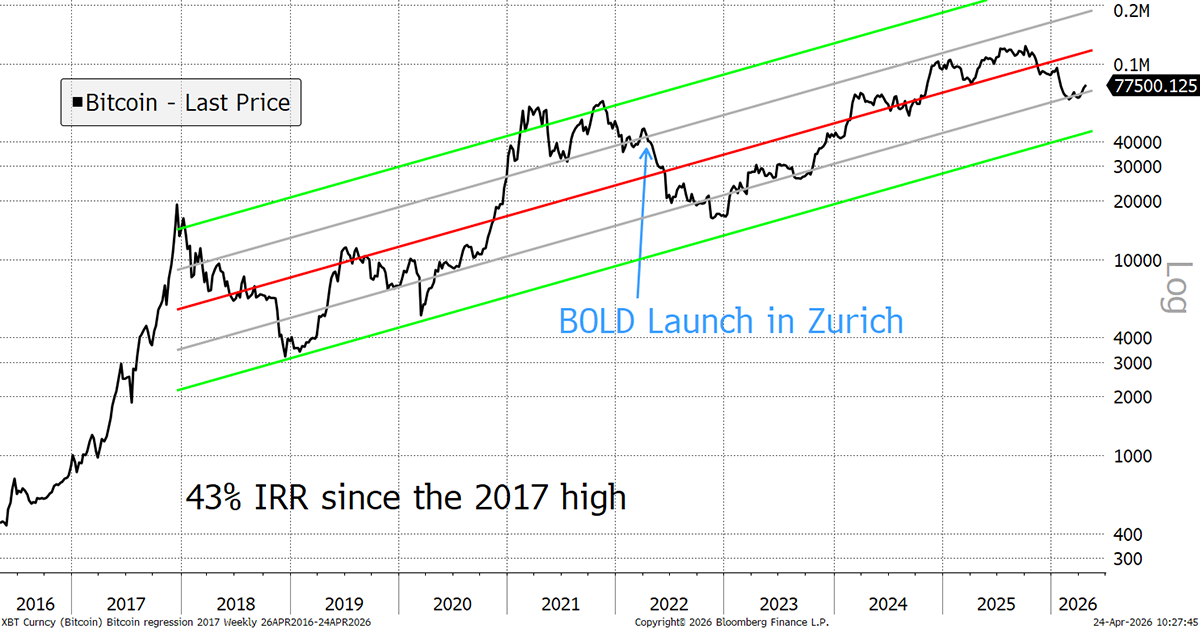
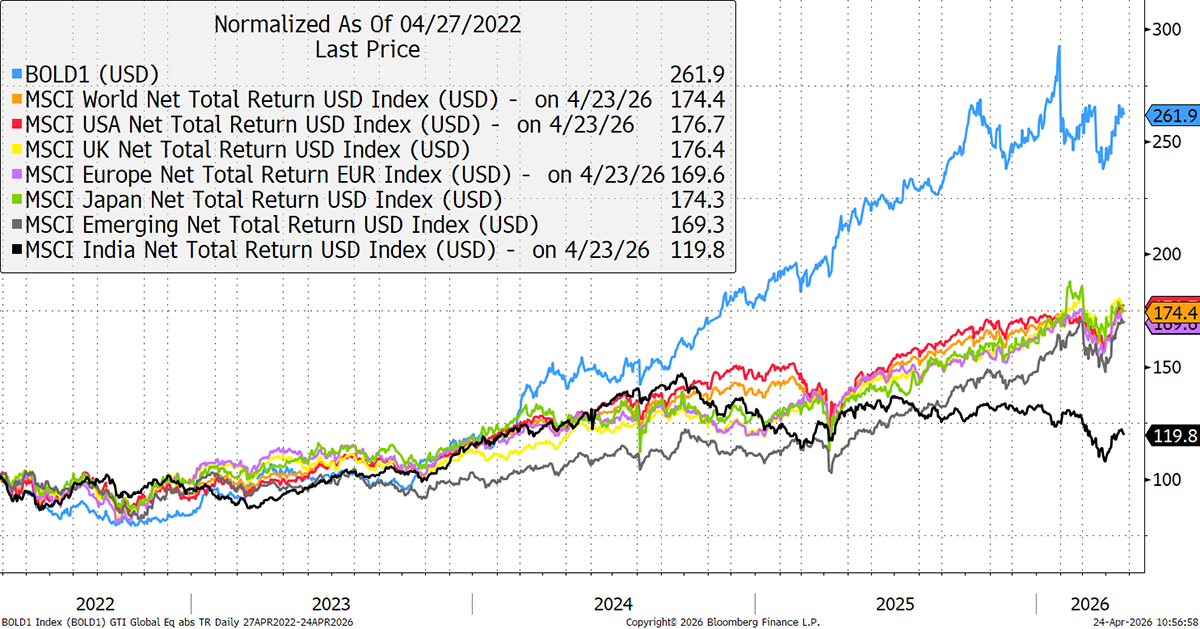
On the face of it, launching BOLD during a Bitcoin bear market was unlucky, but as the saying goes, the best time to plant a tree was ten years ago, and the second-best time is now. Although few people invested in BOLD in 2022, or in 2023 for that matter, building a track record is invaluable, especially when it is good. Despite a soft start, BOLD has comfortably beaten all regional equity markets, including dividends, since launch.
BOLD vs Equities
It is such a simple idea, yet so powerful. I started learning about Gold in 1999, when the price touched $255 an ounce. Ever since, I have spent most of the last 27 years holding gold or the miners in portfolios I have been managing or advising. Curiosity led me to Bitcoin in 2013, and ByteTree was created to analyse its blockchain. The data set we created brought it to life as we were able to visualise the inner workings of the blockchain in real time, gaining a deep understanding of how it worked. I quickly recognised that it was much more than a speculative electronic tulip, and that it would become a long-term store of value. Bitcoin paved the way for a new digital asset class.
Asset Classes
New asset classes don’t come around often. First, there were commodities, real estate and debt in early civilisation. Equities probably originated in Sweden in 1288, but they only took off in 1600/1602 in London and Amsterdam with the English and Dutch East India companies. There are also collectables, such as art and fine wine, which presumably date back a long time.
Since the 1980s, we’ve had derivatives, hedge funds, private equity, infrastructure, and private credit, but none of these are asset classes as such. Derivatives are bets on other asset classes, private equity is unlisted equity, and private debt is still debt. Infrastructure is alternative real estate, and hedge funds are strategies rather than assets. That makes digital assets so important because new asset classes only come around every few hundred years.
Decentralised
This is why the establishment, governments, big business, regulators, and media were initially so suspicious of Bitcoin. It was a new idea, and one they could not control, as Bitcoin was decentralised. Who’s the CEO? There isn’t one. Where’s the board? There isn’t one. Bitcoin is governed by its blockchain and, ultimately, the miners. Anyone can be a miner, and you don’t have to ask permission to join the ranks.
Gold isn’t controlled by anyone either. It is a natural chemical element, an inert metal with a high density and natural beauty. While you can try to control the gold market, no one can control gold itself because it was created by God.
Limited Supply and Liquidity
Both assets have limited supply, which becomes appealing in a debt-fueled world with an ever-increasing money supply. This is similar to collectables and possibly land, but with one key difference. Bitcoin and Gold are highly liquid alternative assets, whereas collectables and land are hard to trade. Gold trades $150 billion per day, and Bitcoin in the region of $50bn per day. These are more liquid than most major stock and bond markets, which is remarkable. Bitcoin and Gold are the world’s most liquid alternative assets, plain and simple.
The Evolution of BOLD
Through a career in fund management, I have long been interested in volatility and what it means. It is poorly understood, but powerful. It measures how much a price has moved, up or down, over a period of time. Safe assets, such as short-term government bonds, have low volatility, while junior mining stocks or technology concepts have high volatility. The volatility reflects the market’s level of uncertainty.
Risk-weighted portfolios use volatility to reduce risk. The more volatile stocks have a smaller weight, while the calmer stocks have a higher weight. I compare the S&P 500, which weighs stocks by market value, with the S&P 500 minimum volatility index. Over 20 years, they have ended up in the same place with minimum volatility (black) leading until around 2015, before the main index (red) takes over again, as the big tech stocks kicked in.
S&P 500 and Minimum Volatility
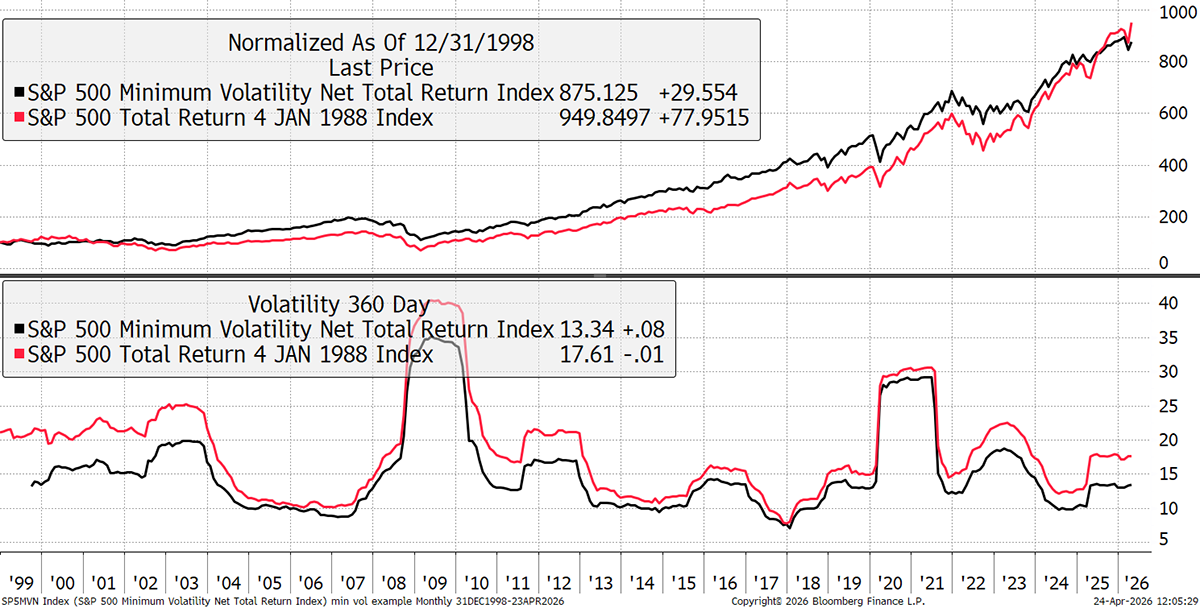
The minimum volatility is therefore more defensive, and the cap-weighted is more sensitive to its largest constituents. However, the minimum volatility fund had an average volatility of 15.2%, whereas the main index had an average volatility of 18.4%. Although the 27-year performance was essentially the same for both strategies, the minimum volatility fund had less risk and fell 5% less during the 2008 financial crisis.
The risk reduction is impressive, but the returns are the same. The lower risk is straightforward, but in this case, the same return comes for two reasons. The first is that the index is rebalanced twice a year, which isn’t that frequent. The second, and more important reason, is that the stocks inside the index are essentially correlated. That means they generally rise and fall together.
In contrast, Bitcoin and Gold have a low correlation; just 9% on average. They tend to take it in turns to perform in different macroeconomic scenarios, which makes them complementary. When Bitcoin wins, the BOLD rebalancing transactions take profit from Bitcoin and reinvest it into Gold. When the turn in the market comes, there is plenty of Gold, and not too much Bitcoin, and so BOLD is well placed. The same happens in reverse when Gold is leading Bitcoin.
Bitcoin and Gold Deviation
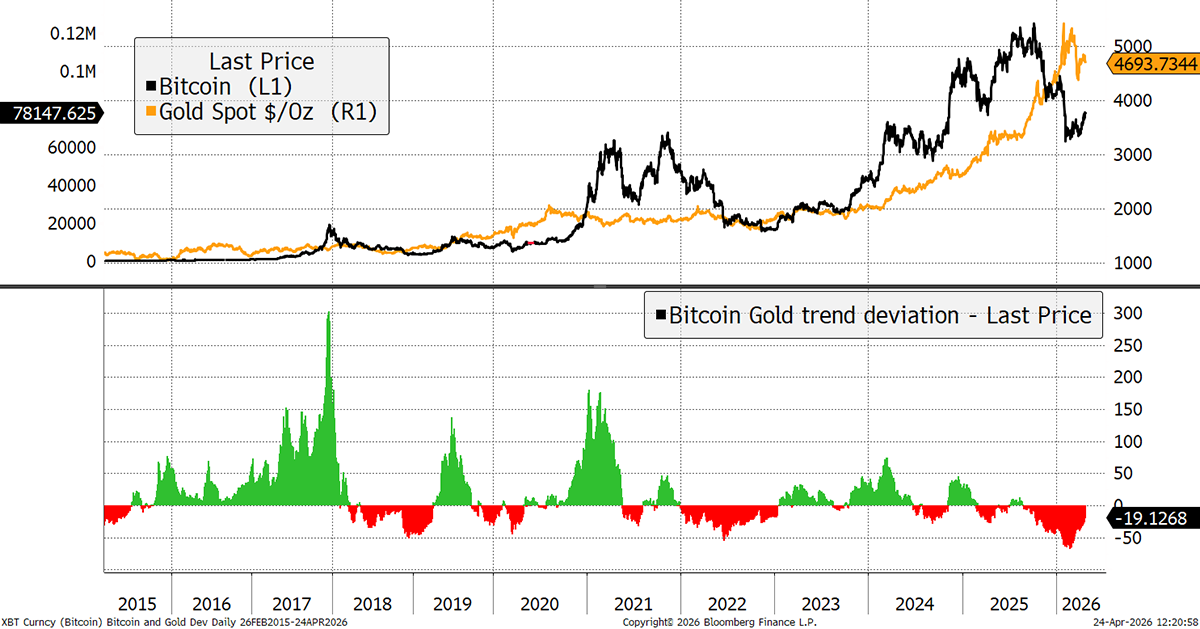
There is no other major, highly liquid asset pair with these qualities. They are both alternative assets, free from interference from the financial system, with natural low correlation and countercyclicality.
Volatility Harvesting
BOLD invests in Bitcoin and Gold on a risk-adjusted basis. Not only does risk-weighting their exposure by inverse volatility reduce overall volatility, but the rebalancing transactions add value through a process known as “volatility harvesting”. As the linked paper by Bouchey, Nemtchinov, Paulsen, and Stein states, “volatility is a drag on the compounding effect.”
Compounding
Family offices, with long-term investment horizons, understand this. Many opt for conservative, compounding, absolute return strategies over beating the index, which amounts to FOMO. The former cares about risk more than the latter. After all, if a portfolio halves, it needs to double to get back to square one. By avoiding large drawdowns, compounding can take place at a higher rate over the long term.
Bitcoin and Gold have both had 50% drawdowns in living memory. In 1999, Gold was down by 70%, and post-2011, it was down by 44%. Bitcoin has had several larger drawdowns, as the media love to highlight. Yet BOLD, the risk-weighted approach, had its largest drawdown of 24% in 2022.
Bitcoin, Gold, and BOLD Drawdowns
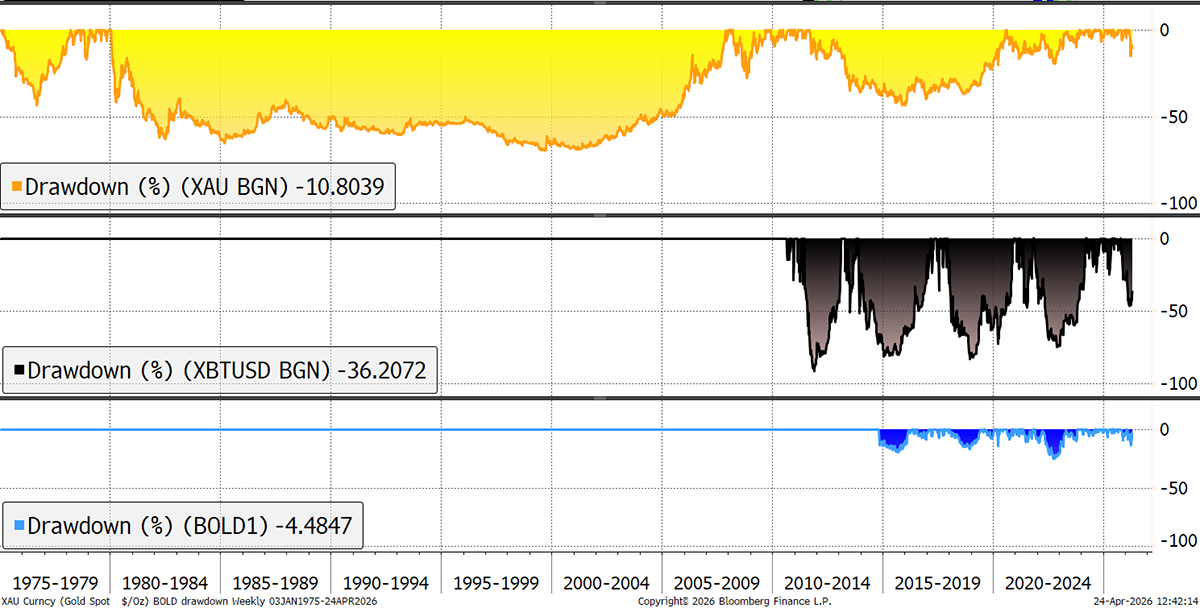
It is entirely possible that BOLD could have a larger drawdown in the future, but it would struggle to be lower than the worst of the two assets. Lower drawdowns mean faster recovery times. To put it another way, over the 500 weeks of data, Bitcoin has recorded a new high in 36 weeks, Gold in 69 weeks, and BOLD in 96 weeks. In that sense, BOLD is the superior compounder.
These days, more and more investors agree that they should hold both Bitcoin and Gold. This contrasts with just a few years ago, when the Bitcoiners believed they would disrupt and overtake Gold, making it relevant. In the meantime, the goldbugs believed Bitcoin, the “Ponzi scheme”, would burst. Finally, after years of rigorous debate, the consensus is shifting towards “better together”.
That is a huge leap forward, but still, many investors who like Bitcoin and Gold still don’t understand the true merit of holding BOLD. The risk-weighted approach, combined with monthly rebalancing transactions, makes BOLD less risky while delivering higher returns.
Beating the Money Supply
A world awash with debt makes investing for the long-term essential, and this is BOLD’s finest hour. Combining the world’s most liquid alternative assets, which have limited supply, is an efficient way to beat the ever-expanding global money supply. Quite simply, while Bitcoin and Gold are said to be monetary assets, their link with the money supply is lumpy. But when you combine them, the results are remarkable and smooth. Not only is this a better match than global equities, but the outperformance is staggering.
BOLD performs best when the money supply is rising. Over ten years, the money supply has increased by 95% from $60tn to $116.3tn. Global equities have risen by 170% (price return), whereas BOLD has risen by 1,319%. In other words, global equities have risen at nearly 2x the rate of the money supply, and BOLD at 7.25x, yet both are correlated.
BOLD vs the Money Supply
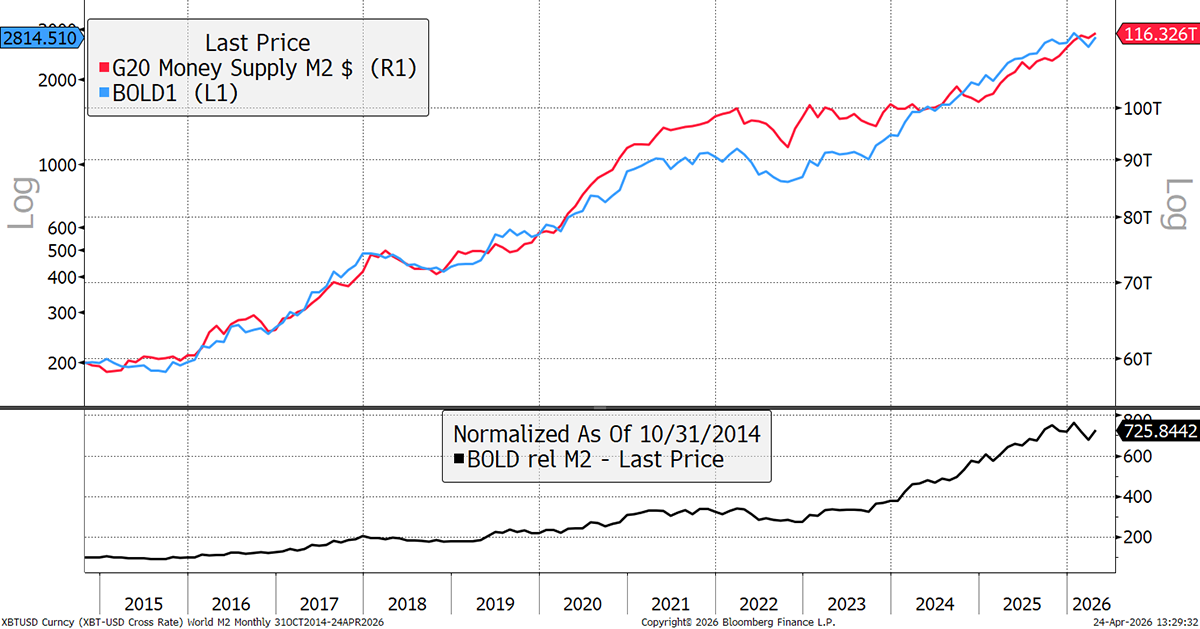
If you think that governments will continue to grow the money supply, BOLD is a simple and powerful way to address that.
Summary
Happy Fourth Birthday to BOLD.
It should really be its sixth birthday, as two years of graft preceded the launch. Never has something so simple been made so difficult by the establishment. I am delighted to say the worst is behind us, and we are no longer considered such an outcast. With recent listings on the London and Milan stock exchanges, maybe BOLD will one day join the ranks of the financial establishment.


